
What Does the Bible Say About Courage and How to Live It
Explore what does the Bible say about courage through key verses, Hebrew and Greek meanings, and practical ways to walk in bold faith today.

In this article
- Why Courage Is a Question the Bible Keeps Asking
- Start With the Decision, Not the Feeling
- Be Strong and Courageous in Joshua 1
- Strength Joined With Resolve
- Courage and Fear Working Together in Scripture
- Notice What Fear Is Asking You to Do
- How the New Testament Expands the Meaning of Courage
- Confidence Can Come Before or After Action
- Biblical Portraits of Courage That Are Not Uniform
- Courage for Readers Facing Persecution, Anxiety, and Trauma
- Distinguish the Need Before Giving Advice
- A Simple Three-Step Practice for Building Courage This Week
- Name, Reflect, Act
- Carrying Courage as a Portable Companion
- Leave Room for Help
You've typed the message, but you haven't sent it. It might be an apology, an honest answer, or a request for help you've been avoiding. You know the next step could cost you something, and you're wondering whether being afraid means you're not ready to take it.
Why Courage Is a Question the Bible Keeps Asking
That hesitation is a useful place to begin asking, what does the Bible say about courage? Not from a distance, where bravery sounds inspiring, but at the edge of a decision whose outcome you can't control. You may know what's right and still wish someone else could do it for you.
A common mistake is to treat courage as an emotional qualification. We assume that courageous people feel confident, while fearful people need to wait until their nerves settle. That assumption can leave a sincere believer praying for a feeling instead of discerning a faithful response.
Start With the Decision, Not the Feeling
In Joshua's story, God addresses someone who already has a difficult responsibility. The command to act courageously comes within a situation that remains threatening, not after the danger disappears. The distinction matters: Joshua needs guidance for what to do, not permission to pretend everything is easy.
For our purposes, biblical courage is faithful action under pressure, guided by God's instruction and sustained by trust in his presence. This definition doesn't make every difficult action righteous. It asks whether the action is obedient, truthful, loving, and appropriate to the situation.
You don't have to sound confident to take a faithful step.
Consider the difference between admitting a mistake and winning an argument. Both may require nerve, but only the first necessarily involves accepting responsibility. Courage isn't just doing whatever feels intimidating.
- For the hesitant reader: The question is whether fear has become your final decision-maker.
- For the naturally bold reader: The question is whether your confidence remains accountable to wisdom and obedience.
- For someone facing danger: The question includes safety, dependents, and the support you need.
These questions leave room for honest self-examination without turning courage into a personality test. A quiet person can act bravely, and a forceful person can act recklessly. We need Scripture's context to tell the difference.
Be Strong and Courageous in Joshua 1
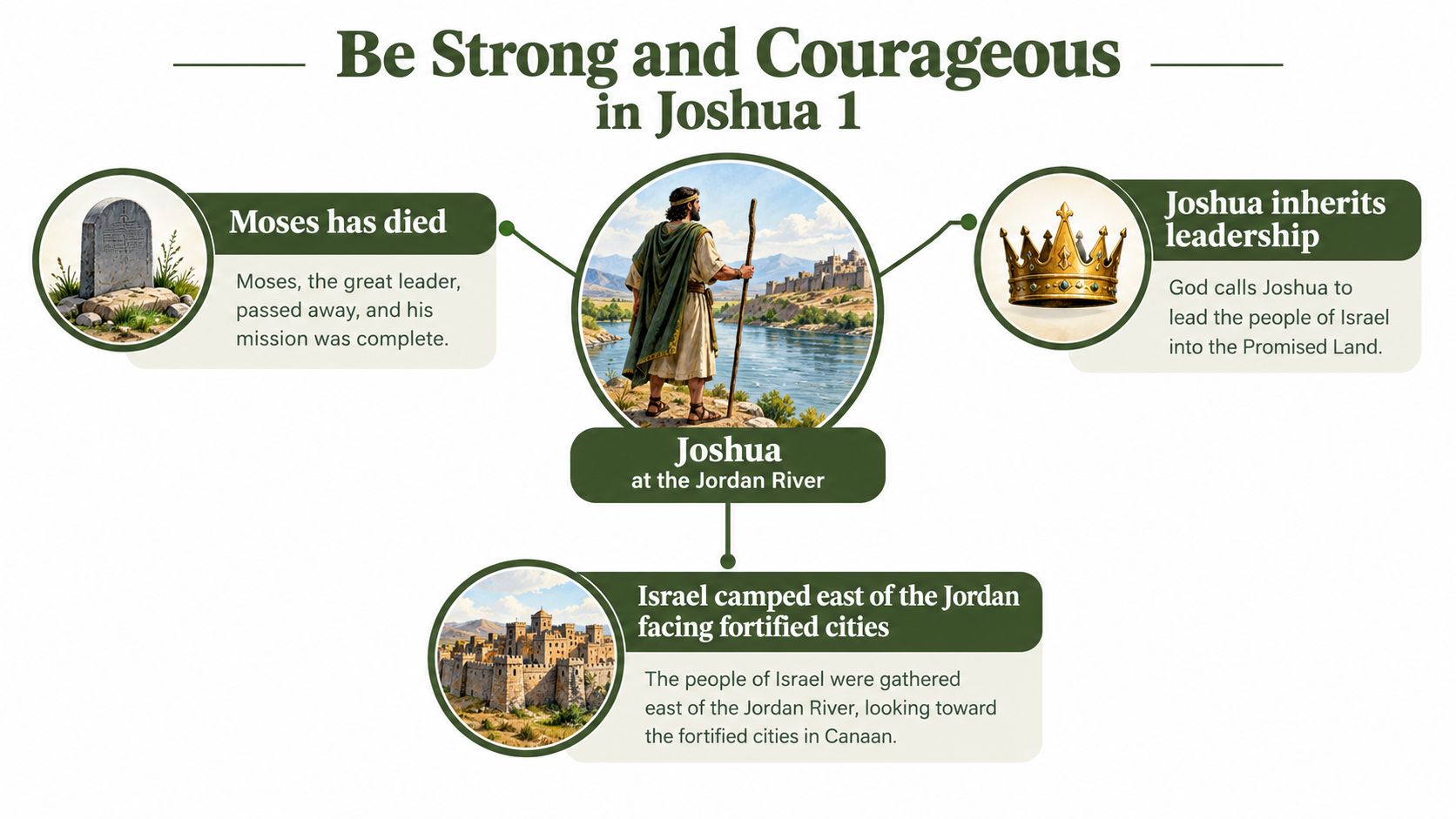
The words “be strong and courageous” meet Joshua at a moment of national change. Moses had died, Joshua had inherited national leadership, and Israel stood east of the Jordan, preparing to enter territory with fortified settlements and hostile populations. God repeats the command three times within four verses, in verses 6, 7, and 9, and anchors it in the promise, “the LORD your God is with you wherever you go” (Joshua's leadership setting and the repeated command). The command addresses a real responsibility, not a demand to feel fearless.
Strength Joined With Resolve
The Hebrew expression commonly transliterated as ḥazaq weʾemats brings together strength or firmness and resolute boldness. One describes staying steady; the other, being ready to act. Joshua needs both. Resolve without guidance could become rashness, while steadiness without action could leave his responsibility unmet.
Repeated words can work like a bell: each sounding draws attention back to what matters. Here, the command is repeated as Joshua receives responsibility affecting an entire people. It does not require him to produce a particular emotional state. Courage can accompany uncertainty, much as a person can take the next careful step without seeing the whole road.
God's instruction gives that courage direction. Joshua is told to meditate on the law and follow it, without turning aside. His courage has moral boundaries. A bold choice is not automatically faithful, and strength does not give him permission to act on impulse.
Rather than treating the passage as a formula, notice how its parts fit together: Joshua has an assigned responsibility, God's instruction shapes how he carries it out, and God's presence is the ground for his courage. For a reader weighing a difficult choice, the order matters. First ask what faithfulness requires, then consider what action is appropriate.
Joshua's calling was distinctive; the passage does not promise that every personal ambition will succeed. It teaches a more grounded lesson: trust in God belongs alongside careful attention to his instruction, especially when responsibility feels overwhelming. Faithful action under pressure may be quiet and deliberate, rather than dramatic.
Courage and Fear Working Together in Scripture
A King James Bible concordance lists “fear” 970 times, illustrating how often biblical readers encounter the subject (King James Bible concordance entries for fear). That frequency doesn't mean every occurrence describes the same experience. It does establish that fear isn't a marginal topic Scripture ignores.
Joshua 1:9 pairs the positive command with prohibitions against being afraid and dismayed. As noted in Joshua's passage, the setting remains difficult. God addresses both the perception of danger and the discouragement that can undermine a person's willingness to continue.
The visual below highlights that pairing, while the meaning still depends on reading each passage in context.

Notice What Fear Is Asking You to Do
Fear and dismay aren't identical. A person may recognize a threat and remain able to act, or become so discouraged that the task seems impossible. The distinction helps us name what's happening without assuming that every anxious feeling proves spiritual failure.
| Question | What it helps you examine |
|---|---|
| What am I afraid of? | The specific threat, rather than a vague sense of dread |
| What conclusion am I drawing? | Whether uncertainty has become a prediction of inevitable failure |
| Who else is affected? | The responsibilities your decision carries beyond yourself |
The communal dimension matters in Joshua's setting. He follows the wilderness generation's earlier failure to enter the land because of fear, and his leadership affects the new generation's movement. His response isn't only about his private peace of mind.
A similar question belongs in ordinary decisions, though the circumstances differ. If you're reluctant to disclose an error at work, ask who might bear the consequences of your silence. If you're afraid to request help with caregiving, consider whether continuing alone serves the person receiving care.
Courage requires examining fear's influence, not denying its existence. Fear may identify something that needs attention. The task is to assess that concern and decide what faithful responsibility requires, rather than letting the most frightening possibility settle the matter.
How the New Testament Expands the Meaning of Courage
A person may believe that honesty matters and still feel unsure about correcting a misleading statement. The New Testament helps explain why courage can include both inner confidence and the choice to undertake a difficult action. It shifts attention from leadership amid danger to public testimony and costly action, without treating fearlessness as the measure of faithfulness.

The Greek vocabulary makes this distinction clearer. Tharreō expresses confidence or boldness, while tolmaō emphasizes daring to undertake something (biblical courage and its Greek vocabulary). The terms point to related parts of courage: what a person trusts, and what that person chooses to do.
Confidence Can Come Before or After Action
Suppose someone needs to correct a mistake in a meeting. They may feel sure that honesty is right, yet still hesitate to speak. Or they may speak while uncertain about the response. In the second case, courage is visible in the undertaking, even without a strong feeling of assurance.
That difference helps us look at conduct rather than judge someone's inner state. A person can:
- Speak truth by correcting their own misleading statement without shifting blame.
- Persevere in duty by returning to a responsibility they have discerned is theirs, even when it feels uncomfortable.
- Enter a difficult conversation by asking sincerely and listening to the answer, rather than preparing only to defend a position.
These actions do not promise approval or an easy outcome. They give a group concrete ways to discuss whether someone acted responsibly. For a person carrying trauma or anxiety, courage need not mean forcing a disclosure or entering an unsafe situation. A small, considered action may be the faithful choice.
For reflection alongside these examples, consider the accompanying video.
Joshua's example connects conviction with conduct. Remembered instruction can give someone a reason to act, but remembering alone does not carry out the responsibility. A useful small-group question is, “What would living this belief require here?”
Courage is not a performance. Speaking loudly, taking over a discussion, or provoking opposition does not prove faithfulness. Sometimes the harder action is to answer gently, admit uncertainty, or listen before speaking.
Biblical Portraits of Courage That Are Not Uniform
Esther speaks in a dangerous political setting; David faces an opponent in public view. Their stories show two different ways faithful action can look under pressure. Neither asks readers to copy a dramatic gesture without considering the circumstances.
Esther's words, “if I perish, I perish,” express resolve despite a real cost. David's declaration, “for the battle is the LORD's,” places his confidence beyond his own ability (Esther's resolve and David's trust in the biblical courage narratives). These words describe trust and responsibility, not a promise that events will turn out as hoped.
The stories also ask different questions. Esther's choice invites us to consider what responsibility may call for costly speech. David's trust asks whether we mistake visible resources for the whole basis of faithful action. These are distinct pressures, not a single test with one correct appearance.
Elijah's story adds another dimension. After acting faithfully, he collapses in fear and exhaustion. His experience challenges the idea that courage means staying emotionally steady. A person can show faithfulness and still reach a point of deep depletion.
Jesus' withdrawal from threats offers a further contrast. At times, he moves away from danger. That choice shows why retreat cannot be judged by appearance alone: leaving a threatening situation may be prudent, while another circumstance may call for staying and speaking. The question is what faithfulness requires in that setting.
A question for discernment: Am I choosing the faithful response, or the response that will make me look brave?
Together, these portraits show courage taking different outward forms. Public speech may fit one situation; protection, patience, or private faithfulness may fit another. The action itself does not reveal the whole story, just as an open door does not tell us what lies beyond it.
For a small group, explore each story through the pressure its central figure faces, the responsibility that person carries, and the assumption the story unsettles. This makes room for careful interpretation without turning Esther, David, Elijah, or Jesus into a single pattern everyone must follow.
Courage for Readers Facing Persecution, Anxiety, and Trauma
Advice about courage becomes harmful when it ignores real danger. A person living under coercion, abuse, or surveillance isn't facing a larger version of ordinary nervousness. Their choices may affect physical safety, freedom, and the welfare of dependents.
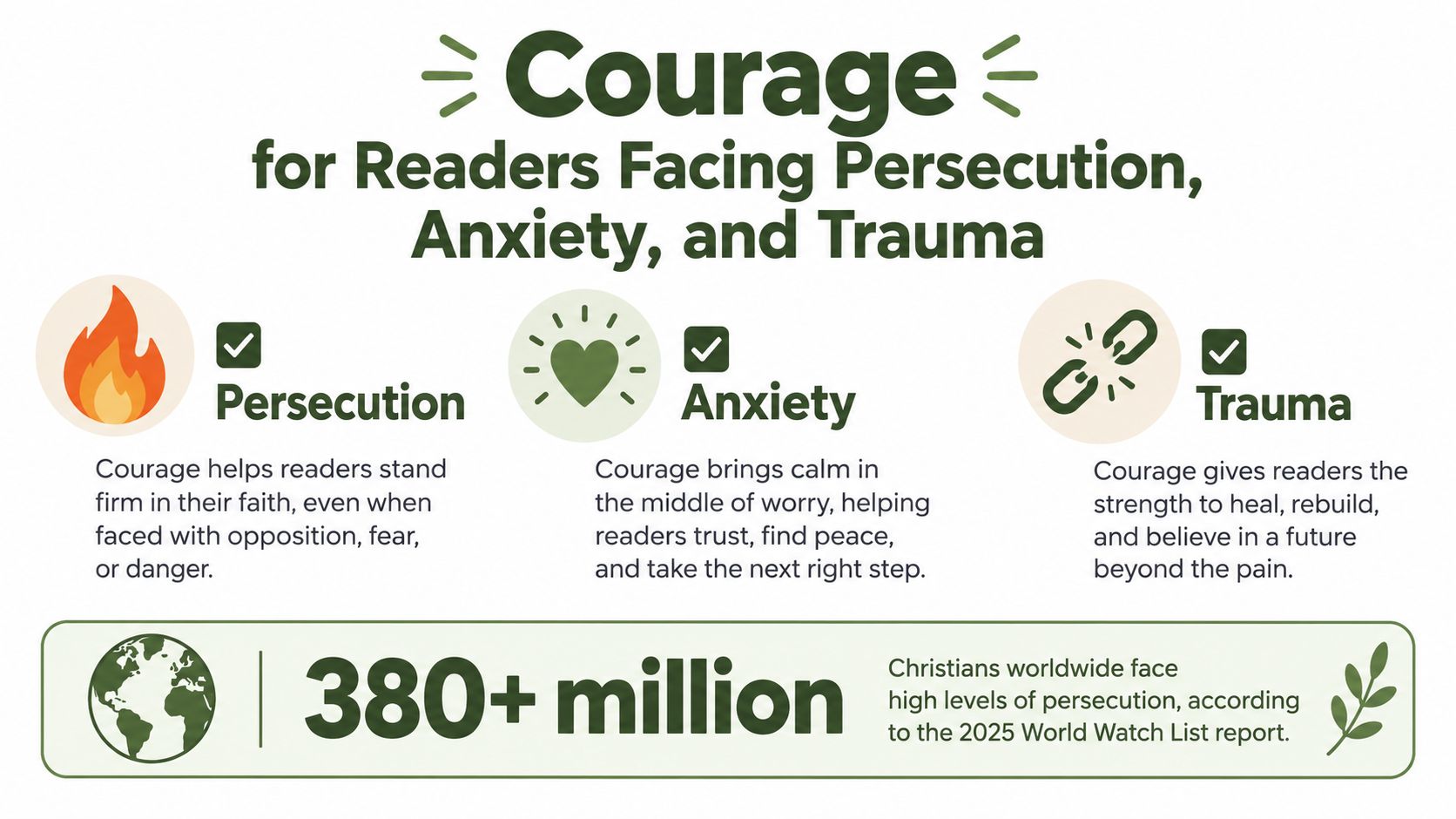
The 2025 World Watch List reported more than 380 million Christians facing high levels of persecution or discrimination, and 54,780 Christians physically or mentally abused during the reporting period (Open Doors reporting on persecution and abuse). These realities demand more careful pastoral language than telling people to be bold and trust that everything will work out.
The infographic identifies distinct situations that require thoughtful care, not a single response.
Distinguish the Need Before Giving Advice
“Do not fear” must not be used as a demand to suppress trauma symptoms. A pastoral application of courage should leave room for safety planning, trusted community, and professional care alongside prayer. Needing help isn't a test someone has failed.
| Situation | A responsible question |
|---|---|
| Ordinary anxiety | What concern needs naming and careful assessment? |
| Wise risk assessment | What harm is possible, and whom must I protect? |
| Lament | Can I express grief honestly without being pressured to sound hopeful? |
| Courage under coercion | What options preserve safety and faithful responsibility? |
Public identification may endanger people who haven't chosen the risk themselves. Silence can therefore require discernment rather than immediate condemnation. Speaking publicly, protecting family, fleeing danger, and remaining faithful privately must be considered within their actual circumstances.
Christian traditions may disagree about how to apply passages concerning witness, authority, resistance, and nonretaliation. That disagreement is a reason for careful interpretation and trustworthy counsel, not for demanding that vulnerable people prove their faith through preventable harm.
Safety matters: Don't use a courage passage to pressure someone to remain in immediate danger.
If you're being threatened, seek appropriate local emergency assistance or a qualified support service when it's safe to do so. A trusted person can help you consider next steps without requiring you to confront an aggressor alone.
For those offering support, begin by listening. Ask what the person fears, what constraints they face, and what help they want. Don't make your preferred image of bravery another burden they have to carry.
A Simple Three-Step Practice for Building Courage This Week
Choose a situation small enough to describe clearly. Instead of trying to become courageous in general, identify a responsibility you've been avoiding. Keep the safety distinctions above in view: the practice isn't an instruction to confront danger unnecessarily.
A useful application of Joshua 1 is to identify the threatening situation, rehearse the governing principles, and take the next obedient action, treating fear as an emotion to manage rather than a final decision-maker (a practical application framework for Joshua 1:9).
Name, Reflect, Act
Name the pressure. Write a plain sentence describing what you fear and what responsibility is involved. For example: you need to acknowledge an error, but you're afraid the other person will lose respect for you. Naming both parts prevents the exercise from becoming vague positive thinking.
Reflect on the passage in context. Read Joshua's courage passage alongside its surrounding instructions. Consider what it teaches about obedience, then ask what principles govern your situation. A study tool with original-language explanations and cross references can help, provided you also read the chapter.
Choose an observable response. Send the honest correction, ask a trusted person for support, or arrange the conversation you need. Pick something you can recognize as completed, rather than making your goal “feel braver.”
Close with a prayer that fits the passage and your responsibility. Ask for clarity, willingness, and help acting wisely; you don't need elaborate wording.
- For continuity: Attach this reflection to an existing part of your day.
- For prayer: Use these ways to build a daily prayer habit to make returning easier.
- For review: Ask whether you acted faithfully and what counsel you still need, rather than grading your emotional confidence.
The practice is a tool for attention and obedience, not a guarantee that repeated reflection will remove anxiety.
Carrying Courage as a Portable Companion
Think of courage less as armor you must produce and more as a way of walking with God through a responsibility you can't avoid. You don't have to become a different personality before you can begin. You need a faithful direction, appropriate support, and a willingness to take the step that belongs to you.
Joshua's assurance of accompaniment gives that image its foundation. His assignment is particular, but the passage directs our attention away from self-sufficiency. The question isn't whether we can make ourselves invulnerable.
Leave Room for Help
Courage and receiving care belong together. Ask someone trustworthy to listen, pray, or help you assess a decision. Community doesn't remove your responsibility, but you needn't treat every difficult choice as a solitary test.
- Carry a passage: Keep it accessible, with its context intact.
- Carry an honest question: What does faithfulness require here?
- Carry a connection: Know whom you can approach when your own judgment feels strained.
The Bible's varied portraits also leave room for an unfinished story. You may have spoken truth without receiving understanding, or sought safety while still feeling shaken. An uncomfortable outcome doesn't by itself establish that your action was wrong.
Begin with a passage today, not with a demand that you feel ready. Read carefully, pray sincerely, and choose a responsible response. Fear may still be present when you act, but it doesn't have to determine every choice.
Scroll With God offers a focused Bible verse feed, chapter context, study explanations, and verse-linked prayers to help you turn phone time into thoughtful Scripture reading. Visit Scroll With God to explore courage passages, read their surrounding chapters, and begin a daily practice of reflection, prayer, and faithful action.