
A Bible Verse on Forgiveness That Explains Its Meaning
Explore a bible verse on forgiveness, understand its context, and learn how to apply forgiveness without confusing it with trust, safety, or reconciliation.
In this article
- Finding the Right Bible Verse on Forgiveness
- Understanding Matthew 18 Verse 35
- Sincerity without pretending
- Reading the Servant Story in Context
- Why the contrast matters
- What Forgiveness Does and Does Not Mean
- Forgiveness and Related Ideas
- Applying Forgiveness Through a Gradual Prayer Practice
- Move from naming to discernment
- Forgiveness in Everyday Relationships
- Different harms call for different responses
- When You Want to Forgive but Still Feel Hurt
- Notice direction rather than demanding completion
- A Final Reflection on Mercy and Responsibility
Matthew 18:35 is a Bible verse on forgiveness that calls for mercy “from your heart.” In practical terms, biblical forgiveness means releasing revenge and extending mercy, not automatically trusting the offender, restoring the relationship, or removing consequences.
Perhaps you've reread a hurtful message, rehearsed an argument, or wondered what you'd say if someone finally apologized. You want to obey God, but you don't want to pretend the injury never happened. Jesus' teaching gives that struggle a serious answer, rooted in both mercy and moral responsibility.
Finding the Right Bible Verse on Forgiveness
The conversation ended, but you're still having it in your head. You remember what the other person said, what you couldn't say, and what remains unresolved. Searching for a Bible verse on forgiveness may be your way of asking a more personal question: How do I respond faithfully without denying what happened?
Matthew's closing verse in the servant story offers a useful starting point because Jesus addresses something deeper than polite behavior. His concern is whether someone who has received mercy will extend it sincerely to another person. The focus is not merely on saying acceptable words while privately planning repayment.
A starting question: Am I asking God to help me become merciful, or only looking for words that will make this conflict disappear?
A short verse can be memorable, but reading it alone can leave you confused. You might hear a demand for instant emotional relief or assume that keeping a boundary proves you're unforgiving. Neither assumption gives sufficient attention to the story Jesus tells.
Read the closing statement as the conclusion of a moral argument, not as an isolated instruction. The servant's conduct reveals a contradiction between the mercy he receives and the mercy he refuses. That contradiction gives the verse its force and provides a better place to begin than measuring your spiritual progress by how calm you feel today.
Understanding Matthew 18 Verse 35
Jesus ends the parable by warning that his hearers must forgive sincerely. The central phrase is brief:
“from your heart”
That wording appears in the closing application of Matthew's account of the unforgiving servant. Jesus doesn't leave forgiveness as a financial image or an outward exchange. He applies it to the inner life of the person listening.
From the heart means more than performing forgiveness for an audience. Someone might stop arguing while continuing to cultivate a plan to humiliate the offender later. Another person might speak graciously yet use every future disagreement as an opportunity to demand emotional repayment.
Sincerity without pretending
A helpful reading distinguishes honest surrender from manufactured feelings. You can acknowledge that you still feel angry while asking God to change what you intend to do with that anger. Sincerity doesn't require claiming an emotional condition you haven't reached.
The warning also deserves its full weight. Jesus connects receiving divine mercy with extending mercy toward others. He isn't presenting forgiveness as an optional courtesy for unusually patient people, and the ending shouldn't be softened into advice about feeling better.
At the same time, self-examination should focus on more than the presence of distress. Ask whether you're deliberately feeding retaliation, refusing every possibility of mercy, or using another person's wrongdoing to justify cruelty of your own.
- Examine your motives: What outcome am I hoping for when I think about this person?
- Examine your conduct: Am I telling the truth, or trying to injure them in return?
- Pray: God, show me where I'm resisting mercy, and help me respond without pretending.
These questions make room for repentance without turning pain itself into evidence of spiritual failure.
Reading the Servant Story in Context
Peter asks whether forgiving someone seven times is sufficient. Jesus answers, “not seven times, but seventy-seven times,” then tells a story contrasting a servant's debt of 10,000 talents with a fellow servant's debt of 100 denarii, as recorded in Matthew's teaching on forgiveness.
The exact modern value of those debts is uncertain. What matters is the deliberately extreme contrast: the servant owes an overwhelming royal debt, while someone else owes him a comparatively manageable amount.
The sequence below provides a visual overview of the parable.
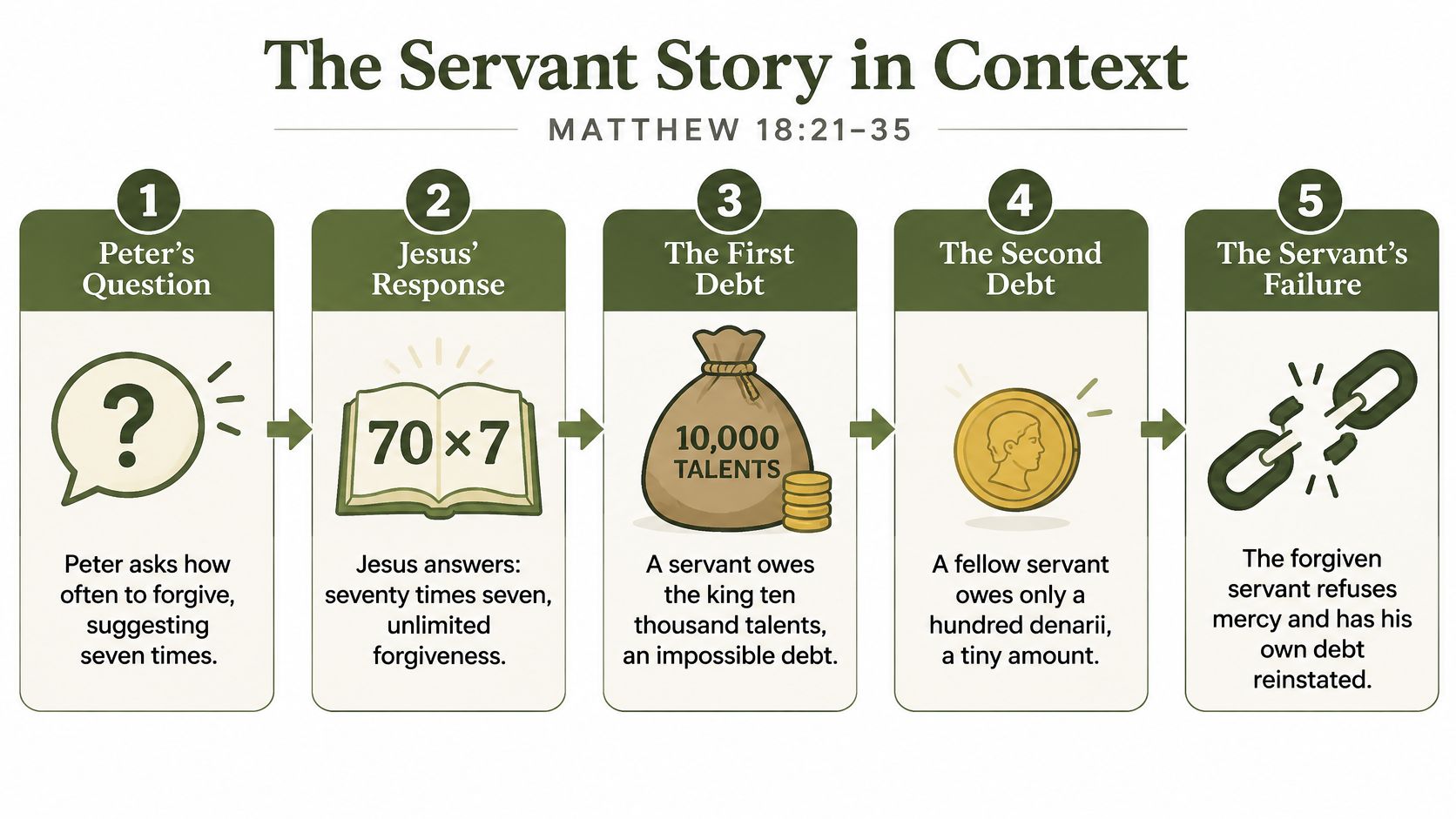
The king cancels the enormous obligation. Yet the released servant refuses to show comparable mercy to his fellow servant and has him imprisoned. When the king learns what happened, he reverses his act of mercy and holds the servant accountable.
Why the contrast matters
The servant doesn't fail because the smaller debt is imaginary. His fellow servant really owes him something. He fails because he receives extraordinary mercy and then treats another person as though mercy has no claim on his own behavior.
That distinction matters when you've been wronged. Jesus doesn't need to declare the offense unreal in order to condemn a merciless response. The wrong can be genuine, and revenge can still be wrong.
Nor does Jesus replace Peter's proposed limit with a larger permission slip for eventual retaliation. His numerical answer redirects Peter away from keeping a tally. The question becomes not whether someone has exhausted an allowance, but whether a person shaped by mercy will continue practicing it.
For slower reflection, use a guide to meditating on Scripture. Pause at the king's cancellation and the servant's refusal, then consider the difference between receiving grace gratefully and allowing it to influence your next decision.
What Forgiveness Does and Does Not Mean
Forgiveness becomes confusing when several different decisions get packed into the same word. A person may hear forgive and assume it means dismissing the offense, dropping a complaint, or welcoming someone back into private life.
Those decisions aren't interchangeable. A careful treatment of Matthew's teaching, including the related passage about divine forgiveness, should distinguish the inward and moral work of forgiving from judgments about reliability, access, and consequences.
Forgiveness and Related Ideas
| Meaning | What it involves | What it does not automatically require |
|---|---|---|
| Forgiveness | Relinquishing personal revenge and cultivating mercy | Feeling calm or resuming contact |
| Excusing | Treating conduct as less blameworthy or not blameworthy | Forgiveness doesn't require calling wrongdoing acceptable |
| Pardon | Releasing a penalty where someone has authority to do so | Canceling legal, workplace, or protective consequences |
| Trust | Judging someone reliable enough for a particular responsibility | Believing an apology without evidence of change |
| Reconciliation | Working toward a repaired relationship | Immediate closeness or unilateral restoration |
| Accountability | Naming wrongdoing and requiring an appropriate response | Hostility, humiliation, or personal retaliation |
Consider a damaged lock. Choosing not to retaliate against the person who broke it doesn't mean leaving your door unsecured. Similarly, a forgiving response can include a firm decision about what access someone will have.
Practical rule: Make decisions about access according to safety and demonstrated behavior, not pressure to prove that you've forgiven.
This also helps distinguish resentment from responsible action. Reporting misconduct, documenting an incident, or requesting supervision can serve protection and truth rather than revenge. The purpose and manner of the response matter.
You don't need to make a sweeping promise that everything will return to normal. More honest language might be: I'm working toward forgiveness, and I'm not ready to rebuild trust. That statement names a spiritual intention without claiming a relational outcome that hasn't become possible.
Applying Forgiveness Through a Gradual Prayer Practice
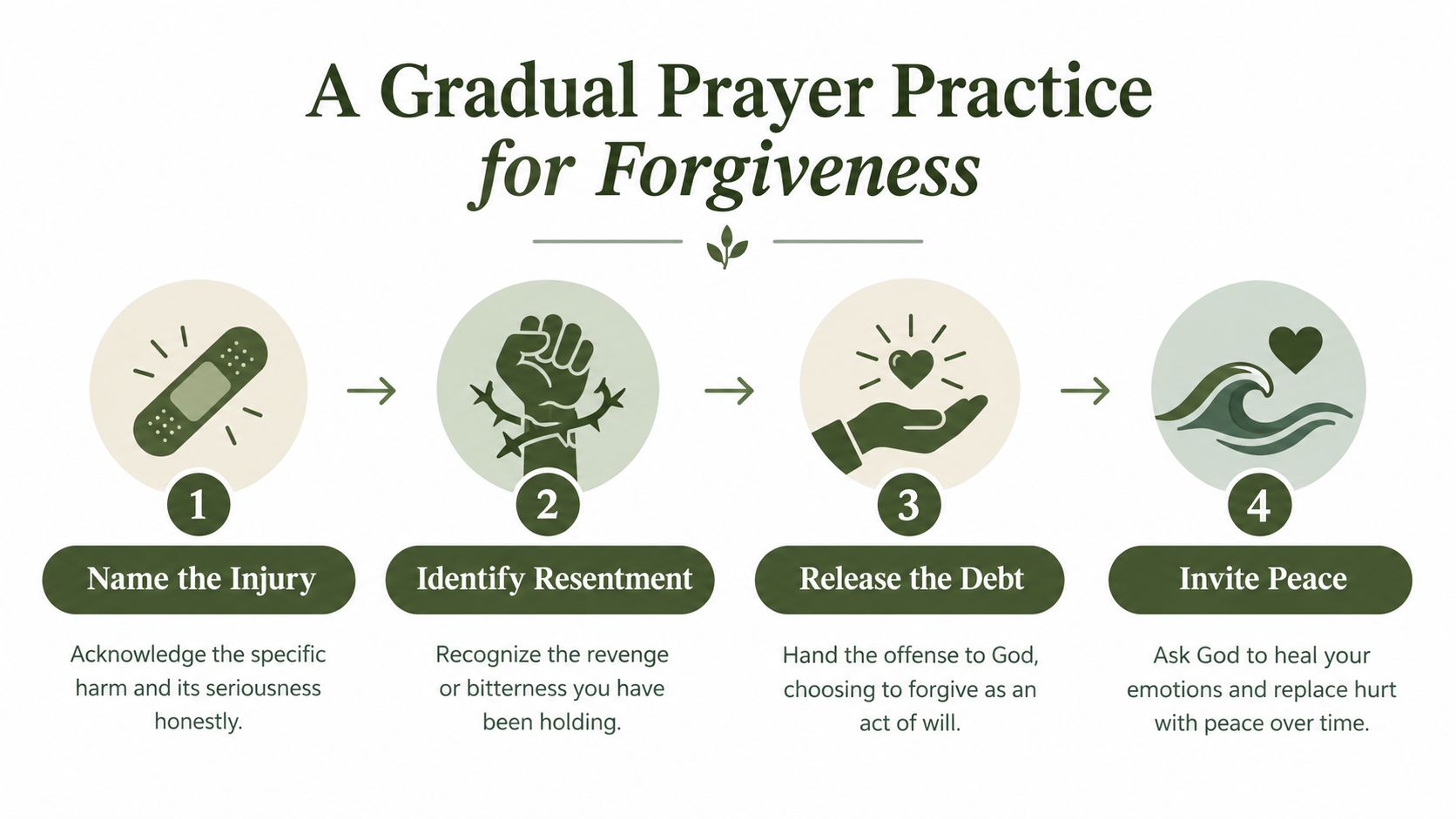
Begin prayer with what happened, not with what you think a forgiving Christian ought to feel. Name the injury plainly: a confidence was shared, a promise was broken, or someone used power to cause harm. Avoid minimizing language if it hides the seriousness of the offense.
The visual below offers a simple pattern you can return to without treating prayer as a test.
Move from naming to discernment
- Acknowledge the harm: Tell God what happened and what you lost. You don't have to defend the offender's behavior to begin.
- Identify your desired repayment: Notice whether you're imagining embarrassment, exclusion, or suffering for the other person. Distinguish those wishes from a legitimate desire for justice.
- Offer a voluntary surrender: Ask for help giving up personal retaliation. If willingness is difficult, begin by asking for willingness rather than making a declaration you don't mean.
- Choose a wise next action: Write down a boundary, identify someone who can help, or postpone a conversation that would currently be unsafe.
Then ask for steadiness rather than demanding immediate peace. A prayer might be: God, I'm still angry. Help me tell the truth, refuse cruelty, and recognize what is safe.
A meta-analysis of forgiveness interventions found benefits from process-based individual programs, while decision-only interventions showed no effect. That clinical finding doesn't establish a theological claim, but it supports a practical caution: don't reduce a difficult process to an isolated declaration.
Return to your notes and notice what remains unresolved. Guidance on building a daily prayer habit can help you create a consistent place for that reflection. If you miss a prayer period, resume without turning the interruption into another reason for shame.
Forgiveness in Everyday Relationships
Suppose a friend breaks a promise and leaves you managing a difficult situation alone. A merciful response might involve a direct conversation rather than a campaign to turn mutual friends against them. You can explain the impact and make different plans next time without using the incident permanently.
A family member's careless comment may call for another response. Instead of answering with an equally painful remark, you could say that the subject is hurtful and end the conversation if it continues. Choosing your words carefully doesn't require agreeing with what was said.
Different harms call for different responses
- A coworker takes credit: Present the relevant work records and ask a manager to correct the account. Keep the focus on accuracy rather than attacking the coworker's character.
- Someone repeatedly betrays confidence: Remain civil while no longer sharing sensitive information. Confidential access needn't continue because you're pursuing mercy.
- A person behaves abusively: Prioritize protection and qualified support rather than arranging a private encounter to demonstrate forgiveness.
The distinction is especially important in unsafe relationships. Theological analysis of forgiveness and reconciliation distinguishes forgiving from full reconciliation; rebuilding a relationship generally involves repentance, changed behavior, wisdom, and safety.
These are representative situations, not documented case studies. Their purpose is to show why applying the same teaching doesn't always produce the same outward response.
If you're supporting someone else, resist prescribing a reunion before listening to the harm. Choosing a Bible verse to encourage someone should accompany patient attention, not replace it. Ask what support would help them act wisely, rather than asking when they'll finally move on.
When You Want to Forgive but Still Feel Hurt
You may leave prayer intending to show mercy and feel upset again when a memory returns. That doesn't automatically mean your earlier prayer was dishonest. Distinguish renewed pain from a renewed decision to retaliate.
This reflective image can serve as a pause before you put those feelings into words.

A 2025 systematic review of forgiveness in relationships synthesized 37 studies and reported associations with improved emotional well-being, relational health, and mental or spiritual well-being. Associations aren't guarantees, and psychological findings aren't proof of Jesus' theological teaching.
Notice direction rather than demanding completion
Ask whether you're becoming more able to name the offense accurately, interrupt revenge fantasies, or seek help without shame. Those questions are more useful than requiring yourself to feel untouched by the memory. A journal can hold both an intention to forgive and an honest account of continuing grief.
Use the video below as an optional pause for further reflection, not as a deadline for reaching peace.
If distress interferes with daily life or follows traumatic harm, consider trauma-informed professional support. Scripture, prayer, and counseling needn't compete. Seeking care isn't a failure of faith, and you don't have to process a serious injury alone.
A Final Reflection on Mercy and Responsibility
Matthew's closing call to forgive from the heart asks for more than courteous words. The servant story invites an unending posture of mercy, while its serious ending keeps responsibility in view.
During your next prayer time, choose a concrete response: name the hurt you've avoided, surrender a retaliatory plan, or seek guidance about a needed boundary.
God, give me a forgiving spirit without dishonesty. Help me acknowledge wrongdoing, receive your mercy, and extend it with wisdom. Teach me to act compassionately without placing myself or others in danger. Amen.
Scroll With God offers focused Scripture reading, passage context, and verse-linked prayers, with access to the surrounding chapter. Visit Scroll With God to make room for a steady practice of reading, reflection, and prayer as you work toward forgiveness.