How to Meditate on Scripture a Practical Guide
Learn how to meditate on scripture with a step-by-step guide rooted in ancient tradition. Practical tips, real examples, and ways to read verses in context.
In this article
- Why Most Scripture Meditation Feels Shallow
- Two Ways the Practice Drifts
- The Four Stages of Meditating on a Verse
- Observe What Is Actually There
- Understand the Context
- Reflect on What It Reveals
- Respond in Prayer and Action
- A Step-by-Step Practice You Can Use Today
- Work Through Joshua 1:8
- Why Repeating This for a Week Helps
- How This Differs from Mindfulness and Bible Study
- Reading Verses in Their Actual Context
- Four Guardrails That Take a Minute
- When the Practice Feels Empty or Hard
- What to Do in the Messy Middle
- Your First Week of Scripture Meditation
You're sitting on the edge of the bed, phone in hand, trying to start the day with God before the day starts with you. You open a verse, read it twice, and wait for something to happen. Nothing obvious does. If that's familiar, you're not doing it wrong because you're lazy or unspiritual. You probably just haven't been shown a repeatable way to stay with a passage.
Why Most Scripture Meditation Feels Shallow
The alarm goes off and you reach for your phone with good intentions. You open a Bible app, land on a highlighted verse, and tell yourself you'll meditate for five minutes. Two minutes later you're rereading the same line, wondering about a footnote, then remembering an email you forgot to send.
It's an ordinary scene, and it can leave you feeling oddly guilty. You wanted quiet attention, and instead you got distraction. You wanted insight, and instead you got a flat feeling and a wandering mind.

Most advice doesn't help much because it stops too early. You're told to repeat a verse, paraphrase it, or pick a favorite word, but nobody explains what should happen between reading the words and applying them. Without that middle work, meditation easily becomes a mood you're chasing.
That gap creates two common problems.
Two Ways the Practice Drifts
- Shallow affirmation: You pull an encouraging phrase out of its chapter and treat it like a personal slogan, even if the passage is saying something more complex.
- Detached analysis: You collect facts about the text, feel informed, and never slow down long enough to pray or respond.
Neither problem means you've failed. Both usually mean you haven't separated interpretation from application. You need to know what the text meant before you decide what it asks of you today.
Distraction during meditation isn't proof that the time didn't count. Noticing you've drifted and returning to the words is part of the practice itself.
That's why learning how to meditate on Scripture works better as a four-stage discipline than as a single tip. Observe, understand, reflect, and respond gives your attention somewhere to go. It also gives you language for awkward moments when you feel nothing, get confused, or find the passage painful rather than peaceful.
You don't need a special personality for this. You need a short passage, a little structure, and permission to move slowly. The method matters because it keeps you from grading a session by how calm or inspired you felt.
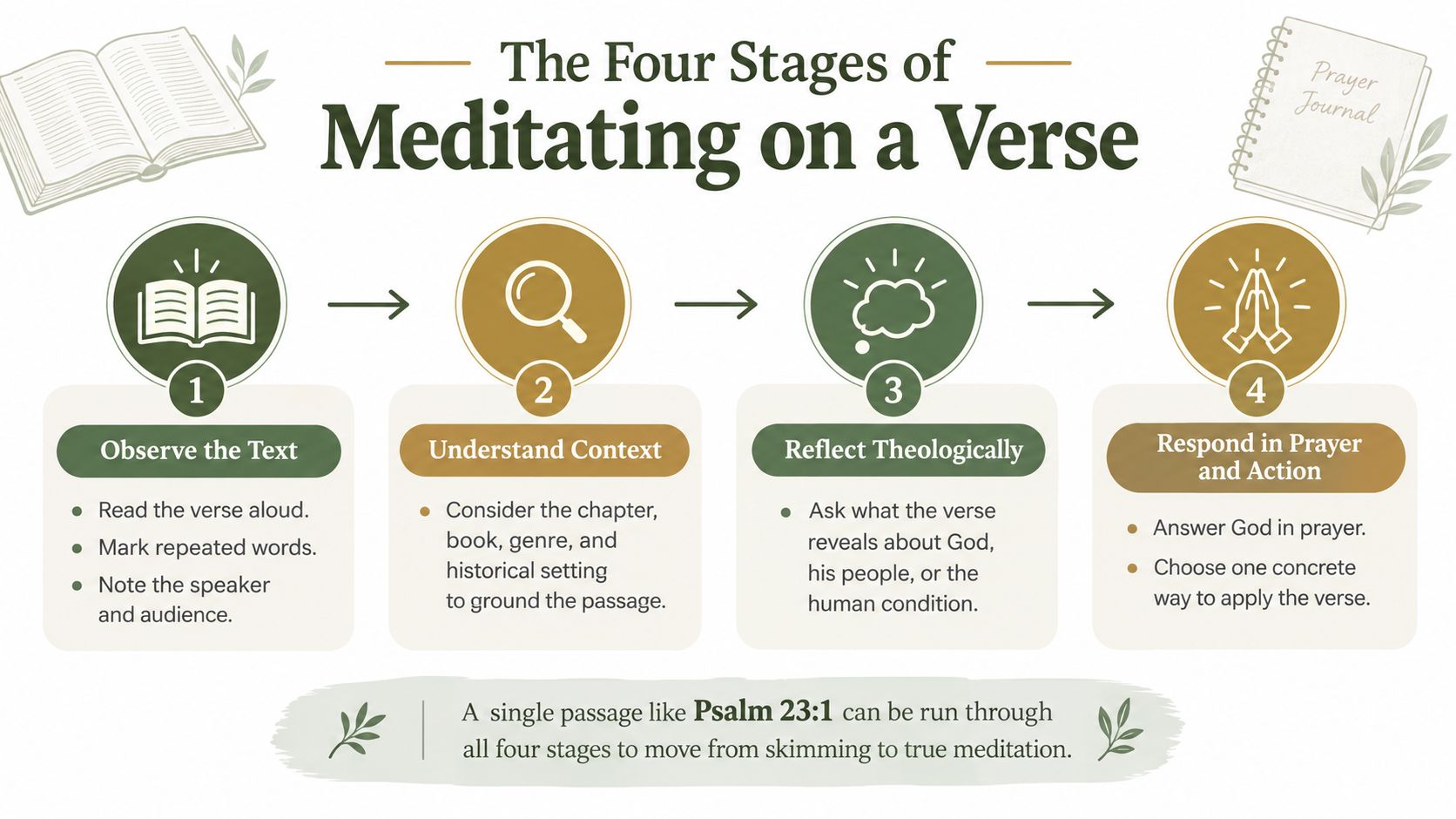
The Four Stages of Meditating on a Verse
Think of meditation as moving through four rooms rather than staring at one sentence. Each stage has a different job, and skipping one usually creates the confusion people blame on themselves. Psalm 23:1, "The Lord is my shepherd, I lack nothing," is a helpful passage to practice with because it's familiar enough to skim.
Observe What Is Actually There
Start by reading the verse slowly, ideally aloud. Notice repeated words, contrasts, commands, promises, and who's speaking. In Psalm 23:1, David isn't giving a lecture about shepherds. He's making a personal claim, and the small word my carries a lot of weight.
Write down what you see before you decide what it means for you. Who is acting? What verb is used? Is the tone confident, pleading, grateful, or afraid? Observation slows down the rush to make the verse say what you already hope it says.
Understand the Context
Next, place the verse inside its chapter, book, and genre. Psalm 23 is poetry, not a contract that lists guaranteed outcomes. Its images of shepherding, valleys, enemies, and God's house belong together, so verse 1 shouldn't be lifted away from the danger named later in the psalm.
Ask who first heard these words and what situation they faced. You don't need a seminary degree for this stage. Reading the surrounding chapter and checking whether you're in narrative, poetry, prophecy, or a letter already prevents many misreadings.
Reflect on What It Reveals
Only now ask the theological questions. What does this passage show about God's character? What does it reveal about his people, or about ordinary human fear and trust?
With Psalm 23:1, reflection might sound like this. David trusts God's care before he describes walking through the valley. Provision, in this psalm, isn't the absence of threat. It's confidence that he isn't abandoned inside it.
A useful check: If your reflection could be said about almost any verse, you probably haven't stayed with this particular text long enough.
Respond in Prayer and Action
Finish by answering God directly. Your response might be gratitude, confession, a request, or one concrete action. For Psalm 23:1, you might pray, "You are my shepherd, and I'm acting today as if everything depends only on me. Teach me to trust your care while I do the next faithful thing."
That last stage keeps meditation from staying private and abstract. You observed the words, understood their setting, reflected on their meaning, and now you let them shape a choice. Run any passage through those four movements and you'll feel the difference between skimming for comfort and dwelling with Scripture.
A Step-by-Step Practice You Can Use Today
A framework helps only if you can use it on a tired Tuesday. This session uses a simple Read, Notice, Respond, Apply loop drawn from lectio divina. It fits into a short sitting, and you can use a chair, a kitchen table, or the side of your bed.

Set a timer if that helps you stop checking the clock. Keep your eyes open while reading, then close them if you want during prayer. There's no required posture, though sitting in a way that keeps you awake usually helps more than lying down.
Work Through Joshua 1:8
Joshua is about to lead Israel, and God tells him to keep the Book of the Law on his lips and meditate on it day and night so he can obey it. Read the verse aloud twice, slowly enough to hear the verbs. The second time, let one word hold your attention without forcing a dramatic reason.
Maybe the word is careful, always, or meditate. Stay with it and ask plain questions. What would careful obedience have meant for Joshua, who carried public responsibility? What does repeated attention do that a single quick reading doesn't?
Then turn that noticing into prayer using your own sentences. You might say:
- Read: "Lord, this verse connects remembering your words with obeying them."
- Notice: "The word careful stands out because I often rush and call it faithfulness."
- Respond: "Slow me down today when I'm tempted to react before I listen."
- Apply: "Before I answer that difficult message, I'll pause and reread this verse."
Notice that the application is small and checkable. You're not promising to transform your whole life before lunch. You're choosing one place where the passage can interrupt an old pattern.
Why Repeating This for a Week Helps
A single moving session can be meaningful, but it isn't a reliable measure of growth. In a randomized controlled trial of daily Psalm-based lectio divina, 29 participants practiced for seven days while 32 people served as controls, and the practice group showed significant improvements in hope and wellbeing. Those results are encouraging but preliminary because the sample was small, so treat them as a reason to practice consistently rather than as a guaranteed outcome.
Use the same loop tomorrow with a short psalm. Read, notice, respond, and apply, then write one line about what you did. That written trail matters on flat days because it reminds you that meditation is measured by sustained attention and obedience, not by a constant feeling of peace.
How This Differs from Mindfulness and Bible Study
Many people hesitate because they aren't sure what they're supposed to be doing with their minds. Should you empty your thoughts like a meditation app suggests? Or should you open commentaries and study like you're preparing an exam?
Biblical meditation sits in a different place. It fills attention with a specific text and directs that attention toward God. You're not trying to detach from thought. You're thinking, remembering, speaking, and praying with words you've received.
That pattern is old. Joshua 1:8 presents meditation as keeping the Book of the Law on your lips day and night so you can obey it, which points to repeated verbal engagement rather than sitting with an empty mind. The aim isn't calm for its own sake. The aim is a life increasingly shaped by Scripture.
Bible study isn't the enemy here, and meditation doesn't replace it. Study asks what a passage meant, how its argument works, and how it connects with the rest of Scripture. Meditation uses that understanding, then lingers long enough for prayer and response. If you're comparing tools for both habits, a guide to apps for Bible study and prayer can help you see which features support study and which support slower devotional attention.
| Practice | Main focus | Typical ending |
|---|---|---|
| Generic mindfulness | Present-moment awareness | Calm or detachment |
| Bible study | Meaning and context | Clearer understanding |
| Scripture meditation | Text, reflection, and prayer | Trust, repentance, or action |
The Christian tradition made this rhythm durable through lectio divina, or divine reading. The Rule of Saint Benedict organized monastic life around prayer, work, and slow, prayerful Scripture reading in the sixth century, and Guigo II later formalized four movements of reading, meditation, prayer, and contemplation. You're joining a practice built for formation over time, not performing a technique you have to get exactly right on the first morning.
Reading Verses in Their Actual Context
Context isn't a scholarly extra. It's the guardrail that keeps a verse from becoming whatever you need it to say in the moment. A sentence can sound like a promise, a command, or a comfort depending on who said it and why.
You don't need to research every verse for an hour. You need a few quick checks you can repeat until they become instinct. Guidance on meditatio within studying God's Word supports separating observation and context from personal reflection, so application doesn't drift away from the passage.
Four Guardrails That Take a Minute
- Read the chapter: Look at what comes before and after your verse, especially if the tone changes.
- Name the genre: Treat a lament, a proverb, a prophecy, a narrative, and a letter differently.
- Identify the voices: Ask who's speaking, who's being addressed, and whether the words are description or instruction.
- Test the application: Ask whether your response honors the original meaning or only borrows the wording.
Consider a lament psalm where the writer says God has forgotten him. If you pull a later line about hope into isolation, you might turn the psalm into cheerful advice. Read in full, the movement is slower and more honest. The writer complains, remembers, asks, and only gradually rests in trust.
That difference matters when you're choosing a Bible verse to encourage someone or meditating during your own grief. A verse meant to give language for sorrow shouldn't be used to rush yourself or anyone else past sorrow. Context teaches you to receive the kind of comfort the text offers.
Don't ask only, "What does this mean to me?" Ask first, "What is this passage doing, and why was it said this way?"
Genre awareness also protects you with narrative. When a Bible character does something, the story may be describing a failure rather than recommending a model. With prophecy, a promise to Israel in exile may point toward God's faithfulness without becoming a direct guarantee about your job, health, or timeline.
If an application requires you to ignore the audience, flatten the genre, or silence the hard verses nearby, pause. Write interpretation on one line and possible application on another. That small label creates room for humility, and humility is not a brake on meditation. It's what keeps meditation truthful.
When the Practice Feels Empty or Hard
Some mornings your mind wanders every thirty seconds. Some mornings you read carefully, pray sincerely, and feel almost nothing. Occasionally a passage about suffering, judgment, or loss makes distress sharper instead of softer.
None of those experiences automatically means you're doing it wrong. Christian meditation has long included noticing a thought, returning attention to a sacred word, and continuing in silence or prayer. The returning is not an interruption to the practice. In many sessions, it is the practice.

What to Do in the Messy Middle
When you drift, name it without scolding yourself. Say, "planning," "worrying," or "remembering," then reread the last line aloud. Hearing your own voice often brings you back more gently than trying to force concentration.
When you feel flat, shorten your expectations rather than abandoning the time. Observe one verb, pray one sentence, and choose one small response. A quiet session can still train attentional awareness, even if it doesn't produce a memorable insight.
When emotion rises, don't force positivity onto the text. You can acknowledge grief, anger, doubt, or fear, read the surrounding chapter, and move to a lament that tells the truth about pain. Research on Scripture reflection and stress found that nearly 60% of participants who reflected on prosocial New Testament passages for about 15 minutes said it helped reduce stress, compared with 43% in a nonreligious-passage group. That supports offering meditation as a structured coping practice, not as a guaranteed treatment.
There's also a clear stopping point. Reviews of contemplative practices report possible adverse effects including affective difficulty, derealization, hallucinations, delusions, interpersonal problems, and false memories, which supports stopping when distress escalates and seeking qualified pastoral or mental-health support. Most sessions won't be destabilizing, but you don't honor Scripture by pushing through panic or dissociation.
If the same passage keeps intensifying pain, set it aside and talk with a pastor, counselor, or trusted friend. God isn't asking you to use meditation as a substitute for care. Sometimes the faithful response is to close the book, breathe, and let another person help you carry what surfaced.
Your First Week of Scripture Meditation
Start smaller than your ambition wants. Choose the same time and place for seven days, keep each session brief enough to repeat, and use the same four stages each time. Consistency teaches your body and mind what this chair, this mug, and this open Bible are for.
You could move through Psalm 23, Psalm 42, Joshua 1, Psalm 121, Psalm 130, Isaiah 40, and John 15. That mix gives you trust, lament, instruction, and Jesus's teaching in one week. Each day, finish with one concrete application you can complete before bed.
If anxiety makes sitting still hard, read aloud, walk slowly with one verse, or copy the passage by hand. If you don't understand a passage, read the chapter, write your question down, and meditate on the part that's clear without inventing certainty. Group meditation also counts, especially when each person shares an observation before anyone rushes to application.
Pair the practice with simple ways to build a daily prayer habit so meditation and prayer begin supporting each other. By day seven, look back at your notes and notice patterns in what you observed, prayed, and did. That's a better measure than whether every morning felt peaceful.
Scroll With God helps you practice this rhythm one verse at a time, with passage context, plain-language study help, and a written prayer attached to each verse so you can move from reading into response without losing the surrounding chapter. If you want a calmer way to begin tomorrow morning, visit Scroll With God and start your first week with a single passage, a few unhurried minutes, and one faithful next step.