How to Thank God in Prayer: Scripture-Based Steps
Learn how to thank God in prayer with Scripture prompts, a five-step structure, and sample prayers for ordinary days and hard seasons.
In this article
- Scripture Prompts That Start Gratitude
- Choose the verse that fits today
- How to Pray a Thankful Prayer Step by Step
- Move from the passage to your own words
- Keep the prayer focused, not forced
- Thanking God When You Do Not Feel Thankful
- Words for when gratitude feels out of reach
- Sample Prayers for Ordinary and Hard Days
- Morning before the day gets loud
- After good news from a clinic
- Over a shared meal
- While waiting for a job decision
- Adapting Thankful Prayer to Your Tradition
- Keep the meaning while adapting the form
- Start a Daily Thanksgiving Habit This Week
- Give the practice a dependable place
You sit down to pray, but your mind goes straight to the unanswered message, the appointment you're worried about, or the person you miss. You want to thank God, yet the words feel either too small or too cheerful for what you're carrying.
Learning how to thank God in prayer doesn't require polished language or a better mood. You can begin with a passage of Scripture, name something concrete, and speak to God about the day you're living.
Scripture Prompts That Start Gratitude
| Theme | Verse | What to thank God for |
|---|---|---|
| God's goodness | Psalm 107:1 | His steady goodness and enduring love |
| Thanks in every circumstance | 1 Thessalonians 5:18 | His presence on hard days as well as good ones |
| Gifts from above | James 1:17 | Daily provision, health and the people who help |
| Faithfulness | Lamentations 3:22–23 | Mercies that are new each morning |
| Welcome into God's presence | Psalm 100:4 | Being invited to come before him |
| Remembered benefits | Psalm 103:2 | Specific past answers and rescues |
| Requests with thanksgiving | Philippians 4:6 | Permission to bring needs to God with thanks |
A verse works as a prompt, not a script. It gives you something to notice about God and something to thank him for, without requiring you to copy its wording. Read the passage in your Bible so you can hear the thought in its surrounding context.
For example, James 1:17 can help you notice provision you might otherwise overlook. Your prayer might name breakfast, medicine, or the neighbor who checked on you. You're not trying to produce an impressive list, just to recognize a gift and acknowledge its giver.
Choose the verse that fits today
If you're facing uncertainty, Philippians 4:6 gives you room to bring a request. If your attention keeps returning to what you lack, Psalm 103:2 invites you to remember what you've received. Choose the passage that fits your present season rather than the one you think you ought to find most uplifting.
Psalm 136 repeatedly returns to God's enduring love. The pattern helps you answer different gifts with the same steady acknowledgment: God's love hasn't become less worthy of thanks because your circumstances have changed.
Practical rule: Choose a verse that helps you tell the truth, not one that pressures you to sound cheerful.
Thanksgiving also belongs to a much older pattern of worship than a personal gratitude exercise. The St Andrews Encyclopaedia of Theology's account of prayer connects Christian thanksgiving with the Psalms and identifies Jesus' thanksgiving over bread and wine at the Last Supper as central to the Eucharistic tradition.
You can follow that pattern by remembering what God has done, recognizing who he is, and thanking him for present provision. Before praying, write down a verse reference and a theme, such as Lamentations 3:22–23, faithfulness. That small choice gives your attention somewhere to settle.
How to Pray a Thankful Prayer Step by Step
Start by noticing what you're bringing into prayer. Are you relieved, distracted, disappointed, or afraid? You don't need to change that feeling before you begin, but naming it keeps you from speaking words you don't mean. Thankful prayer works like a conversation with someone who already knows your day: honesty at the start makes the thanks at the end mean something.
Move from the passage to your own words
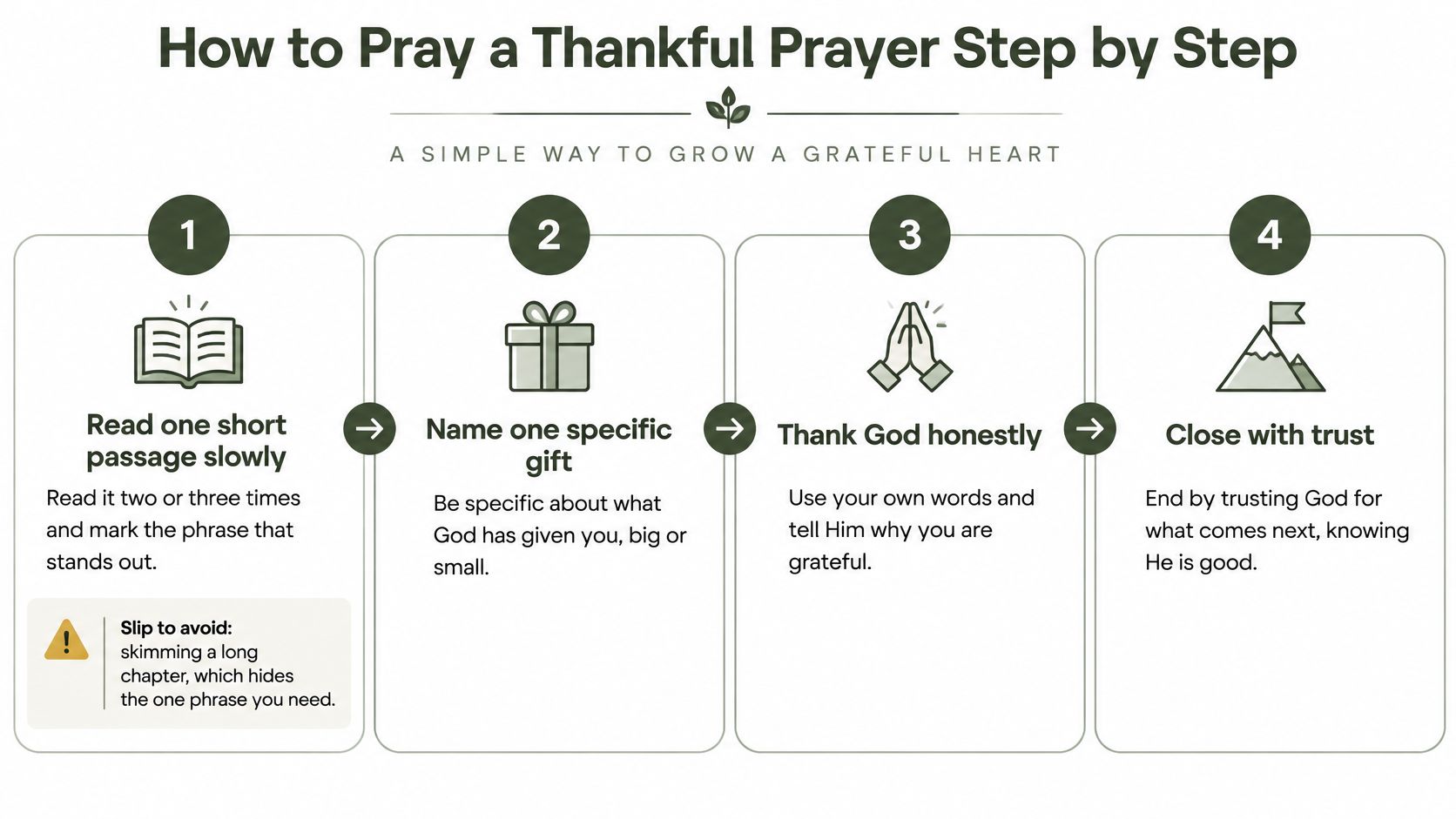
Read a short passage slowly. Read it again and mark the phrase that catches your attention, perhaps God's faithfulness or an invitation to come before him. The common slip is skimming a long chapter and missing the one phrase you could pray.
Name a specific gift. Connect the passage with something recognizable: a friend's call, a meal delivered on a difficult afternoon, the strength to get through a hard morning. Thanks for everything is easy to say and hard to mean, while a concrete detail shows you what you're acknowledging.
Thank God sincerely. Paraphrase the truth in language you'd naturally use: Father, thank you that you're faithful even when my plans fall apart. Repeating the verse without reflection can leave its meaning disconnected from your life.
Apply it to a present circumstance. Name what you face today and how the passage speaks to it: I'm worried about this meeting, so help me enter it remembering your care. Thanking God for his faithfulness during a hard week is not the same as calling the week good.
Close with trust and a request. Ask for the help you need, then finish with Amen. Leaving requests out can turn thankful prayer into a place where only your easier feelings are welcome.
The five steps in this visual condense the same movement from reading to response.
Keep the prayer focused, not forced
After reading about God's provision, you might pray: Father, thank you for the groceries my sister brought. I've been ashamed to need help, but I receive her kindness as a gift. Please help me ask for what I need while I look for work. Amen.
The prayer names provision and need in the same breath, which surprises some people the first time they try it. If you're unsure how the two belong together, this guide to Bible verses about prayer and supplication can help you find language for asking without abandoning thanks.
Don't judge the prayer by whether you feel better immediately. A systematic review of 64 randomized trials of gratitude interventions reported improvements in gratitude, mental health, and mood, while rating the certainty of the evidence very low, so treat gratitude as a practice you return to rather than a technique with a guaranteed payoff.
Before you finish, check whether you can name the gift you thanked God for in one clear sentence. If you can't, make the prayer more specific next time. Keep the passage short and the application honest, and leave room for whatever else you need to say.
Thanking God When You Do Not Feel Thankful
The myth is that a thankful prayer must feel joyful. That assumption can turn gratitude into pressure, especially when you're grieving, ill, anxious, or waiting for an answer that hasn't come.
Thanking God for his presence isn't the same as approving of what hurts. You can grieve a death without calling the loss good. You can oppose injustice while thanking God for someone who stands beside you.
The Methodist Church's guidance on grateful prayer makes room for fear and anxiety and encourages thanks for God's presence even in darkness. That gives you a workable alternative to pretending: acknowledge the pain and name whatever support, love, or hope you can recognize.

Words for when gratitude feels out of reach
Try these as prayer starters, changing anything that doesn't fit:
- When you can't understand: God, I don't understand this, but thank you for staying with me and helping me take the next step.
- When you're grieving: Thank you for the years I had with them, even though I miss them today.
- When you're anxious: I'm afraid, and I'm still grateful that you hear me.
Lament means bringing your sorrow and protest to God. It's prayer, too. The Psalms give you language for asking how long, naming distress, and remembering God's care without pretending those experiences cancel each other out.
If loss has made even these words difficult, Bible verses for grief and loss can offer language to sit with rather than language you must immediately feel.
You can tell God what hurts without adding a cheerful ending.
Don't force a positive explanation during acute distress. You don't have to decide why something happened before you can pray, and thanking God isn't a bargain that obligates him to give you the outcome you want.
Thankful prayer doesn't replace medical, psychological, pastoral, or practical support. Contact a doctor or counselor when distress interferes with sleep, eating, work, or caring for yourself; ask a pastor for spiritual companionship and trusted people for practical help. If you're in immediate danger, seek emergency assistance.
For the moment, ask a gentler question than whether you feel grateful: What is still true and still good right now? The answer may be as small as someone willing to stay on the phone.
Sample Prayers for Ordinary and Hard Days
Use these prayers as starting points, then rewrite them in your own voice. A couple of honest sentences count as a real prayer, even if you pause, repeat yourself, or can't find a graceful ending.
Morning before the day gets loud
Anchored in Lamentations 3:22–23.
Father, thank you for meeting me with fresh mercy this morning. I'm already thinking about everything I need to do, and I don't want to hurry past your care. Help me notice your kindness and receive this day without demanding that I manage it perfectly. Amen.
Why it works: It connects God's faithfulness with an ordinary morning rather than promising an easy day.
After good news from a clinic
Anchored in Psalm 103:2.
God, thank you for the relief of today's results. Thank you for the clinician who explained them and for my friend who drove me to the appointment. Help me remember this care when I'm frightened again, and show me how to support someone still waiting for news. Amen.
Why it works: It names the relief and the people involved without implying that everyone receives the same outcome.
Over a shared meal
Anchored in Psalm 136:1.
Father, thank you for your goodness and for the food in front of us. I'm grateful for the people at this table and for everyone whose work helped bring this meal here. Help us share what we have with others. Amen.
Why it works: Children can add a short sentence naming their own gift without needing grown-up vocabulary.
While waiting for a job decision
Anchored in Philippians 4:6.
Lord, I want this job, and I'm finding the uncertainty hard. Thank you for the friend who practiced interview questions with me and for the support I already have. Please provide work and help me make wise decisions while I wait. Amen.
Why it works: It brings a clear request alongside gratitude without treating the desired answer as guaranteed.
These aren't formulas to recite correctly. God welcomes the awkward, unpolished version, so replace any phrase you wouldn't say.
Adapting Thankful Prayer to Your Tradition
| Mode | Good fit for | Example |
|---|---|---|
| Spoken prayer | Daily personal conversation | Thank God for the rain on the garden |
| Written prayer | Journaling and processing emotion | Write down gifts you noticed before bed |
| Singing or hymns | Communal worship and expressing praise | Sing a familiar doxology |
| Service and generosity | Readers who find words hard | Visit someone sick and thank God for the opportunity |
| Remembrance and grace before meals | Families and shared tables | Offer a brief blessing before food |
| Silent attention | Contemplative or grieving readers | Sit quietly before God, remembering a gift |
Christian thanksgiving can sound different across churches, families, and cultures. According to Pew Research Center's account of American religious practices, about one-third of Americans always or often say grace before meals, while another 18% do so sometimes. A table blessing is familiar to many people, but it isn't everyone's usual starting place.

Keep the meaning while adapting the form
If your church uses set prayers, pause over a phrase instead of assuming familiar words can't be personal. In a liturgical setting, a doxology or established table blessing can give you words to receive and mean afresh. If your church emphasizes spontaneous prayer, a simple acknowledgment in your everyday voice may feel more natural.
Writing can help when speaking feels rushed. Singing lets you join others' words when you can't supply your own. Neither requires you to imitate someone else's emotional tone.
A useful distinction: Thanksgiving concerns God's character as well as his gifts, not only whether your circumstances are comfortable.
Can you thank God through action or silence? Yes, you can offer service as a response to his generosity or sit attentively before him without filling every moment with speech. The point isn't that any helpful act automatically becomes prayer, but that you can intentionally offer it to God in gratitude.
Choose a mode you already practice and add a gratitude element this week. Before visiting a neighbor, acknowledge the care you've received; before a familiar hymn, name what you're thanking God for.
Start a Daily Thanksgiving Habit This Week
In a 2009 study of prayer and gratitude, prayer frequency in a longitudinal sample of 780 participants predicted greater gratitude six weeks later, even after researchers controlled for initial gratitude and religiosity; a separate experimental component found higher follow-up gratitude among participants assigned to pray daily than among controls.
That supports practicing prayer consistently rather than waiting for a grateful mood. It doesn't guarantee better physical or mental health, and it doesn't make an inconsistent week a spiritual failure.
A Scripture prompt on your phone can give you somewhere to begin.

Give the practice a dependable place
- Choose a daily cue. Attach prayer to something you already do, such as making coffee or plugging in your phone at night. Choose a moment when you can give God your attention safely, without multitasking.
- Use the verse-linked structure. Read, notice a gift, thank God, apply the passage, and close with your request. Let the structure help you begin rather than become another task to perform perfectly.
- Review your week. Write down specific gifts you remember and notice which daily cue was easiest to keep. If you missed a day, return at the next opportunity instead of trying to make up a prayer debt.
For help choosing a realistic cue, these ways to build a daily prayer habit offer practical starting points. A notebook works well for recording your verse and response.
If you prefer a phone-based prompt, our Scroll With God app pairs each verse with a prayer drawn from it and keeps count of the days you say Amen. You can use it without creating an account and tap a topic pill to steer the feed toward peace, strength, grief, or gratitude.
You can also set aside a quiet moment with this video.
Tonight, choose a verse and leave it where you'll see it tomorrow morning. Begin with a gift, a verse, and a sentence of thanks, offered to God in the circumstances you have today.
Visit Scroll With God to begin with a Bible passage and a prayer drawn from it. Choose a gratitude prompt, read it slowly, and add your own specific thanks, whether today feels ordinary, joyful, or hard.