Bible Verse Prayer and Supplication Guide
Bible verse prayer and supplication, with key verses, postures, and a simple way to pray one passage today.

In this article
- Bible Verses for Prayer and Supplication
- Choose the passage that fits today
- Read the neighboring words
- What Prayer and Supplication Mean
- A request doesn't need stronger language
- Neighboring terms invite different responses
- Five Postures Inside One Prayer
- Hear the difference in ordinary words
- Let the situation guide the combination
- How to Pray One Verse
- Move from the passage to your response
- Keep the expectation proportionate
- When Supplication Does Not Calm You
- Change the posture, not your honesty
- Don't turn peace into a test
- Three Passages Prayed in Real Life
- An unpaid bill
- Grief after a loss
- Concern for a sick friend
- Pray One Verse for Seven Days
- Keep the practice small and honest
The familiar advice is to find a verse, ask God for what you need, and keep praying until you feel peaceful. That advice leaves something important out: supplication isn't a calming formula, and asking isn't the only faithful response to Scripture. A grieving person may need words of lament; someone who has caused harm may need confession; someone receiving help may need thanksgiving.
A useful approach to Bible verse prayer and supplication begins with a different question: What kind of response does this passage invite? You don't have to manufacture an emotion or find impressive words. You can start with a passage, name your situation, and respond in the posture that fits.
Bible Verses for Prayer and Supplication
| Passage | Posture | Plain-language cue |
|---|---|---|
| Philippians 4:6 | Supplication with thanksgiving | Bring a request and give thanks in the same prayer |
| 1 Timothy 2:1 | Supplication, prayer, intercession, and thanks | Pray for all people, not only yourself |
| Ephesians 6:18 | Ongoing prayer and supplication | Keep praying for fellow believers |
| Matthew 6:9-13 | Pattern of prayer | Begin with God's name, then daily need, forgiveness, and protection |
| Hebrews 4:16 | Confident request for mercy | Come for help in a time of need |
| James 5:16 | Confession and intercession | Pray honestly for one another |
| 1 Thessalonians 5:16-18 | Joy, prayer, and thanksgiving | Pray continually and give thanks |
| Psalm 13 | Lament | Ask how long, then turn toward trust in God's steadfast love |
| Psalm 51:1-2 | Confession | Ask for mercy and cleansing |
| Luke 18:1 | Persistence | Don't give up on prayer |
Choose the passage that fits today
Name your situation in a short phrase before choosing a row. You might write an overdue payment, my friend's illness, regret over an argument, or grief that won't lift. This keeps you from choosing a passage merely because its wording sounds comforting.
For a personal need, begin with Hebrews 4:16 or Philippians 4:6. For someone else's need, choose 1 Timothy 2:1; for guilt, begin with Psalm 51:1-2. If you can't get beyond the question of why suffering continues, Psalm 13 gives you a place to begin without pretending you're ready to give thanks.
Notice that the passages don't all ask you to do the same thing. Matthew 6:9-13 includes reverence, provision, forgiveness, and protection within a shared pattern. James 5:16 places honest confession alongside prayer for one another, rather than treating prayer as an entirely private activity.
Read the neighboring words
In Philippians 4:6, supplication appears alongside thanksgiving. Asking isn't meant to occupy the whole prayer while gratitude disappears. You can bring a serious need without losing sight of a concrete good you've already received.
Likewise, 1 Timothy 2:1 names supplications, prayers, intercessions, and thanksgivings together. These are related words, but the list encourages a broader response than repeating your own request. It also directs attention outward, toward other people.
Starting point: Choose the row that helps you tell the truth about today, not the row that makes you sound most spiritually composed.
For practical use, prayer is the whole conversation with God, and supplication is the humble, specific request inside it. You don't need to work through every row. Pick a passage now, and keep your present situation beside it as you read.
What Prayer and Supplication Mean
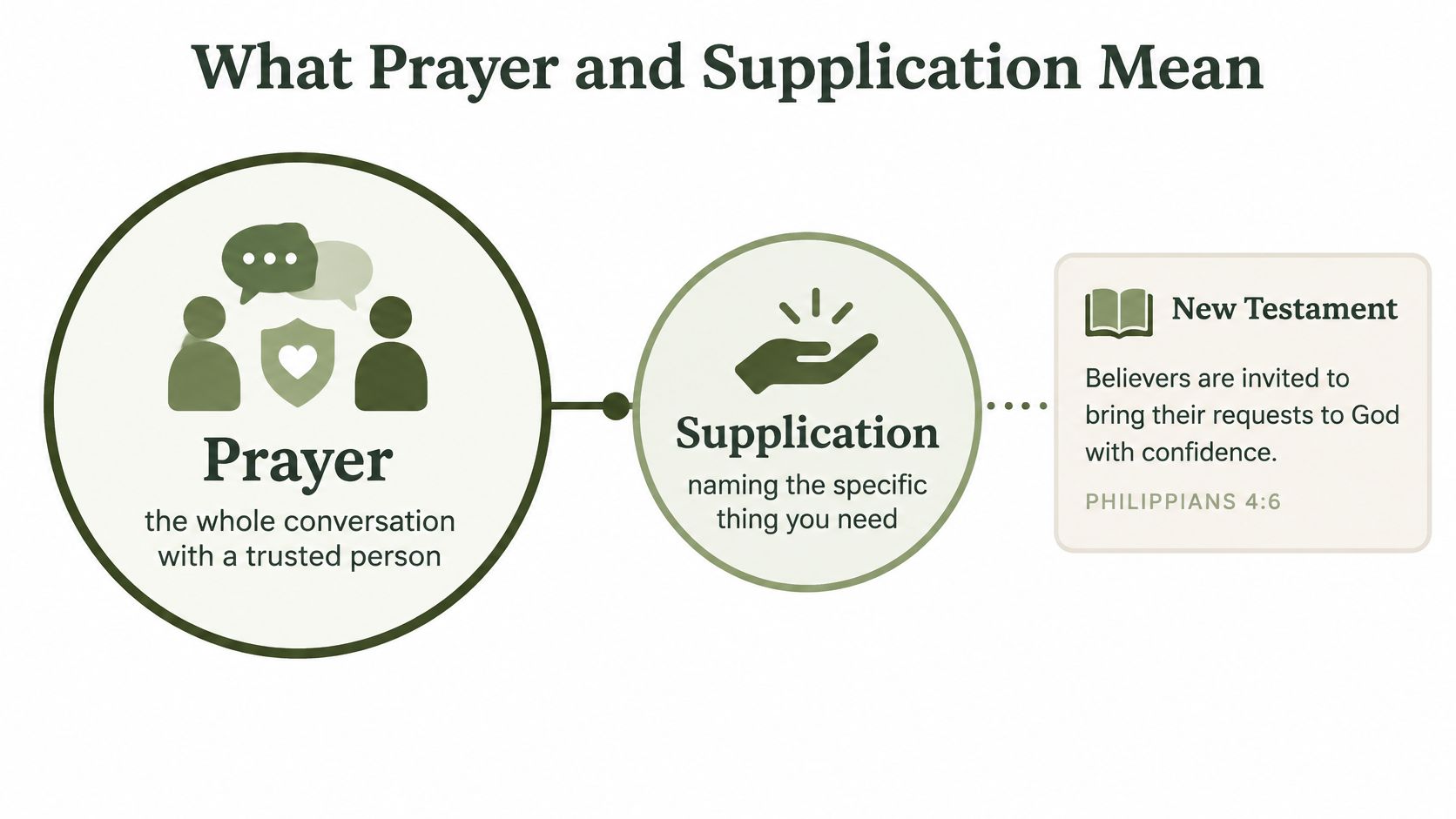
Think about a conversation with someone you trust. You might express appreciation, admit a mistake, describe something painful, or ask for help. The request belongs within the conversation, but it isn't the whole relationship.
That analogy helps distinguish prayer from supplication without making either mysterious. Prayer includes the full range of speaking and responding to God. Supplication names a felt need and brings it to him humbly.
The relationship between the terms is easier to see visually.
A request doesn't need stronger language
In Philippians 4:6 and Ephesians 6:18, the pairing commonly translated prayer and supplication uses proseuche for prayer and deesis for an entreaty or request. These terms help identify what the person praying is doing; they aren't special words you must pronounce.
Deesis carries the sense of asking from need. It can be urgent, but urgency doesn't mean volume, elaborate wording, or emotional pressure. A quiet request for courage before a difficult conversation can be supplication.
Humility also doesn't require self-contempt. You can acknowledge that you need help without describing yourself as worthless or assuming that distress proves you've disappointed God. The emphasis belongs on honest dependence, not on making yourself feel smaller.
Neighboring terms invite different responses
The list in 1 Timothy 2:1 helps fill out the conversation:
- Supplication brings a need to God.
- Intercession asks on behalf of another person.
- Thanksgiving names a good already received.
- Prayer serves as the broader language of approaching God.
These categories overlap in ordinary practice. You might ask for your own patience, pray for a colleague, and thank God for someone's kindness within the same conversation.
But the passage still matters. Matthew 7:7 invites asking, seeking, and knocking, so a request is a fitting response. Psalm 100 calls for joyful worship and thanksgiving, so turning every line into a demand would miss its emphasis.
The Hebrew prayer tradition expressed in the Psalms includes praise, petition, and complaint. Psalm 13 therefore needs more room than a neat definition of supplication can provide: the speaker brings the experience of abandonment into the prayer itself.
The posture determines what you say next. A request passage invites you to name a need; a praise passage invites you to attend to God's character. You aren't forcing every verse into the same template.
Five Postures Inside One Prayer
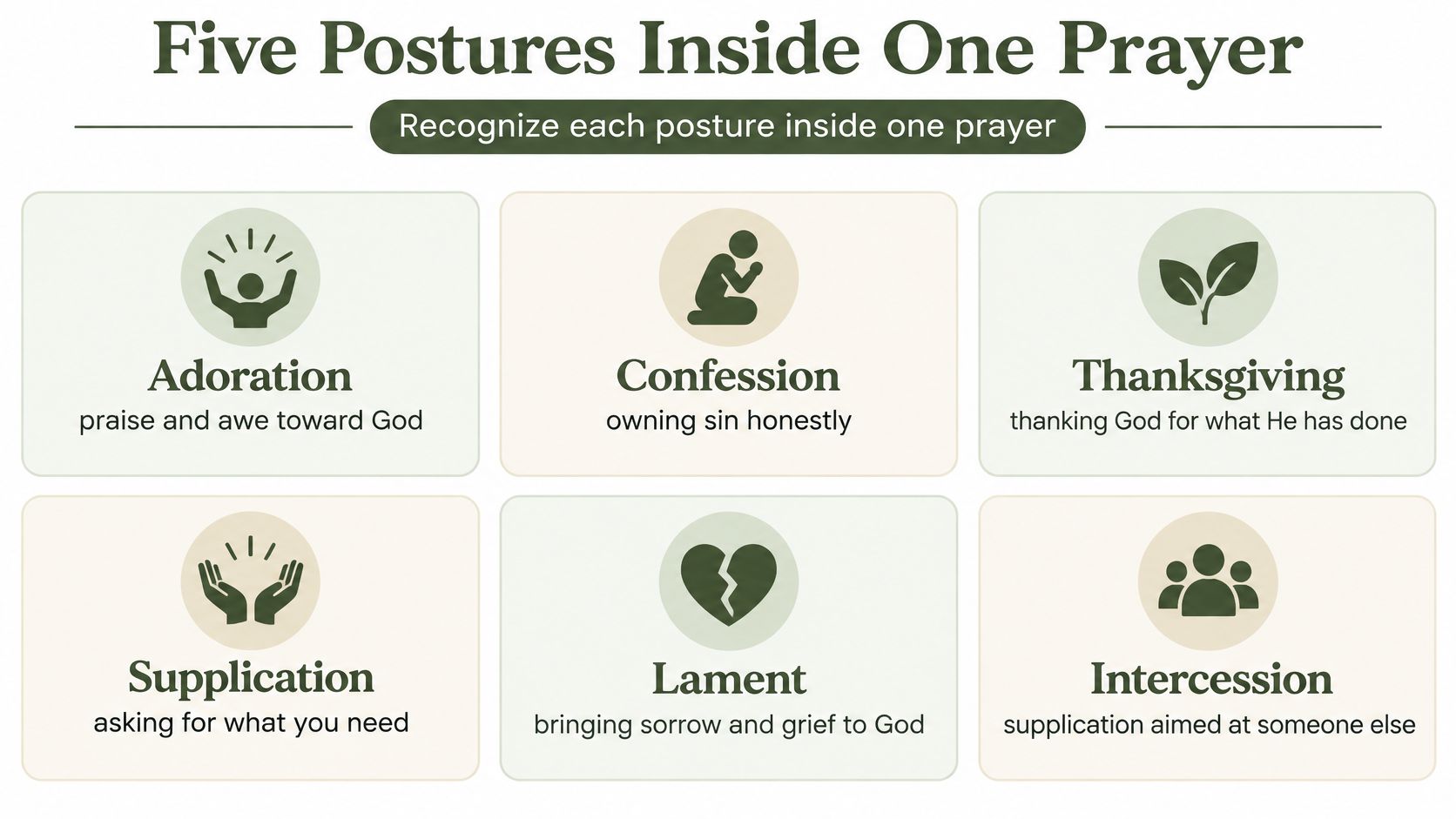
You can recognize different prayer postures by their purpose, not by how polished they sound. The following comparison also names a risk: not something wrong with the posture in itself, but something to watch for when it becomes your only way of praying.
| Posture | Purpose | Anchor passage | Risk if used alone |
|---|---|---|---|
| Adoration | Praise who God is | Psalm 145 | Can avoid an honest need |
| Confession | Name wrong and seek mercy | Psalm 51 and James 5:16 | Can deepen guilt without mercy |
| Thanksgiving | Name a specific gift | 1 Thessalonians 5:18 | Can feel false in grief |
| Supplication | Ask for one concrete need | Matthew 7:7 and Philippians 4:6 | Can raise anxiety about an outcome |
| Lament | Tell God the pain | Psalm 13 | Can become repetitive without room for trust or support |
| Intercession | Ask for someone else | 1 Timothy 2:1 | Can replace listening to that person |
Intercession appears alongside the other postures because it's useful to recognize separately, though it's a form of supplication directed toward someone else's need.
Hear the difference in ordinary words
Adoration might sound like this: God, you are faithful even when I can't see what comes next. Its purpose is attention to God's character, not avoidance of what hurts.
Confession is more direct about personal responsibility: I spoke cruelly to my sister. Please forgive me and help me repair what I can. It shouldn't become an endless rehearsal of wrongdoing with no room to receive mercy.
Thanksgiving names something particular: Thank you for the meal my neighbor brought. You don't have to call the whole situation good in order to recognize a genuine gift within it.
Let the situation guide the combination
Supplication might be: Please give me wisdom for tomorrow's appointment. The request is concrete, but it doesn't dictate what the appointment must reveal.
Lament makes room for words such as: I don't understand this loss, and I feel alone. A grieving person doesn't have to reach a tidy conclusion before the prayer counts as faithful.
Intercession turns attention toward another person: Please comfort Daniel and help his care team make wise decisions. Listening to Daniel afterward may be part of loving him well.
These postures are ingredients, not competing brands of prayer. You don't need to use every ingredient every time.
Philippians 4:6 combines asking and thanksgiving rather than making the reader choose between them. In practice, grief may need lament before petition, guilt may need confession before a request, and an ordinary moment of gratitude may need thanks rather than another ask. Don't rush the response just to complete a pattern.
How to Pray One Verse
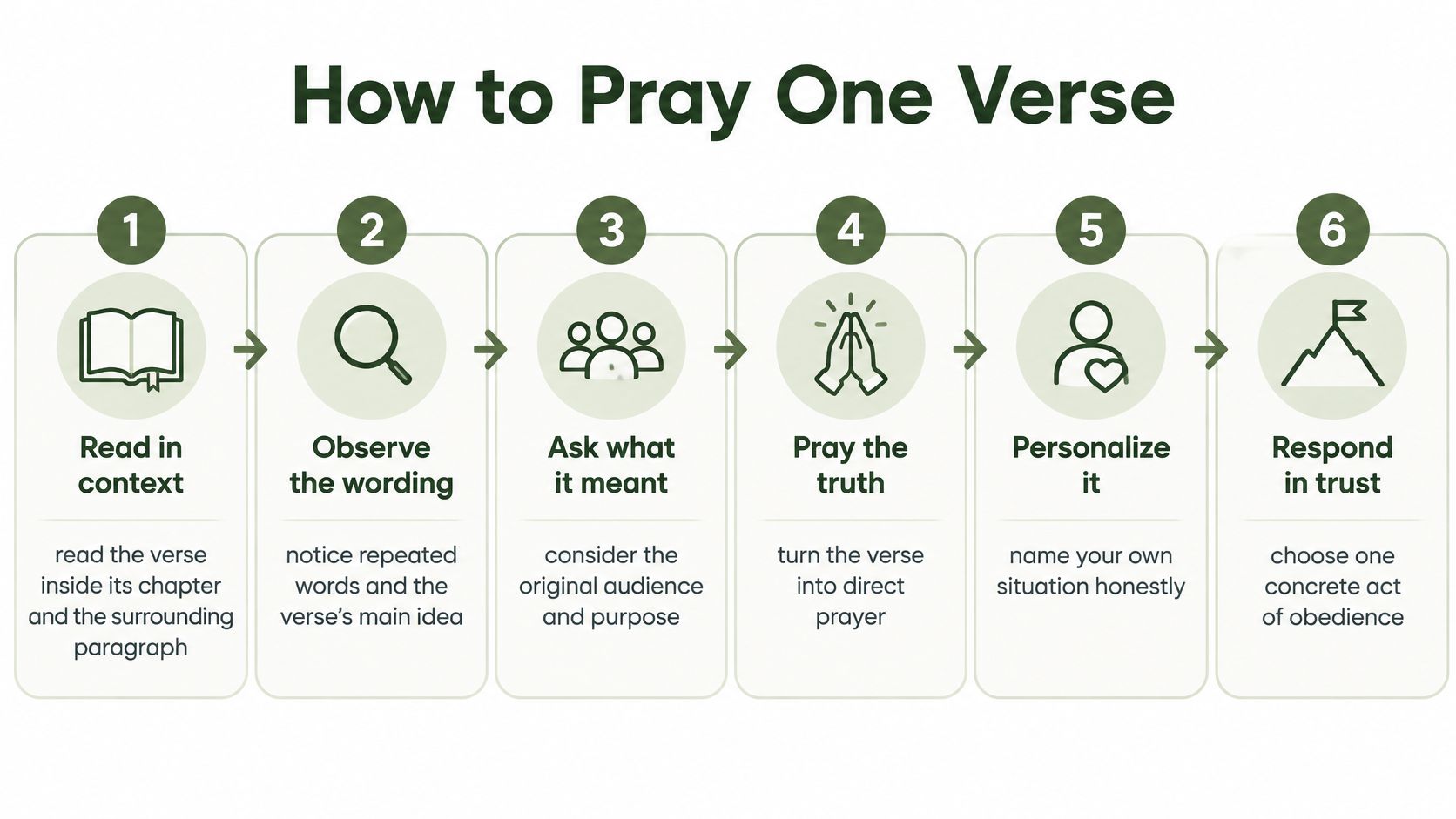
Use a sequence that moves from reflection to response. First attend to what the passage says; then connect that meaning to the actual person, concern, or gratitude you're bringing to God.
This visual offers a companion overview of reading, interpreting, and responding to Scripture.
Move from the passage to your response
Read in context. Read the surrounding paragraph, and continue through the chapter when you can. Notice who is speaking, who is being addressed, and whether the verse is a command, promise, description, or prayer. This helps you avoid treating someone else's particular experience as a guarantee about yours.
Name the posture aloud. Say request, thanksgiving, confession, lament, praise, or intercession. Naming it makes you pause before turning the verse into your usual kind of prayer.
Restate the theme in your own words. For Hebrews 4:16, you might write that believers are invited to approach God for mercy and timely help. Keep the sentence close to the passage rather than adding an outcome it doesn't name.
Make the response specific. Name the person, difficulty, wrong, or gift. Avoid petitions that intensify fear, guilt, or helplessness, and don't pray as though a verse guarantees a particular medical result. Asking for help while awaiting test results is different from declaring that the results must be favorable.
Include the passage's companion response. Add thanksgiving where the passage calls for it, or allow room for trust after honest complaint. Don't paste a cheerful ending onto sorrow merely because you feel uncomfortable leaving it unresolved.
Choose a fitting action. Rest, apologize, contact a trusted person, arrange care, or ask for qualified financial guidance. The action isn't payment for an answer; it's a responsible response to the situation you've named.
If beginning feels awkward, a short prayer before reading the Bible can help you approach the passage with attention rather than hurry.
Keep the expectation proportionate
A systematic literature review published by Springer examined 87 papers published between 2000 and 2020 and found associations between prayer and psychological well-being, but the evidence doesn't establish that prayer independently causes improvement. This practice can support meaning and consistency; it isn't treatment or proof of better mental health.
For a roughly minute-long example, read Hebrews 4:16 and identify its invitation to mercy. Then pray:
God, I need help with my worry about tomorrow's meeting. Please give me wisdom to prepare and courage to speak honestly. Help me accept support rather than carry this alone.
Finish by choosing someone to tell about the worry. You don't have to feel different before taking that step.
When Supplication Does Not Calm You
Why does praying for an outcome sometimes leave you more worried? The question deserves more than an instruction to pray harder or believe more strongly.
A person waiting for an answer may remain troubled, even while praying sincerely.

A nationally representative U.S. finding discussed in a paper on prayer and mental health associated support-focused prayers, including requests for health or financial aid, and belief that prayer solves problems with higher anxiety; praise and some expectations of answered prayer were associated with lower anxiety, while petition for others had no clear anxiety association. The same paper reports a study of 335 Polish single adults over six months that found no relationship between the prayer types examined and changes in anxiety or depression, while confession was linked to reduced psychological well-being among participants who already prayed.
In a study of 285 Polish Christian adults aged 18 to 60, thanksgiving correlated positively with psychological well-being, while supplication correlated negatively. These associations don't show that asking caused distress: people may ask more urgently because they're already suffering, an explanation called reverse causation.
Change the posture, not your honesty
If your request becomes a repeated bargain for certainty, consider changing what you say:
- Lament names the fear without disguising it.
- Thanksgiving acknowledges a real good without denying the difficulty.
- Surrender leaves the outcome with God while you take appropriate action.
These aren't techniques for making distress disappear. They offer language beyond repeating the same demand.
Scripture also makes room for requests that don't receive the outcome sought. In Matthew 26:39, Jesus asks that the cup pass while submitting to the Father's will; in 2 Corinthians 12:8-9, Paul repeatedly asks for relief from his thorn and receives an answer centered on grace.
Use the video as a further prompt for reflection, not a promise about what you should feel.
Don't turn peace into a test
You don't need to judge the sincerity of your prayer by whether your body relaxes afterward. Exploring what peace means in the Bible can help you avoid reducing a spiritual word to a required emotional sensation.
Prayer may support meaning and reflection, but it doesn't replace medical, psychological, financial, or pastoral care. If repeated praying accompanies worsening distress, tell someone qualified to help rather than assuming you need more forceful words.
Three Passages Prayed in Real Life
An unpaid bill
Say you've opened a bill you can't currently pay. Read Philippians 4:4-7, not verse 6 alone, and identify the posture as supplication with thanksgiving.
An unhelpful version assumes a promise the passage doesn't make: God, because I'm praying this verse, you must send the money before the deadline.
A revised prayer might be:
God, this bill is due, and I don't know how to cover it. Please provide what I need and give me wisdom about the options available. Thank you for the groceries already in my cupboard and the friend who offered to help me think. Keep me honest as I decide what to do.
The next action is practical: contact the billing office about a payment arrangement, review the budget, or seek qualified financial guidance. Don't treat taking action as a sign that your prayer was insufficient.
Grief after a loss
You've returned home after a funeral, and the quiet feels unbearable. Begin with Psalm 13:1-2, allowing its questions before reading the psalm's turn toward trust in God's steadfast love.
An unhelpful version suppresses sorrow: God, take this grief away now so I can prove that I trust you.
Try a prayer of lament instead:
God, this house feels empty, and I don't understand how to live with this loss. I feel forgotten tonight. I remember your care, but remembering doesn't make the absence stop hurting. Please help me receive companionship without pretending I'm fine.
Choose someone who can listen and ask whether they're available to talk or sit with you. The action isn't a solution to bereavement; it's a way to avoid carrying the evening alone.
Concern for a sick friend
A friend tells you that treatment decisions are becoming complicated. Read 1 Timothy 2:1 and identify your response as intercession.
An unhelpful version claims knowledge you don't have: God, I declare that this treatment will certainly cure my friend.
A more careful prayer is:
God, please have mercy on my friend. Give comfort through the uncertainty and wisdom to everyone involved in the decisions. Help the care team understand what is needed. Show me how to offer support that my friend actually wants.
Send a message asking whether a meal, a ride, or quiet company would help. Don't make your friend responsible for reassuring you.
For your own situation, write a short note with the passage, the posture, your specific words, and an action. Keep the wording honest enough that you can pray it.
Pray One Verse for Seven Days
Choose a situation, a posture, and a passage from the opening chart. Pray with that passage each day for a week, using the reading-and-response sequence rather than searching for a new verse whenever the words feel familiar.
Keep a simple tally of the days you finish. Don't grade eloquence, emotional intensity, or whether you received the answer you wanted.
Keep the practice small and honest
- Stay in context. Read the surrounding chapter during the week so the verse remains connected to its setting.
- Adjust when needed. If asking becomes bargaining, make room for lament, surrender, or a specific thanksgiving.
- Use a dependable cue. Attach the practice to breakfast, a lunch break, or settling down for the evening.
For more help choosing a cue, use these ways to build a daily prayer habit. The aim is a practice you can return to, not a streak you're afraid to break.
If your phone makes sustained reading difficult, our Scroll With God app can serve as a reminder: morning, midday, or evening notifications show the verse or your plan. Each verse includes a prayer drawn from it, and the app counts the days you say Amen.
The week is for attention and consistency, not a cure. If you're facing a medical, psychological, financial, or safety crisis, seek qualified help now rather than waiting until the week ends.
Scroll With God offers verse-linked prayers and the NIV, ESV, and KJV translations, so you can read a passage and respond to its meaning. Visit Scroll With God, choose a verse for your present situation, and begin with an honest request, lament, confession, or thanks.