How to Highlight Bible Verses: A Simple Color System
How to highlight Bible verses with a four-color system, a five-step method, and fixes for cluttered Bibles in print or digital.
In this article
- A Four-Color System to Start With
- Two Colors Readers Often Confuse
- How to Highlight a Verse in Five Steps
- Why restraint beats volume
- Print Bibles Versus Digital Apps
- What to do differently in print
- What to watch on a phone or tablet
- Mark Verses Without Relying on Color
- A non-color system you can copy
- Fixing a Cluttered or Outdated Highlight System
- One cleanup routine
- Mark Your First Verse This Week
You open your Bible, highlighter in hand, determined that this time you'll build a system you'll use. Three chapters later, half the page is yellow, a few verses are pink for reasons you can't recall, and you're already wondering whether you should start over. That's not a discipline problem. It's usually a system problem.
Knowing how to highlight Bible verses well means making fewer, clearer marks you can find and understand later. I recommend starting small, writing down what each mark means, and accepting from day one that some highlights will need correcting as your understanding grows.
A Four-Color System to Start With
Most rainbow systems fail for a boring reason. You have to remember too many categories while you're trying to read. Four colors give you enough distinction without turning every verse into a filing decision.
| Color | Marks | Example verse |
|---|---|---|
| Yellow | Promises and facts about God | John 3:16, God's love and the gift of eternal life |
| Blue | Commands to obey | Micah 6:8, act justly, love mercy, walk humbly |
| Pink | Warnings, sin and conviction | Proverbs 16:18, pride goes before destruction |
| Green | Growth and prayer prompts | Philippians 4:6-7, bring requests to God in prayer |
Yellow is for what is true about God or what He has promised. John 3:16 belongs here because the center of the verse is God's love and gift, not an instruction to you. When you later flip through yellow marks, you should get a record of God's character and commitments.
Blue is for obedience. Micah 6:8 tells you to act justly, love mercy, and walk humbly. If a verse mainly asks you to do, stop, forgive, give, speak, or refrain, blue keeps that action visible.
Two Colors Readers Often Confuse
Pink and green can blur if you don't define them tightly. Use pink for warnings, sin, and conviction, such as Proverbs 16:18 on pride going before destruction. Use green for growth, examples to follow, and prayer prompts, such as Philippians 4:6-7 on bringing requests to God in prayer. Ask a simple sorting question. Is this mainly alerting me to danger, or is it mainly showing me a healthy response?
Highlighting works best as active engagement, a way to return to, compare, remember, and apply a passage, and there's a large audience reading this way. The American Bible Society's 2025 State of the Bible release found that in a survey of 2,656 American adults, two-thirds of Bible Users accessed the Bible digitally at least some of the time and 62% of digital Bible Users used Bible apps.
Write this key inside the front cover of a print Bible or at the top of your notes in an app. Don't trust your memory across months or years. And don't add a fifth color in week two because you found a verse that feels different. Most verses fit one of these four jobs well enough, and "well enough" is what keeps a system alive.
How to Highlight a Verse in Five Steps
The central skill isn't choosing a color. It's choosing the smallest meaningful unit. A whole paragraph in yellow tells future you almost nothing. A short clause, marked for a stated reason, gives you something to retrieve.
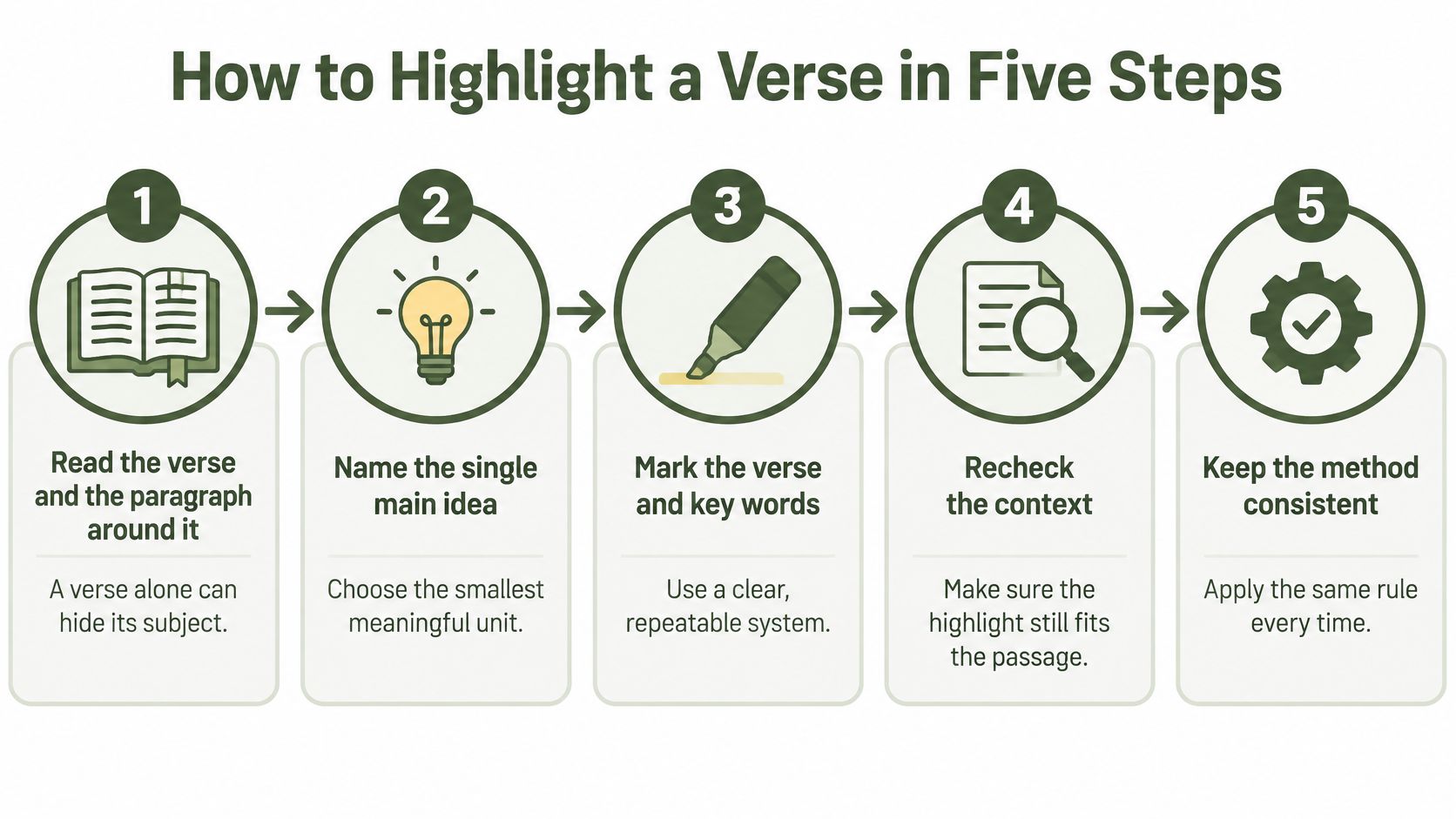
Read the verse and the paragraph around it. A verse read alone can hide who is speaking, who is being addressed, or what problem the writer is answering. Read at least the surrounding paragraph before you mark anything. The common slip is highlighting an encouraging sentence that, in context, is part of a warning or an argument.
Name the single main point with one question. Ask, "What is the main promise, instruction, or truth here?" If you can't answer in plain words, you're not ready to highlight. This question also chooses your color for you, because a promise, a command, a warning, and a prayer prompt point to different marks.
Highlight only the key clause, usually 5 to 15 words. Mark the words that carry the point, not every supporting phrase around them. In a long verse, that may be the result clause rather than the setup. Marking everything feels thorough in the moment, but it buries the very words you wanted to stand out.
Add a short note saying why it matters. Write one sentence in the margin or note field, such as why the promise helps, what obedience would look like this week, or what question remains. A bare color says "important." A note says why. Six months later, that difference decides whether the highlight teaches you anything. If you're torn between two readings, write the question in the note instead of guessing, then settle it on a later reread.
Revisit it by recalling first, then rereading. Before you look, try to state the verse's point from memory. Then reread the verse in context and check yourself. If your memory added a promise the text didn't make, correct the note rather than keeping the nicer version.
Practical rule: If you can't explain a highlight in one sentence without looking, the mark is doing decoration, not study.
Why restraint beats volume
Constrained marking has evidence behind it. A meta-analysis indexed by ERIC covered 36 studies and found learner-generated highlighting improved memory with an average effect size of 0.36, but didn't reliably improve comprehension. Follow-up experiments point the same direction: readers required to mark only a few lines per passage did better on delayed tests than readers free to mark as much as they liked. The lesson isn't that highlighting is magic. It's that limits force selection, and selection is where the learning happens.
Give yourself a soft budget of a few highlights per chapter. That cap makes you compare verses instead of collecting them, and it pairs naturally with learning how to study the Bible verse by verse in context rather than as isolated lines. When every page glows, nothing signals priority. When only a few clauses glow, each one earns a second look.
Treat your highlights as a working record, not a finished exhibit. A mark you can explain in one sentence is a line you can find, trust, and act on later.
Print Bibles Versus Digital Apps
The method doesn't change between paper and screen. The risks do. Print punishes hasty ink, while digital tools make marking so easy that restraint disappears.
| Factor | Print Bible | Digital app |
|---|---|---|
| Permanence | Permanent once inked; hard to undo | Editable or removable with one tap |
| Finding a verse | Flip pages or use the index | Search by word, reference or saved list |
| Backup | Lost if the book is damaged | Set by the app; check its backup settings |
| Space for notes | Small margins | Longer notes in a dedicated field |
| Revision | Pencil and careful erasing | Edit or delete any time |
What to do differently in print
Test any marker on a blank page at the back before you use it in the text. Thin Bible paper can bleed through and shadow the next page, and you won't know until the ink settles. If you're unsure about an interpretation, start with a light pencil underline and upgrade only after you've reread the passage.
Print retrieval is slower, so build your own index. Keep a short theme list on the inside back cover or in a journal, with references grouped under headings like promises, prayer, forgiveness, and warnings. Ten careful entries beat a beautiful system you can't search.
What to watch on a phone or tablet
The digital move is simple. Press and hold the verse, drag across only the key words, choose one of your four colors, then add the why note before you scroll on. Don't save the note for later, because later you'll remember the feeling but not the reason. If you're choosing a tool, a guide to finding a Bible study app for beginners can help you weigh features without buying more complexity than you'll use.
Backup deserves a direct check. We store saved verses, personal prayers, reading history and preferences on the user's device, and the app has no account or cloud backup. Whatever app you use, copy your most important verses and notes into a journal every few months, because a lost phone shouldn't erase years of study.
Many readers settle on both. Print suits slow study at a desk. An app suits daily reading, travel, and quick review. Use the same four meanings in both places and they'll reinforce each other instead of becoming rival systems.
Mark Verses Without Relying on Color
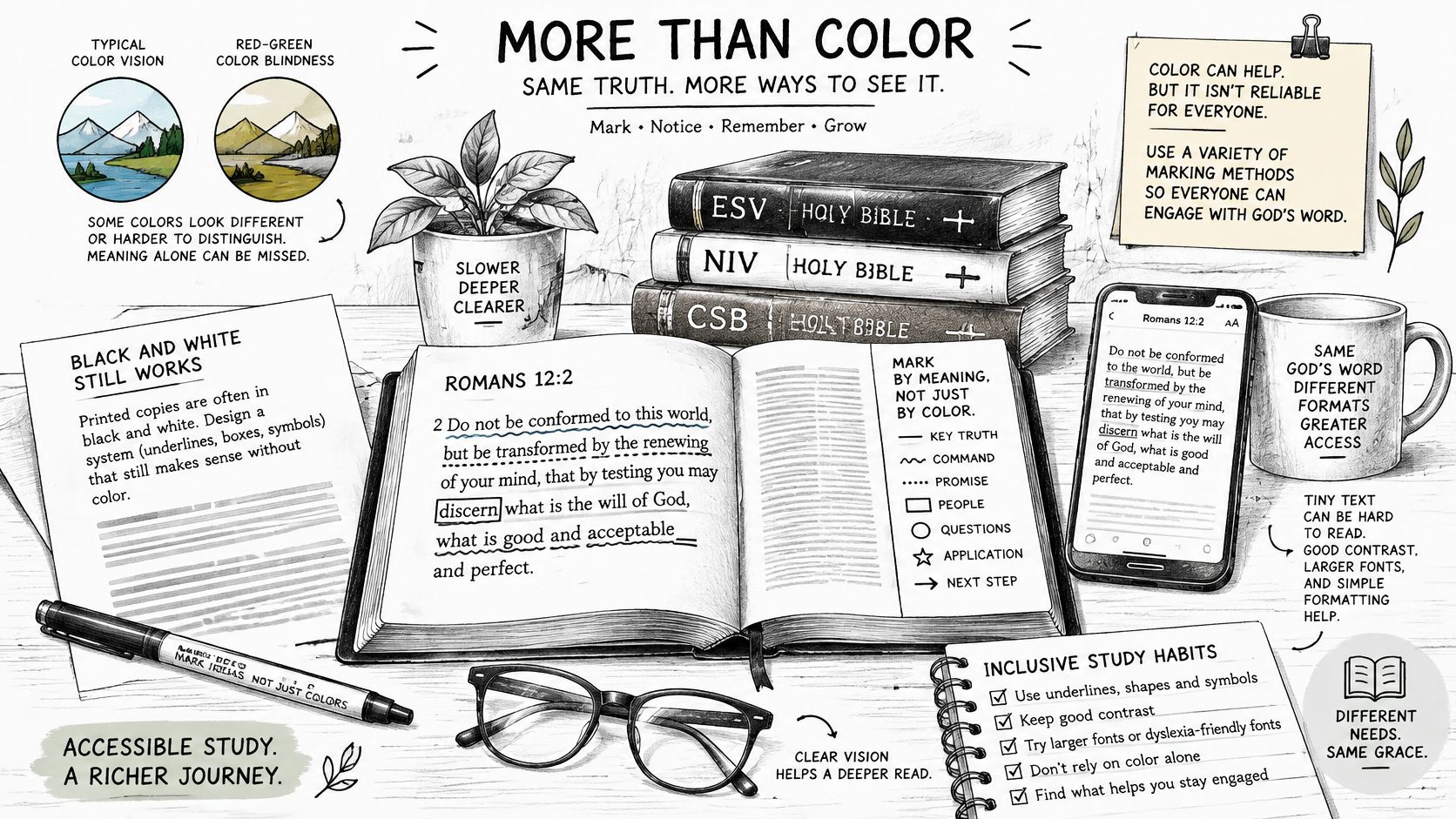
Color fails in ordinary situations. Color-vision differences can make pink and green hard to separate, dyslexia can make some color overlays harder to read, and small phone screens shrink subtle shades into guesswork. Black-and-white printing strips your system entirely. Different paper can also shift how a marker looks.
This illustration shows a desk setup built around visible, repeatable marks rather than color alone.
A non-color system you can copy
- Solid underline: an observation you're confident about after reading the context.
- Dotted underline: a possible point you're still testing and don't want to make permanent.
- ? in the margin: an interpretation, word, or connection you need to check.
- Star in the margin: a verse you want to memorize or revisit this week.
- Arrow in the margin: a personal application, pointing from the text toward a concrete action.
- One-word tag: a label such as promise, prayer, or warning written beside the verse or in the note field.
These signals survive photocopies, dim light, and a change of app theme. They also carry information color can't carry alone. A dotted underline says something honest about certainty, and an arrow distinguishes "this is true" from "I need to act on this Tuesday."
A good mark should still make sense if someone photocopied the page in black and white.
Watch this short walkthrough, then test the marks on a single chapter before adopting them everywhere.
After that test chapter, reread your marks two days later. If you can tell confident observations from open questions at a glance, keep the system. If your symbols collide or slow you down, cut one. Accessibility isn't a separate feature here. It's whether future you can read the record you made.
Fixing a Cluttered or Outdated Highlight System
A cluttered Bible doesn't mean you studied badly. It often means you studied while your questions, vocabulary, and judgment were changing. Revising an old highlight isn't spiritual failure. It's evidence that rereading taught you something.
| Symptom | Likely cause | Fix |
|---|---|---|
| Almost every verse is marked | Marking by emotion, not meaning | Keep only the central clause of each verse |
| Colors no longer mean anything | Too many colors and no key | Cut to four colors and write the key inside the cover |
| An old note seems wrong | Understanding changed with study | Add a dated correction and keep the original |
| A mark with no memory of why | No note was attached | Add a short why note on the next reread |
| Highlights are hard to find | No index or theme list | Keep a list of key verses by theme in the back of the Bible |
Should you highlight everything that moves you? No. Emotion is a fine reason to pause, but it's a poor filing system. Mark the clause that best carries the passage's point, and let strong feelings go into the note, where you can name them.
Can notes be corrected? Yes, and you should correct them visibly. Add a dated note such as "Reread with chapter context, this is a warning, not a promise," and keep the original where possible. That record shows how your reading matured and stops you from mistaking an early impression for settled conviction.
Annotation certainly isn't rare. A YouVersion announcement reported by PR Newswire said an average of 112 Bible verses were highlighted, bookmarked, or noted every second in 2025. Volume alone doesn't tell you whether readers can retrieve or revise those marks later, which is why cleanup matters.
One cleanup routine
Pick one book, not the whole Bible. Reduce each highlight to its central clause, remove or recode any color that no longer matches your key, and convert shaky interpretations to a question mark or pencil mark. Date corrections instead of erasing them, then list the surviving key verses by theme.
Stop after that one book and use the cleaner system for a few weeks. If it holds, clean the next book. A tidier Bible isn't a scorecard. It's a study record you can trust because it shows both what you noticed and what you revised.
Mark Your First Verse This Week
You don't need a new Bible, a fresh notebook, or a free Saturday. You need one chapter and seven small passes through it.
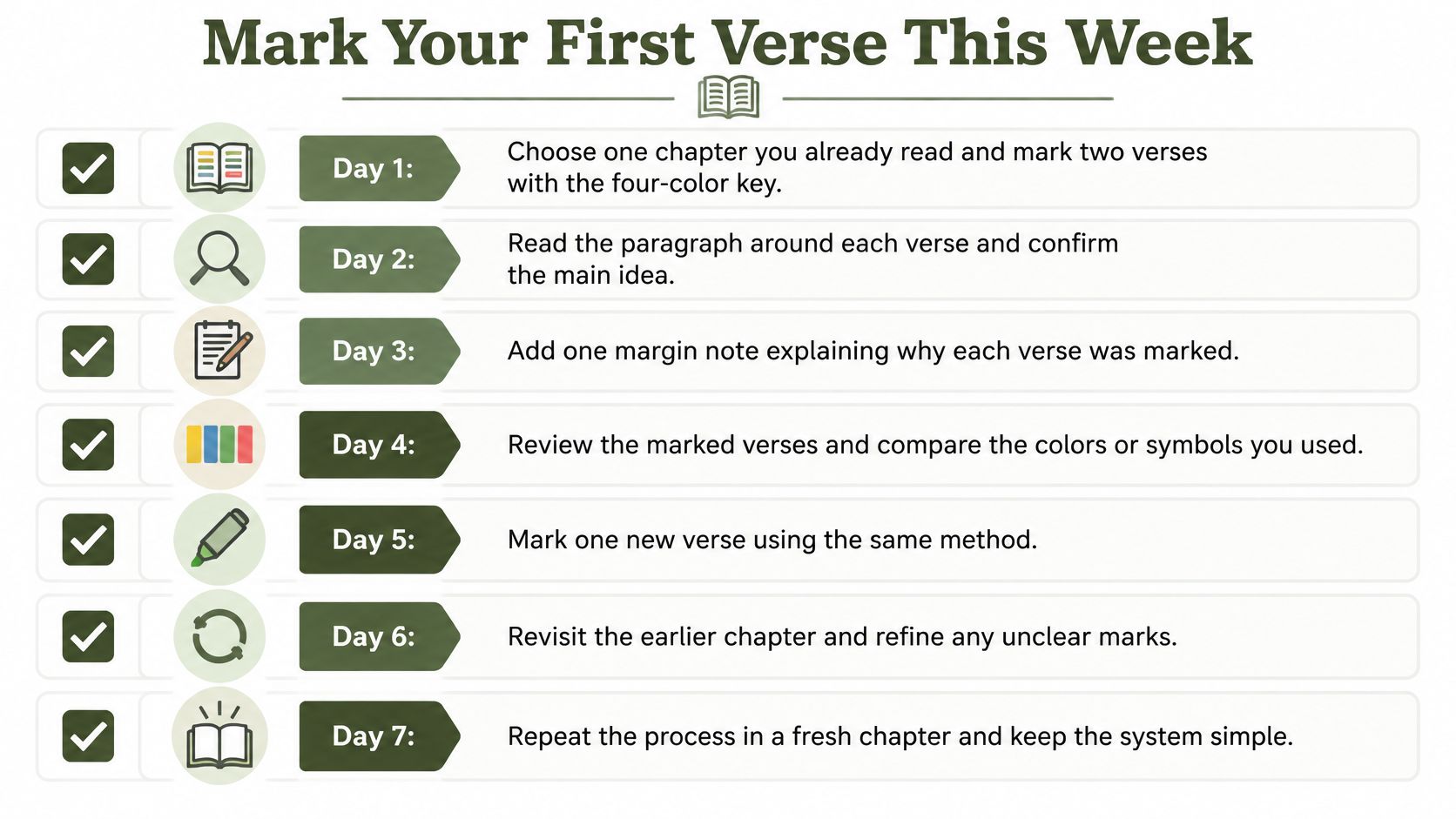
- Day 1: Choose one chapter you've already read and mark two verses with the four-color key.
- Days 2 to 4: Add one note per verse using the why-it-matters prompt.
- Day 5: Recall each highlight's meaning before rereading it, then check the text.
- Day 6: Move any uncertain marks to a question mark or dotted underline.
- Day 7: Write the three most important highlights in one short theme list.
Small repetition matters more than occasional intensity. The American Bible Society's State of the Bible 2025 chapter on flourishing reported daily Bible readers scored 7.9 on its human-flourishing measure, compared with 6.8 among people who never read the Bible. It also found 66% of people who used the Bible four or more times per week strongly agreed it influenced them toward more loving behavior, compared with 22% of monthly users. Those are associations, not proof that reading alone caused the differences, so don't turn them into a promise. Use them as a reason to choose a repeatable practice you'll still be doing next month.
That practice deepens when you slow down long enough to meditate on Scripture instead of only collecting verses. On a phone, Scroll With God is one option among several. You can use it without creating an account, and bookmarks, likes and notes are collected in one library, which keeps this week's marks easy to revisit.
Choose tomorrow's chapter now. Read it once, mark one verse before you close your Bible or app, and write one sentence explaining why. That's a system. Everything else is refinement.
Start with one verse tomorrow, mark only its central clause, and add one sentence about why it matters. Scroll With God keeps your bookmarks, likes, and notes in one library without requiring an account, so the verses you mark stay easy to find when you return to them. Visit Scroll With God and make your first careful highlight today.