What Is a Bible Verse About Friendship? a Clear Answer
What Is a Bible Verse About Friendship? Proverbs 17:17 and John 15:13 explained, with their setting, meaning and when to use each verse.
In this article
- Proverbs 17:17 Gives the Clearest Answer
- Three Ideas Inside One Sentence
- Friendship Verses at a Glance
- How to Use the Table Well
- The Ancient Setting Behind Proverbs 17:17
- Why Adversity Is at the Center
- What John 15:13 Adds About Costly Friendship
- The Words Behind the Verse
- Proportionate Sacrifice and Its Limits
- Faithful Correction in Proverbs 27
- What Faithful Correction Actually Looks Like
- Warning Signs of Control or Cruelty
- Loneliness and Friendship That Feels Out of Reach
- A Gentle Action Plan
- Choose One Verse to Practice This Week
Proverbs 17:17 is the verse often meant when someone asks what is a Bible verse about friendship, and it reads, "A friend loves at all times, and a brother is born for adversity." A true friend, it says, stays loyal in every season, and hard times show whether that loyalty is real.
So why do most lists stop at the quotation? A verse can sound kind and still leave you unsure what to do when a friend disappears, corrects you sharply, or needs help you don't know how to give. The better question isn't only which verse mentions friendship. It's which verse fits the situation you're facing.
Proverbs 17:17 Gives the Clearest Answer
Proverbs 17:17 says, "A friend loves at all times, and a brother is born for adversity." In plain words, real friendship doesn't appear only when life is easy. It holds steady when there's loss, stress, illness, or conflict to carry.
That's a different picture from friendship based on shared interests alone. You can enjoy someone's company, laugh at the same things, and still not know whether they'll answer the phone when you're in trouble. This proverb asks you to judge friendship by steadiness under pressure, not by warmth in good weather.
Three Ideas Inside One Sentence
First, friendship is a steady commitment, not a mood. Feelings rise and fall with tiredness, disappointment, and busy schedules. Loving "at all times" points to a person who keeps showing care even when convenience fades.
Second, adversity is the test. Hardship doesn't create loyalty out of nothing. It reveals what was already there. Someone who stays present, offers practical help, and tells the truth kindly during a crisis shows a different kind of bond from someone who only appears for celebrations.
Third, the verse sets two relationships side by side. A brother's bond comes through family. A friend's bond is freely chosen and kept over time. Both matter, but they work differently. Family duty can pull a relative toward you in trouble. A friend stays because they've chosen to belong to your life and keep choosing it.
Practical rule: When you're unsure about a friendship, don't only ask whether you enjoy this person. Ask who stays present when things get hard.
Proverbs is a book of wisdom sayings, and that matters for how you read it. Wisdom sayings describe how life generally works. They aren't promises that every person who calls you a friend will behave this way, and they aren't guarantees that loyalty will always be returned. They're a standard for recognizing genuine friendship and for becoming that kind of friend yourself.
Use Proverbs 17:17 as your starting point. From there, you can compare other verses that address different needs, including loneliness, honest correction, and costly care. Each one adds something this foundational verse doesn't spell out on its own.
Friendship Verses at a Glance
Think of the table below as a lookup, not a collection to memorize in one sitting. Find the situation closest to yours, note the verse, and then read it in its full chapter before you quote it to anyone. That habit keeps a short line from being turned into advice the passage never meant to give.
| Verse | Core message about friendship | Best fit |
|---|---|---|
| Proverbs 17:17 | A friend loves at all times, and adversity shows real loyalty | Hard seasons, loss and pressure |
| Proverbs 18:24 | A dependable friend is rare and worth more than many companions | Looking for a close, reliable friend |
| Ecclesiastes 4:9-10 | Two people help each other up when one falls | Facing a difficult task alone |
| Proverbs 27:17 | One person sharpens another, as iron sharpens iron | Growing in faith or character with a friend |
| Proverbs 27:6 | A friend's wounds are faithful, while flattery deceives | Needing or giving honest correction |
| John 15:13 | Greatest love is laying down one's life for friends | Costly, sacrificial care |
| Proverbs 27:10 | A nearby neighbor can help more than a distant relative in trouble | Moving, distance or strained family support |
Notice that these verses aren't interchangeable. Ecclesiastes 4:9-10 fits practical help, such as facing a move, a repair, or a demanding project without support. Proverbs 27:17 fits growth, where a friend's influence makes you wiser or stronger in character. Sending the sharpening verse to someone who needs help carrying boxes would miss the point, even though both passages concern companionship.
How to Use the Table Well
- Read the chapter first: Check the verse in its surrounding passage so you understand who is speaking, who is being addressed, and what situation is in view. If you're unsure how nearby passages connect, our guide to what a cross-reference in the Bible is explains how related verses clarify one another.
- Match the situation, not the familiarity: Choose the verse whose problem resembles yours rather than the one you've heard most often at weddings, graduations, or on social media.
- Read two when both fit: A painful conversation might call for both Proverbs 27:6 on honest correction and John 15:13 on costly love, so note the overlap instead of forcing a single answer.
The sections below use this table as a map. They slow down on the setting behind Proverbs 17:17, then look closely at sacrifice, correction, and loneliness, so you can see why each verse belongs in its row.
The Ancient Setting Behind Proverbs 17:17
Proverbs 17:17 comes from Israel's ancient wisdom tradition. The sayings in Proverbs were gathered and taught over time, not written as modern greetings about companionship. Proverbs 25:1 says that officials in King Hezekiah's court copied additional sayings attributed to Solomon, a detail that points to the book's long history of preservation.
That history helps explain why the proverb is framed as practical guidance. Its words were passed from one generation to another as a way to think about how people should live together.

Why Adversity Is at the Center
In the ancient Near East, households relied on relatives, allies, and neighbors during famine, invasion, and political conflict. Support could mean sharing food, offering shelter, providing protection, or speaking on someone's behalf. In that setting, friendship involved more than affection or pleasant company. It meant dependable help when circumstances became difficult.
Consider a farmer whose harvest fails during a drought. A neighbor who shares grain accepts a real cost, especially when supplies are scarce. The contrast is clear: kind words in a plentiful year are easy; sharing what is needed in a hard year shows commitment.
Adversity isn't an interruption to friendship in Proverbs. It's the moment friendship becomes visible.
The proverb places a brother and a friend side by side. A brother's duty comes through family ties, which carried strong expectations of support. A friend's commitment is freely chosen and shown through steady action. The saying values both bonds: each can bring help when trouble comes.
Proverbs returns to friendship, loyalty, counsel, and harmful influence throughout the book. Proverbs 17:17 belongs to that wider teaching pattern, where relationships are measured by the choices people make, especially under pressure.
For readers today, the setting clarifies why adversity matters without limiting the verse to ancient farming life. The form of hardship may change; the question remains whether a friend stays present when support is needed.
What John 15:13 Adds About Costly Friendship
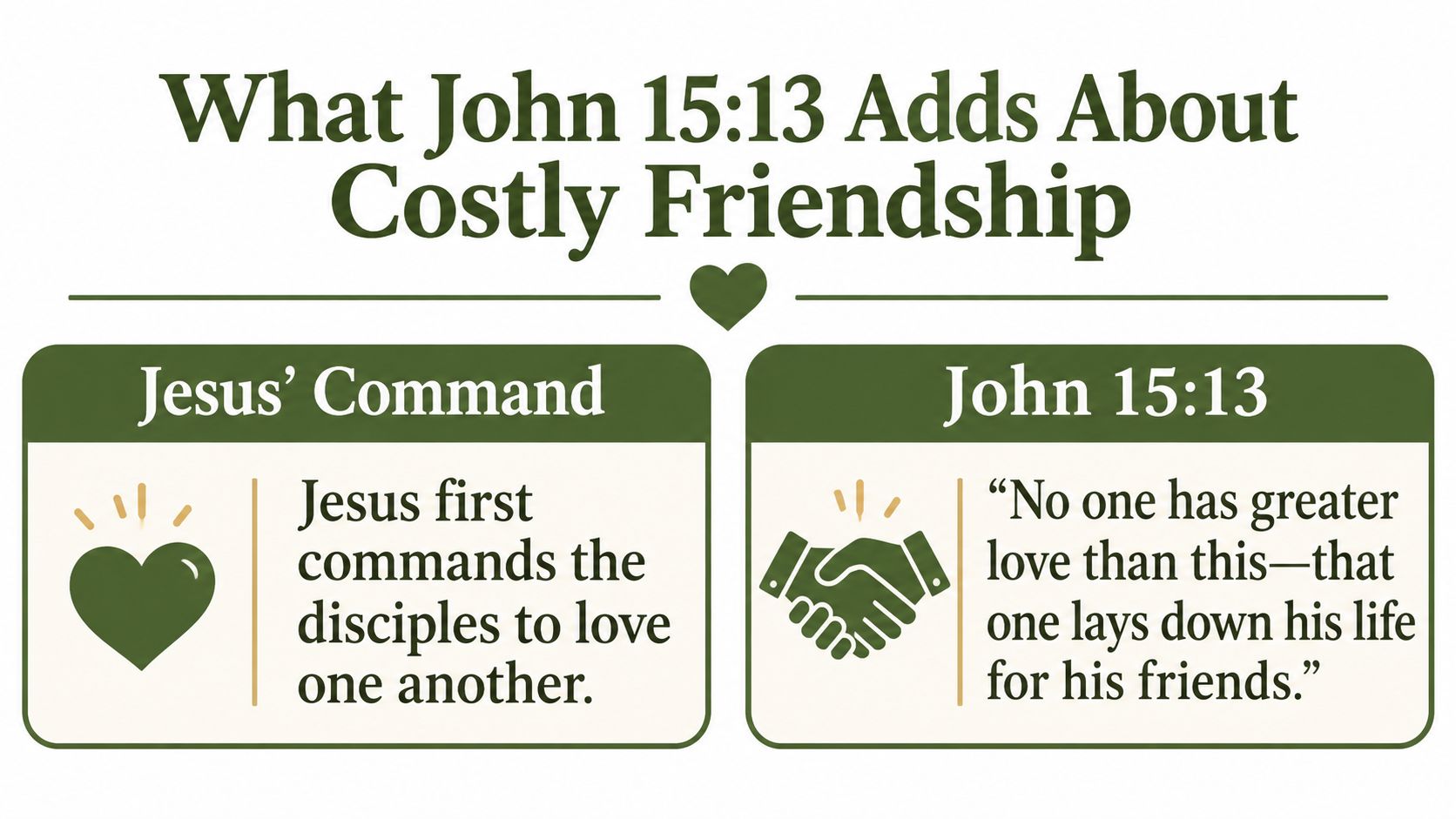
John 15:13 says, "No one has greater love than this, that one lays down his life for his friends." You can read the verse alongside its surrounding passage in John 15 on BibleGateway, where Jesus first commands the disciples to love one another. Only then does he name sacrificial action as the highest expression of that love.
The order matters. Sacrifice isn't presented as a dramatic extra for unusually devoted people. It's the fullest form of the everyday command to love. The graphic below separates the command from the verse so you can see that sequence clearly.
The Words Behind the Verse
The Greek text uses agapē for "love" and philōn, a plural form related to "friends." You don't need Greek to grasp the point, but the pairing helps. This is love directed toward people Jesus is about to call his friends, not an abstract feeling about humanity in general.
In the verses that follow, Jesus identifies the disciples as his friends and links that friendship with obedience and disclosed knowledge. In plain language, they aren't kept at a distance like servants who only receive orders. They're told what their Teacher knows. Friendship here includes trust and being let in, not only being helped.
That gives the passage three linked parts. First, there's benevolent intention, a genuine willing of the friend's good. Second, there's concrete sacrifice, action that costs something real. Third, there's relational trust, the closeness in which knowledge and obedience are shared. Remove any one part and the picture shrinks.
The cause and effect is straightforward. Love becomes demonstrable when it accepts a real cost for another person's welfare. That's why friendship in John 15 is more than affinity, shared interests, or emotional closeness. Those things can exist without sacrifice. Jesus points to love that gives.
For a guided walk through how this teaching is read and applied, watch the video below before considering the everyday examples.
Proportionate Sacrifice and Its Limits
Most readers won't face a literal life-or-death choice for a friend. That doesn't make the verse unusable. It means you apply it proportionately, at the scale of the need in front of you.
- Protect a vulnerable friend: Speak up when someone is being mocked, misrepresented, or pressured, even if staying silent would be easier for you.
- Give time during a crisis: Sit in a hospital waiting room, drive someone to appointments, or bring meals during a family emergency.
- Tell the truth compassionately: Say the hard thing your friend needs to hear, in a way aimed at their good rather than your relief.
- Accept inconvenience: Change your plans, spend your money carefully on their behalf, or take on an unglamorous task they can't manage alone.
The verse doesn't require reckless self-harm, and it doesn't ask you to enable abuse. Laying down your life for a friend's genuine good is different from destroying your health to keep someone comfortable in harmful behavior. It also doesn't mean absorbing mistreatment and calling it love. Sacrifice that helps someone continue in harm isn't life-giving for either person.
Benchmark question: Does this sacrifice serve my friend's real and lasting good, or does it only avoid conflict in the moment?
Ask that before you act. If the answer is your friend's genuine good, and the cost is yours to give without neglecting clear duties elsewhere, you're in the spirit of John 15:13. Purposeful, life-giving sacrifice is the standard, not self-destruction dressed up as devotion.
Faithful Correction in Proverbs 27
A common assumption is that a loving friend never says anything uncomfortable. Proverbs 27 challenges that, but it's also easy to misuse. Some people quote these verses to justify blunt criticism, public shaming, or a running commentary on someone else's life. That's the misreading to name first.
Proverbs 27:5-6 teaches that open rebuke is better than hidden love, and that a friend's wounds are faithful while an enemy's kisses are deceitful. Proverbs 27:9 adds that a friend's heartfelt counsel is sweet. Put together, the passage values honesty that comes from people who care, and it warns against flattery that feels pleasant but leads nowhere good.
What Faithful Correction Actually Looks Like
These verses describe trustworthy, relationally grounded correction. It's spoken by someone who knows you, has your good in mind, and has earned the standing to say a difficult thing. It usually happens privately. It names a specific concern rather than attacking your character. It aims at restoring you, not at winning an argument or relieving the speaker's frustration.
Receiving it can still sting. That's why the proverb calls it a wound. But a wound from a friend differs from a wound from an enemy because of the motive and the relationship behind it. The friend wants you well. The flatterer wants you pleased, which isn't the same thing.
Before you correct a friend, run through three self-check questions.
- Am I correcting to restore, or to win? If part of you wants to prove you were right all along, wait until that motive settles.
- Have I earned enough trust to speak? Counsel lands differently from someone who has been present, consistent, and kind over time.
- Would I want this said to me in this way? If the wording would feel humiliating in reverse, rewrite it before you say it.
Warning Signs of Control or Cruelty
Correction crosses a line when it's delivered as public humiliation, repeated criticism without invitation, or words that mainly serve the speaker's pride. If someone corrects you constantly, ignores your requests to stop, and grows colder when you don't comply, you're not looking at faithful wounds. You're looking at control.
Boundaries belong here too. Forgiveness and reconciliation don't require remaining close to someone who is abusive or persistently harmful. You can wish a person well, release a grudge, and still step back for your own safety. Loyalty in Proverbs never asks you to stay within reach of ongoing harm and call that faithfulness.
Faithful friendship sometimes sounds hard before it sounds kind. The test is the motive and the relationship behind the words.
If you're the one receiving correction, pause before you defend yourself. Ask whether this person has shown steady care, whether the observation is specific, and whether acting on it would make you healthier or more honest. If yes, receive it slowly. If the pattern is mainly shame and control, you're allowed to set a limit and seek counsel from someone safer.
Loneliness and Friendship That Feels Out of Reach
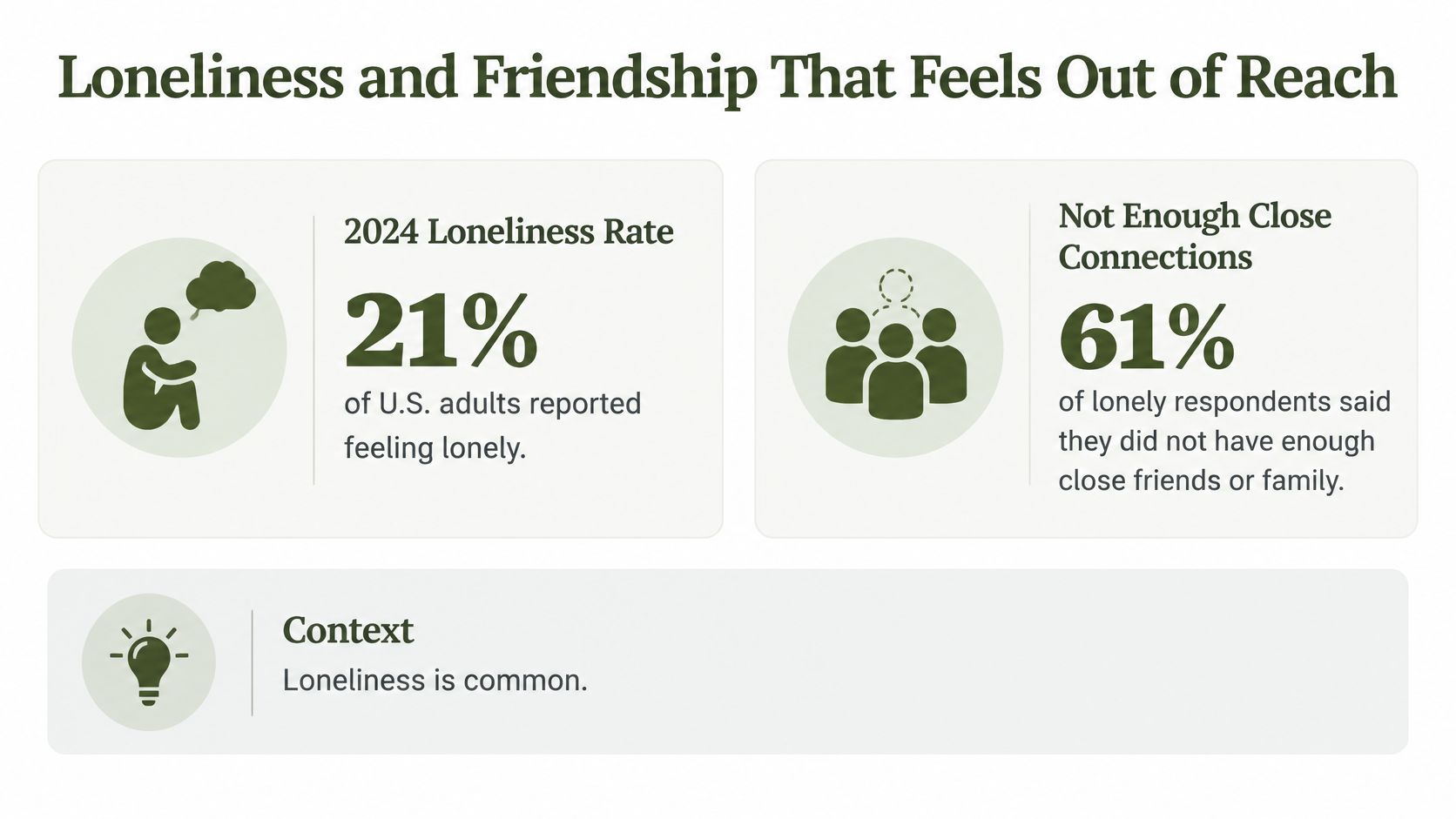
If you're reading about friendship because you don't have enough of it, you're not unusual. In 2024, 21% of U.S. adults reported feeling lonely, while 61% of lonely respondents said they did not have enough close friends or family, according to Harvard University's Making Caring Common report. Loneliness at that scale isn't a rare personal defect. It's a common human experience.
The infographic below puts those two figures side by side.
John 15:15 offers real comfort here. Jesus calls his followers friends, people who are known and let in rather than kept at a distance. For someone who feels excluded or unseen, that belonging can sustain them through a difficult season. It's not a small thing.
But it shouldn't be used to dismiss the need for human companionship. Telling a lonely person that Jesus is their friend, and then offering no practical presence, skips half of what biblical friendship involves. Proverbs describes friends giving counsel, showing up in trouble, and offering mutual care. Those are embodied things. People need people who can sit with them, listen, and help.
A Gentle Action Plan
- Contact one safe person this week: Send a short, sincere message to someone you trust, even if you haven't spoken in a while.
- Join a group that meets regularly: Choose a small group, class, or local church ministry where the same people gather often enough for familiarity to grow.
- Seek support when loneliness persists: Talk with a pastor, counselor, or other professional if low mood and isolation aren't lifting.
- Pray sincerely: Name your need for companionship in prayer without treating loneliness as personal failure.
If you're grieving a friendship that ended, acknowledge that grief before rushing to replace it. Our collection of Bible verses for grief and loss can sit alongside the friendship verses while you process what changed. Feeling the loss first isn't a detour. It's part of being ready to trust again.
Choose One Verse to Practice This Week
Don't try to hold all seven verses at once. Pick one verse from the table that matches your present situation. A verse for correction won't serve a week defined by loneliness, and a verse for sacrifice may not fit a week when you mainly need practical help. Matching is the whole point.
Work through three steps with the verse you choose.
- Read the verse inside its full chapter: Give yourself the surrounding passage so the meaning isn't taken out of context. Notice who is speaking and what problem is being addressed.
- Write one sentence of application: Describe, in a single sentence, how this verse speaks to a friendship in your life. Keep it specific enough that you'd recognize whether you acted on it.
- Contact one person within the week: Reach out to a friend, or to one person who could become a friend. If you want words for that message, our guide to a Bible verse to encourage someone can help you choose something fitting.
A daily reading routine supports these steps because it keeps returning you to the passage instead of a single screenshot. Scroll With God is one optional tool for that routine. The daily verse and the full Bible are free, and a study sheet opened with one tap covers what the verse means, who wrote it and why, the Hebrew or Greek underneath, life in biblical times, cross references, and how to live it out today. Check any study notes against the chapter itself and trusted spiritual guidance, since notes support your reading rather than replace it.
End the week with one reflection question. Which person in your life has shown up when things were hard, and whom have you shown up for? Sit with both halves. Gratitude for the first, and honesty about the second, will tell you which friendship verse you need next.
When you find a friendship verse that fits your situation, keep it close enough to revisit through the week, with its chapter, context, and a prayer drawn from it. That's the reading rhythm we built at Scroll With God, one passage per screen with study help a tap away, so a verse about loyal friendship becomes something you practice instead of something you only save.