
What Does Joy Mean in the Bible Explained
What does joy mean in the Bible? Durable gladness in God, not constant cheer. See Hebrew and Greek terms, key passages, and joy in hard seasons.

In this article
- What Joy Names in Scripture
- The words behind our English word
- Context gives the words their weight
- Joy Rooted in God Not Circumstances
- What people rejoice in
- A compass rather than a thermometer
- How Worship Made Joy Visible
- Participation rather than performance
- A feast isn't the whole story
- Passages Where Joy Meets Hardship
- Read the scene before applying the command
- From announced good news to formed character
- Joy Beside Grief Without Denial
- Related experiences aren't interchangeable
- Don't use joy to silence someone
- Why Scripture Still Feeds Joy
- What the survey findings can tell us
- Read for understanding before emotional relief
- Read One Joy Passage This Week
- Keep the practice close to the passage
Biblical joy is durable gladness rooted in God's character, presence, salvation, and promises, not a temporary mood that requires good circumstances. It includes delight in what God gives now and confidence in the restoration he promises when life is painful.
Popular advice often reduces this to choosing a better attitude. But telling a grieving person to feel cheerful doesn't explain biblical joy, and it can make honest sorrow seem like spiritual failure. Scripture gives us something sturdier than positive thinking.
If you're asking, what does joy mean in the Bible?, the answer begins with whom people rejoice in, what God has done, and what they're still waiting for. Grief and gladness can belong in the same faithful life.
What Joy Names in Scripture
Joy names a response to God's faithfulness, not an agreeable feeling. That response may be quiet confidence, delighted celebration, or an expectation of restoration that suffering hasn't yet erased.
The biblical writers use related words rather than a single technical definition. Their vocabulary includes feelings and actions, personal delight and shared celebration. Understanding those words helps us avoid treating every mention of joy as a command to maintain the same emotional state.
The words behind our English word
Simchah is a Hebrew word for gladness and celebration. In worship and festival settings, it describes the kind of delight people express together, not merely something they hold privately inside.
Gil names rejoicing or exultation. Think of the difference between recognizing good news and responding to it with delight. Biblical writers can describe that response through praise, movement, or an announcement of what God will do.
Gilah belongs to this vocabulary of rejoicing. The Bible Hub Hebrew entry for gilah connects it with Isaiah 35:2 and Isaiah 65:18, where joy accompanies renewed creation and the future restoration of Jerusalem. Against backgrounds of Assyrian aggression and Babylonian exile, those promises announce a reversal of devastation, not an instruction to pretend devastation never happened.
The Greek noun chara names joy, gladness, or delight. Its related verb, chairo, means to rejoice. The distinction is simple: one names the gladness, while the other names the response.
Biblical words for joy
| Term | Language | Plain sense | Sample passage |
|---|---|---|---|
| Simchah | Hebrew | Gladness, brightness, celebration, festival joy | Psalms; communal worship |
| Gil | Hebrew | Rejoicing or exultation | Poetry of praise and restoration |
| Gilah | Hebrew | Joy linked to renewal and future restoration | Isaiah 35:2; Isaiah 65:18 |
| Chara | Greek | Joy, gladness, or delight | Acts and other New Testament accounts of gladness |
| Chairo | Greek | To rejoice, the verb related to chara | Commands to rejoice amid hardship |
Context gives the words their weight
A dictionary meaning is a starting point, not a substitute for reading the passage. Ask who is rejoicing, what has happened, and whether the celebration concerns a present gift or a promised future.
Someone celebrating rescue and someone awaiting restoration may both speak of joy. Their circumstances differ, but each responds to God's faithfulness. We shouldn't flatten those different scenes into a single emotional experience.
Joy, then, is less like a mood switch and more like a settled orientation toward a faithful God. It involves the heart without being confined to feelings, and it invites participation without requiring every worshiper to look equally expressive.
Joy Rooted in God Not Circumstances
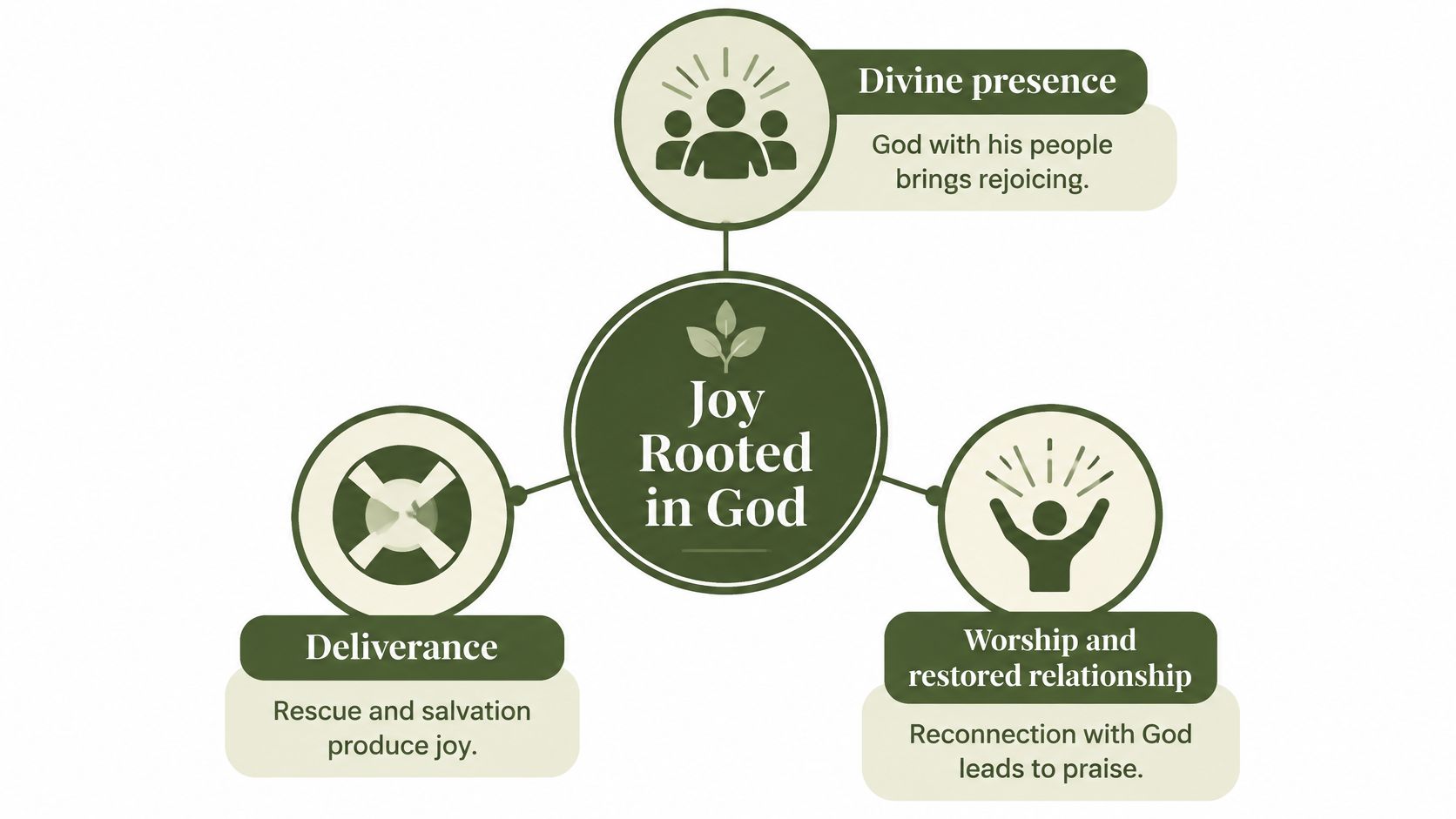
A helpful question is not whether someone feels joyful, but what their joy rests on. The Encyclopedia of the Bible's entry on joy connects biblical gladness with fellowship with God, deliverance, worship, and restored relationship.
That connection matters because favorable circumstances aren't the only reason a person can rejoice. A believer may be grateful for an answered prayer, but may also take comfort in God's presence before an answer arrives. Both responses have an object beyond the feeling itself.
The relationships can be pictured this way.
What people rejoice in
- Joy in God means delight in fellowship with him and confidence in his character. The gift isn't only an improved situation, but relationship with the giver.
- Joy because of salvation responds to rescue, forgiveness, or deliverance. Sometimes the rescue has happened; sometimes people celebrate what God has firmly promised.
- Joy within communal worship is a congregation answering God together. People remember his faithfulness through praise rather than treating faith as a private exercise in feeling better.
These distinctions make prayer more concrete. Instead of asking only for a pleasant emotion, you might ask to recognize God's presence, understand his mercy, or receive help participating in worship while you're tired.
They also protect against a transactional approach to faith. Rejoicing in God doesn't mean praising him so that he'll deliver the circumstances you want. It means responding to who he is, including when you don't understand his timing.
A compass rather than a thermometer
A thermometer reports the surrounding temperature. A compass helps you keep your direction when the weather changes.
Your feelings can truthfully register fear, disappointment, or relief. Biblical joy doesn't require you to falsify that reading. Instead, rejoicing can express the direction in which you continue to turn: toward the God you trust.
A useful question: What about God remains trustworthy in this situation, even before anything changes?
That question overlaps with what hope means in the Bible. When deliverance is still ahead, trust can take the form of expectation rather than immediate emotional relief.
This doesn't settle every question about grief. It does establish that a difficult day isn't, by itself, evidence that someone has lost their relationship with God.
How Worship Made Joy Visible
Consider a typical harvest celebration. Families bring food, people gather, and songs name the God on whom their lives depend. Their eating and singing aren't distractions from worship; they're ways of responding with their bodies and possessions.
This illustration captures that public, embodied quality of celebration.
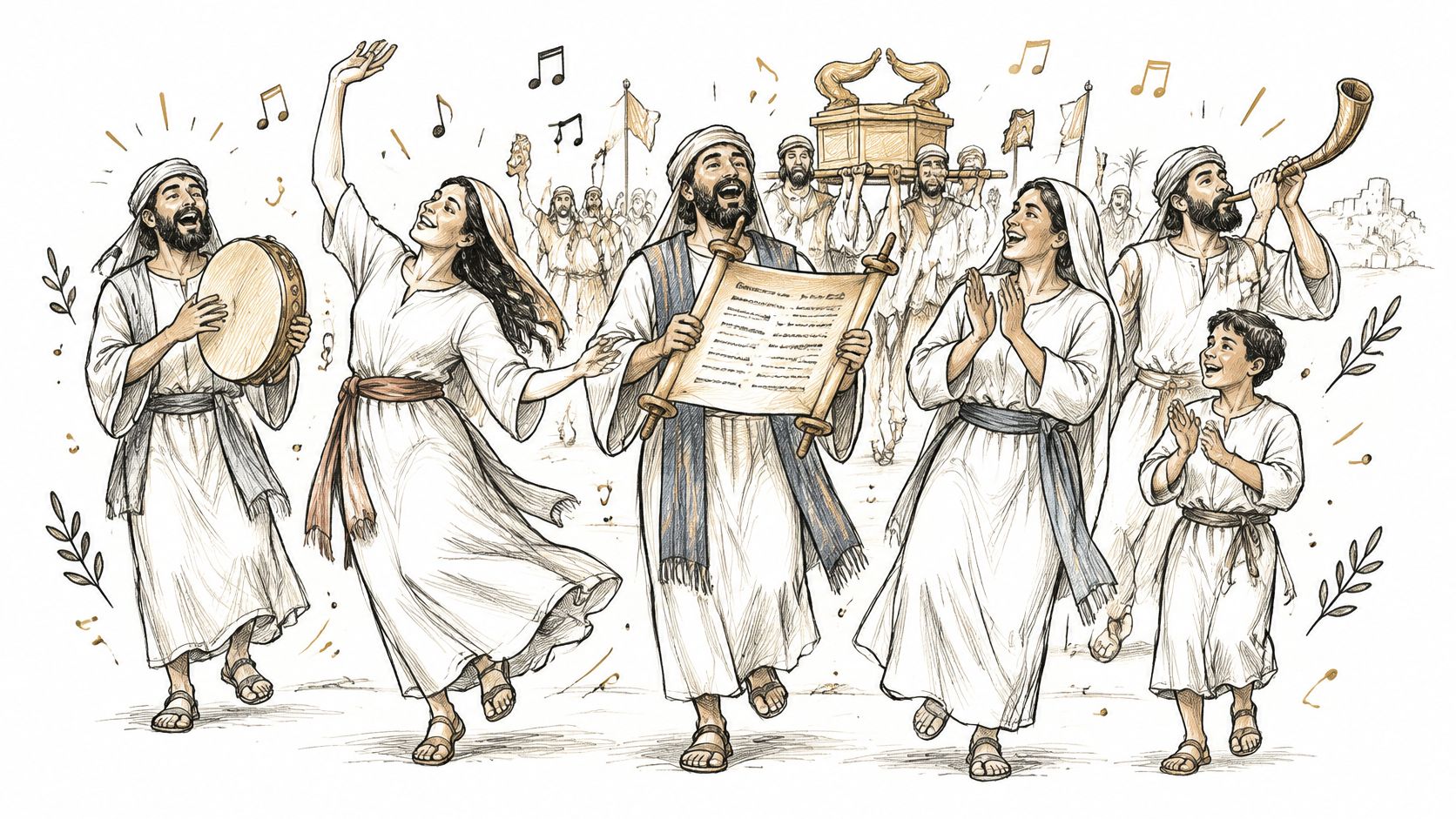
The scene helps correct a modern habit of measuring faith almost entirely by private feelings. Ancient Israel's celebrations involved a gathered people. Singing, processions, clapping, dancing, and feasting gave shared expression to remembered deliverance and expected blessing.
Participation rather than performance
Public celebration asks something different from emotional display. A worshiper can join a song because its words are trustworthy, even when singing them feels difficult. Another person's strong voice may help carry someone who can barely speak.
The practical difference is important:
- Participation means bringing your actual condition into shared worship.
- Performance means presenting an acceptable appearance so nobody notices your pain.
- Mutual care means making room for people whose expressions differ from your own.
A congregation shouldn't assume that an expressive person has stronger faith or that a quiet person lacks joy. Shared practices make room for different people to answer God together.
The connection with gratitude in the Bible is practical. Naming a gift, sharing a meal, or thanking God with others gives a person something truthful to do without requiring them to manufacture an emotion.
This video offers another way to engage with the biblical theme.
A feast isn't the whole story
Communal celebration doesn't mean everyone arrives with an uncomplicated life. A person may carry sorrow into a feast, just as a congregation may remember deliverance while still facing uncertainty.
The purpose isn't to make the gathering look happy. It's to recognize God together and allow others to share the work of remembering. A shared meal, a familiar song, and a listening friend can become concrete ways to include someone who feels distant from celebration.
Passages Where Joy Meets Hardship
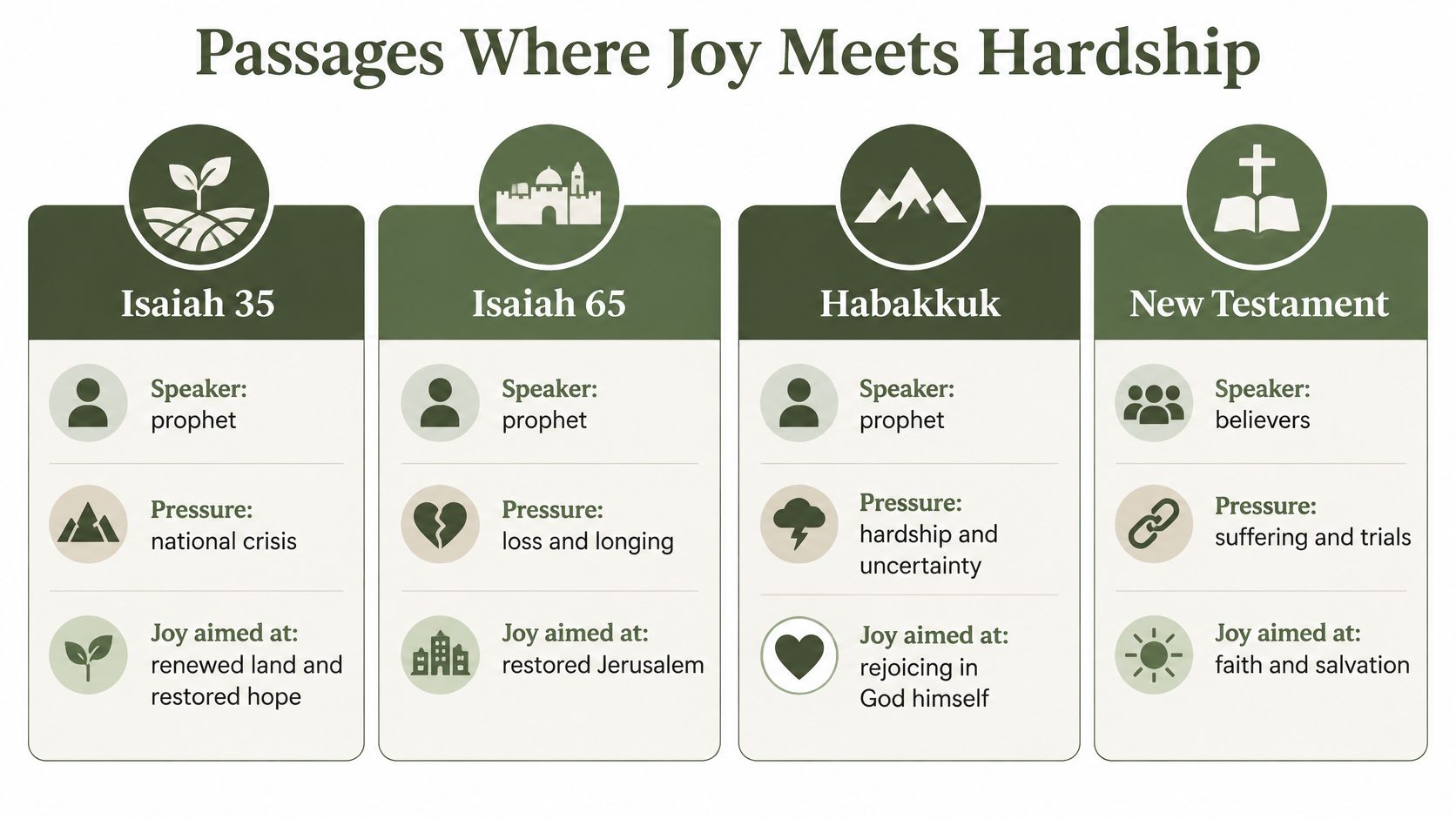
A joy verse can become confusing when it's separated from its setting. A command spoken under pressure means something different from advice offered by someone who assumes life is easy. The BibleTools overview of joy highlights the New Testament's connection between rejoicing, trials, endurance, and faithfulness.
The key is to identify why rejoicing is possible, not to declare suffering pleasant. A passage may point to renewal, God's presence, the Savior's arrival, or the endurance God forms through testing.
These scenes help keep the relationship between pressure and promise visible.
Read the scene before applying the command
Key passages on biblical joy
| Passage | Setting | Pressure in view | What joy rests on |
|---|---|---|---|
| Isaiah 35:2 | Prophetic hope | National crisis and ruined land | Renewal of creation |
| Isaiah 65:18 | Prophetic hope | Exile and a broken city | Future restoration of Jerusalem |
| Habakkuk 3:17-18 | Prophet's prayer | Failed harvest and empty stalls | God as savior |
| Nehemiah 8:10 | Public reading of the law | Weeping and reform | The joy of the Lord as strength |
| Psalm 16:11 | Individual psalm | Threat and mortality nearby | Fullness of joy in God's presence |
| Luke 2:10 | Angel to shepherds | An ordinary night under occupation | Good news of the Savior's birth |
| Philippians 4:4 | Paul in prison | Confinement and conflict | Rejoicing in the Lord always |
| James 1:2 | Letter to scattered believers | Trials of many kinds | Endurance and mature faith |
| Galatians 5:22 | Paul to churches | Life pulled by the flesh | Joy as fruit of the Spirit |
In Isaiah, the prophet directs attention toward what God will renew. The ruined place isn't the final picture. For someone reading during disruption, the application isn't to call destruction good, but to recognize that God's promised future is larger than the present damage.
Habakkuk makes the pressure especially concrete: crops and herds fail. His rejoicing concerns God as savior, not agricultural success. Nehemiah presents a different scene, people weeping as they hear the law, yet being directed toward strength and shared celebration rather than remaining overwhelmed.
From announced good news to formed character
Psalm 16 locates delight in God's presence. Luke presents joy as a response to announced good news: the Savior has been born. Neither scene treats joy as an emotion people must generate without a reason.
Jesus' teaching in John 15:11 connects his joy with the disciples' life in him. The surrounding concern is remaining in relationship with him, not arranging a trouble-free future.
Paul's prison setting gives Philippians its force. He directs believers toward the Lord while writing under confinement, so rejoicing can express allegiance rather than comfort. James explains a different connection: testing can produce endurance, which gives believers a reason to assess trials through more than their immediate unpleasantness.
Galatians calls joy fruit of the Spirit. That description shifts attention away from personality: an outgoing temperament isn't the same thing as spiritual maturity, and a reserved temperament isn't a barrier to it.
Read a joy command by asking what God is doing, promising, or forming, not by asking how to make the pain feel pleasant.
Joy Beside Grief Without Denial
Choose joy can be a helpful invitation, but it becomes harmful when it means appear cheerful or stop grieving. Someone living with depression, illness, bereavement, or injustice doesn't need another test of whether they can look sufficiently positive.
The Bible Odyssey dictionary entry on joy includes ordinary human delight alongside joy in God's saving action. Marriage, children, harvests, and feasts belong within the biblical picture. We don't need to dismiss everyday happiness to make spiritual joy sound important.
The distinction is between receiving good things and requiring a particular feeling regardless of what has happened.
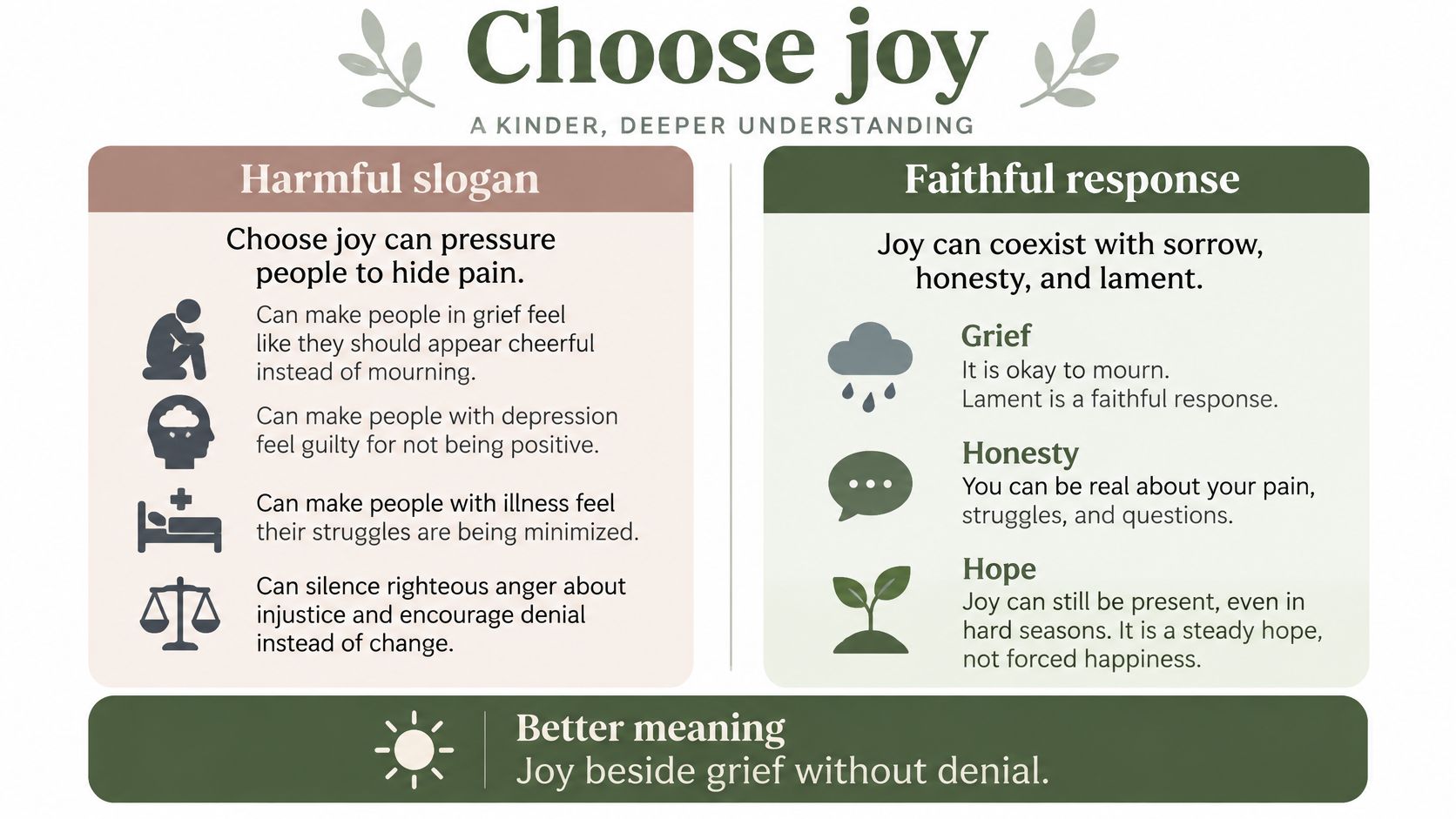
Related experiences aren't interchangeable
These are practical distinctions, not rigid boundaries around every biblical use of a word. Ordinary happiness and joy can overlap.
Joy, happiness, pleasure, lament, and hope
| Idea | What it is | Tied to circumstances | Can it sit with sorrow |
|---|---|---|---|
| Happiness | Felt pleasure when life goes well | Often yes | It may fade as pain rises, though moments can remain |
| Pleasure | Embodied delight such as feast, harvest, family | Often yes | Yes, as a good gift, not the whole of faith |
| Biblical joy | Gladness aimed at God, salvation, and his people | Not primarily | Yes, including anticipatory joy |
| Lament | Honest prayer that names loss | Yes, it reports pain | It belongs beside joy, not against faith |
| Hope | Trust in promised deliverance | Not dependent on favorable circumstances | Yes, especially when joy isn't yet felt |
A grieving person might enjoy a meal and then cry on the way home. Neither response makes the other false. Likewise, a person can trust God's promised deliverance while feeling very little gladness today.
Lament gives faithful language to that gap. It allows someone to name what is missing, ask for help, and bring unanswered questions to God rather than hiding them. When words are difficult, Bible verses for grief and loss can provide a starting place for honest prayer.
Don't use joy to silence someone
If a friend describes pain, listening is often more appropriate than correcting their attitude. Ask what feels hardest, offer concrete help, and leave room for their prayer to sound unfinished.
For your own life, replace the demand to feel better with a more faithful question: how can I remain open to God without denying what hurts? Sometimes that means thanksgiving; sometimes it means asking another person to pray while you can't find the words.
Joy can coexist with sorrow because its object is God's faithfulness, not the absence of pain.
Why Scripture Still Feeds Joy
People often approach Scripture seeking relationship rather than an emotional technique. In 2023, 47% of surveyed U.S. Bible users said their primary reason for reading Scripture was that it brought them closer to God, according to the American Bible Society survey reported by Good Faith Media.
That motivation fits the biblical emphasis on knowing God. Reading isn't just a way to collect reassuring sentences. It can help readers recognize God's character, understand the setting of a promise, and respond with greater honesty.
What the survey findings can tell us
In 2023, Scripture-engaged respondents scored 7.9 out of 10 on the overall Human Flourishing Index, compared with 6.7 among Bible-disengaged respondents, according to American Bible Society findings reported by Metro Voice. These are associations, not proof that reading Scripture causes a particular emotional outcome, and flourishing shouldn't be treated as a synonym for biblical joy.
The audience for a more thoughtful reading habit is substantial: in 2023, 100 million U.S. adults, 39% of the adult population, used the Bible independently at least three or four times during the year, according to American Bible Society findings reported by The Christian Post.
Occasional readers don't necessarily need a larger collection of isolated verses. They may need a better way to read the verse already in front of them.
Read for understanding before emotional relief
- Read the surrounding chapter. Notice who is speaking, who is listening, and what has happened. Don't assume that a promise to a particular community is a guarantee that your immediate problem will disappear.
- Identify the kind of joy. Is the passage describing present delight, promised reversal, or worship during hardship? That question prevents you from demanding an experience the passage isn't describing.
- Answer the text clearly. Name what you understand about God and what remains difficult. A response can include gratitude and uncertainty without forcing either one out.
This approach changes the measure of a worthwhile reading session. Instead of asking whether you finished feeling cheerful, ask whether you understood the passage more clearly and found a truthful way to respond.
Read One Joy Passage This Week
Choose a passage from the table, such as Habakkuk 3:17-18, and read its surrounding chapter. Stay with its actual concerns before applying it to your own. You're listening to a biblical writer, not searching for a slogan.
Then write a brief prayer using these prompts:
- Name the distress. Describe what's difficult without minimizing it.
- Name the relationship or promise. Identify what the passage gives you reason to trust.
- Request a faithful action. Ask for help doing something concrete, such as accepting support, making a needed call, or joining others in worship.
For example, your prayer might name uncertainty about work, acknowledge God as savior, and ask for courage to take the next responsible step. You don't have to borrow the writer's exact circumstances to learn from the writer's trust.
Keep the practice close to the passage
In Scroll With God, each screen shows a single Bible passage, and you swipe up for the next. Our one-tap study sheets explain meaning, authorship, Hebrew or Greek wording, historical context, cross references, and application; topic pills let you steer the feed toward seasons such as peace, strength, grief, and gratitude.
Use study notes as an aid, not a replacement for the surrounding chapter or trusted spiritual guidance. If gladness doesn't arrive during your reading, don't rewrite your prayer to sound happier. Leave the honest request there and return to the passage with patience.
Scroll With God offers focused Bible reading, verse-linked prayers, and context to help you understand what you're reading. Visit the app to choose a passage about joy, open its chapter, and begin a prayer that makes room for both your present trouble and God's promised faithfulness.