What Does Hope Mean in the Bible? Key Verses Explained
What Does Hope Mean in the Bible? Confident expectation in God's promises, the key Hebrew and Greek words, and how it differs from wishful thinking.
In this article
- Biblical Hope Is Confident Expectation, Not Wishing
- Hebrew and Greek Words Behind Biblical Hope
- Read the word in its sentence
- Key Bible Passages That Define Hope
- Biblical Hope Versus Wishful Thinking and Common Misreadings
- Four misreadings to avoid
- How Biblical Hope Shapes Daily Life
- Start Your Hope Study With One Passage
In the Bible, hope is a confident expectation that God will keep his promises, held in trust while the outcome is still unseen. It rests on God's character, not on a guarantee that every personal wish will come true.
But if hope is more than wishing, what does a hopeful person do while waiting? That question matters when the answer to a prayer hasn't come, grief remains, or the future feels uncertain. Biblical hope doesn't ask people to pretend that hardship is easy. It gives them a way to remain oriented toward God while living through it.
Biblical Hope Is Confident Expectation, Not Wishing
What separates hope from a wish for a better outcome? The Bible's answer is the ground hope rests on.
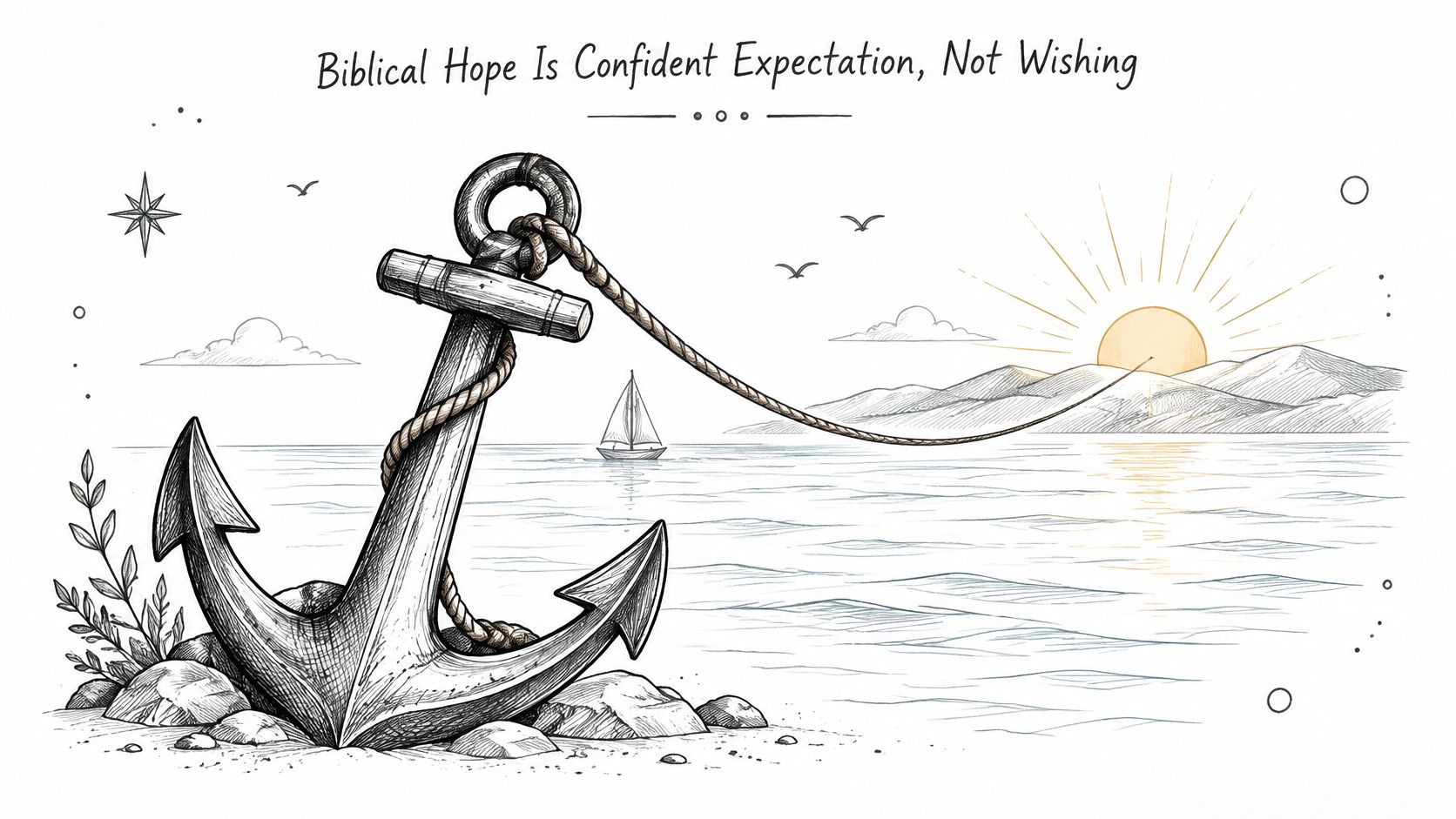
Biblical hope is a confident expectation grounded in God's character, promises, and future action, held while the outcome is not yet visible.
A farmer planting in spring doesn't expect a harvest in the same way a lottery player hopes for a win. The lottery player depends on chance; the farmer has seen seasons turn and trusts that seeds can grow. Yet the farmer still has to wait, tend the field, and live with uncertainty about the exact harvest. That combination of confidence, patience, and work helps explain why biblical hope isn't passive.
In Scripture, hope describes a relationship of trust, not only a feeling. Emotions may rise and fall, but trust can continue through grief, danger, or uncertainty. That distinction helps make sense of why biblical passages connect hope with waiting, endurance, and faithfulness.
The question is also meaningful to readers today. In the American Bible Society's 2024 State of the Bible study, 54% of U.S. Gen Z adults ages 18–27 agreed that the Bible's message had transformed their lives, up from 50% in 2023 (the American Bible Society's finding on Gen Z and the Bible). A person looking for hope in Scripture may be seeking more than a comforting phrase. They may want to know what trust looks like in ordinary life.
As you read, test biblical hope against three markers: its basis is God's faithfulness, its object is God's promised good, and its posture is patient, active waiting. For a related reflection on waiting, see these Bible verses for patience.
Hebrew and Greek Words Behind Biblical Hope
English can squeeze several Hebrew and Greek ideas into one small word: hope. The original terms help you hear the emphasis in a verse, whether the writer is waiting, trusting, or expecting.
| Term | Language | Core meaning | Where it appears |
|---|---|---|---|
| qwh and related noun tiqvah | Hebrew | To wait, expect, look toward | Hebrew prayers and poems where God's answer is still ahead |
| yhl | Hebrew | To wait with confidence | Passages of patient trust in God's timing |
| elpis | Greek noun | Expectation, trust, confidence | Central New Testament term for hope |
| elpizō | Greek verb | To hope, trust, expect | Greek Old Testament rendering of Hebrew hope terms |
A helpful Hebrew starting point is the qwh family. The verb pictures waiting with expectation, and the related noun tiqvah often stands behind English “hope.” Because one English word can cover both the act of waiting and the good being waited for, check which side the sentence stresses. The yhl group adds a calmer note: confidence while time stretches out (a discussion of Hebrew hope vocabulary). These terms belong in laments, prayers, and promises, settings where people keep acting faithfully while the outcome is unfinished.
Greek elpis carries expectation and trust in the New Testament, close to salvation and resurrection. Its reach is present tense too. Hope gives endurance a reason, so conduct changes while the future remains open.
Read the word in its sentence
Psalm 130:5 pairs waiting with hope in God's word. The speaker stays alert, like a watchman whose night duty has meaning because morning is expected. Expectation shapes behavior before the answer arrives.
The Hebrew Scriptures were translated into Greek over time, and Hebrew hope terms were often represented by elpis and elpizō. When a verse uses “hope,” ask three questions: Is the emphasis waiting? Trusting? Expecting? Then read the lines around it before choosing which emphasis fits.
Key Bible Passages That Define Hope
The Bible uses different images and arguments to show what hope does. Some passages describe how it grows through hardship; others picture the steadiness it offers or the future it anticipates.
| Passage | Context or image | What it teaches | Anchor of hope |
|---|---|---|---|
| Romans 5:3–5 | Suffering leads to character | Hope grows through perseverance | God's love poured into hearts |
| Hebrews 6:19 | Anchor of the soul | Hope keeps believers steady | God's sworn promise |
| 1 Thessalonians 5:8 | Helmet of protection | Hope guards the mind in conflict | The hope of salvation |
| Psalm 130:5 | Waiting for the Lord | Patient, expectant waiting | The Lord's word |
| Romans 15:13 | God of hope | Hope fills believers with joy and peace | The power of the Holy Spirit |
| Jeremiah 29:11 | Letter to exiles in Babylon | A future and hope within God's timeline | God's plan for a specific people and period |
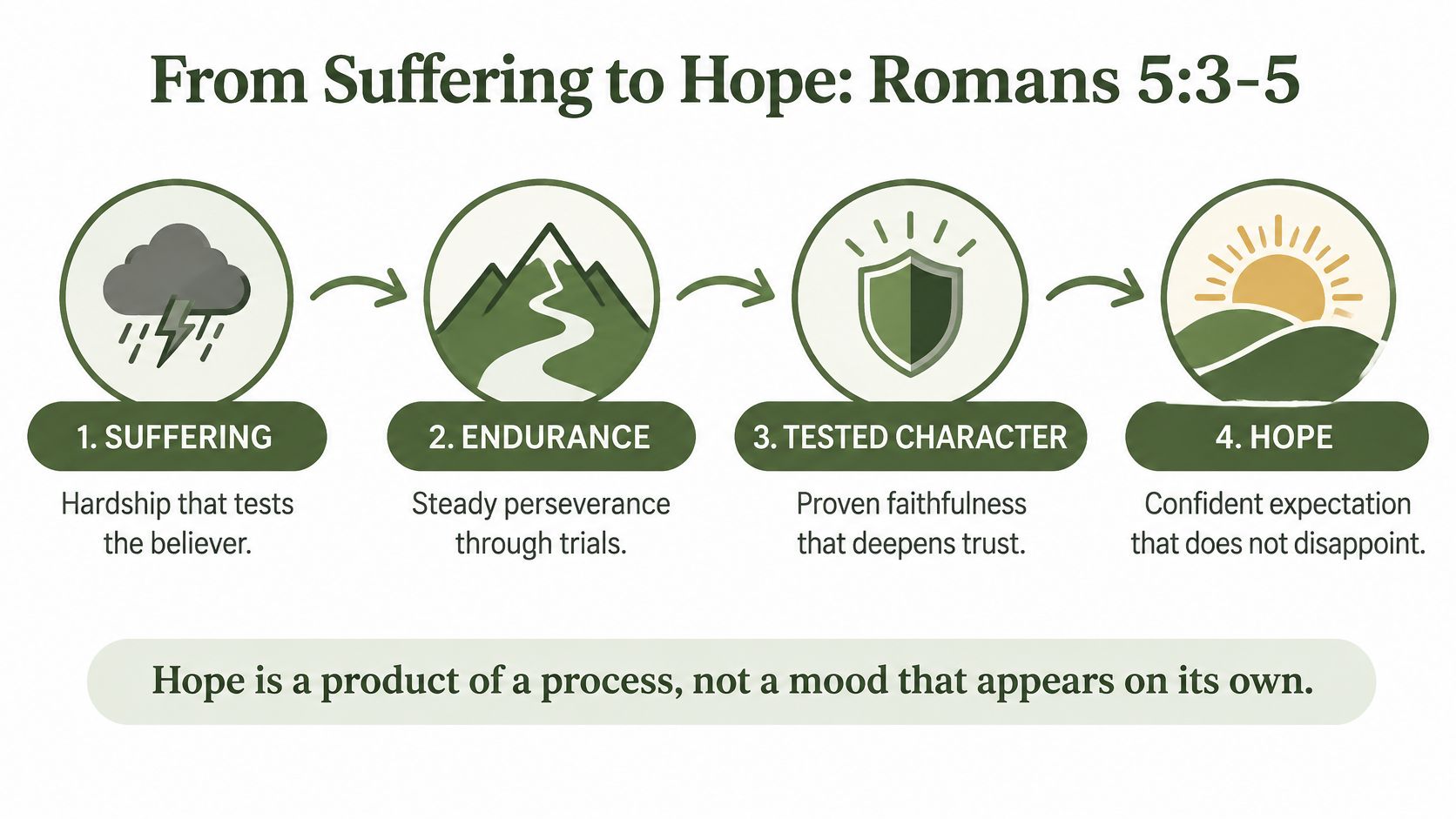
Romans 5:3–5 gives a sequence: suffering produces endurance, endurance produces tested character, and character produces hope. The passage doesn't call suffering good in itself. It describes how enduring hardship can form a tested trust that looks toward God's future.
Hebrews 6:19 calls hope a “sure and steadfast anchor of the soul.” An anchor doesn't stop a storm; it helps keep a boat from drifting. Similarly, hope doesn't mean that suffering disappears. It offers steadiness when circumstances remain rough. In 1 Thessalonians 5:8, the hope of salvation is compared to a helmet, protective equipment for the mind in spiritual conflict. These images present hope as both stabilizing and active (New Testament images of hope as an anchor and helmet).
Psalm 130:5 offers a quieter picture: waiting for the Lord and trusting his word. Romans 15:13 connects hope with joy and peace through the power of the Holy Spirit. Neither passage requires a reader to deny sadness or claim certainty about a preferred personal outcome.
Jeremiah 29:11 needs particular care. It appears in a letter to exiles in Babylon, and the promise of a future and hope belongs to God's purpose for those people within the time described in the surrounding passage. It isn't a general guarantee of career success, health, or wealth for every reader.
When reading a hope verse: Check its historical setting, the promise it rests on, and the response it expects.
Biblical Hope Versus Wishful Thinking and Common Misreadings
| Criterion | Wishful thinking | Biblical hope |
|---|---|---|
| Basis | Desire, mood, or luck | God's character and promises |
| Object | A preferred outcome | God's promised good, on his timing |
| Response to delay | Anxiety or giving up | Patient endurance |
| Role of action | Passive waiting | Prayer, faithfulness, and justice-seeking |
| If the outcome doesn't come | Disappointment and disillusion | Trust held through unanswered prayer |
| Degree of certainty | Fragile and uncertain | Confident expectation, not a personal guarantee |
Wishful thinking starts with what a person wants and imagines that it will happen. Biblical hope starts with trust in God and asks what God has promised. That difference matters when the waiting stretches on: hope doesn't promise a quick answer, but it can shape how someone waits.
Four misreadings to avoid
- Hope means personal success. Jeremiah 29:11 was addressed to exiles and set within a particular story of displacement and return. It shouldn't be treated as a guarantee that every reader will receive a desired job, cure, or financial outcome.
- Hope is only about heaven. Christian hope includes salvation and the future renewal of creation, but that doesn't answer how a person should live today. Biblical hope also informs present endurance and responsibility (a theological discussion of hope's present practice).
- Hope means passive optimism. The biblical language includes waiting and trusting. A hopeful person may pray, remain faithful, encourage others, or seek justice while still unable to control the result.
- Hope is just a feeling. Romans 5 describes hope as emerging through a process of endurance and tested character. That means hope can remain meaningful even when someone feels discouraged.
A useful way to examine your own understanding is to ask: What promise is this hope resting on? Does it change how I act today? Am I still trusting if the answer is no, or not yet? These questions don't make uncertainty vanish. They help distinguish confidence in God from certainty about the outcome a person wants.
How Biblical Hope Shapes Daily Life
Romans 5:3–5 describes hope as part of a process:
Suffering → endurance → tested character → hope
The sequence doesn't say that hardship automatically makes people stronger or that every painful experience feels purposeful. It shows how sustained faithfulness through adversity can deepen trust. Hope, in this account, is not merely a mood that appears when circumstances improve. It's confidence shaped through experience and directed toward God's promised future (the theological pattern in Romans 5:3–5).
That future-facing trust also has present consequences. A hopeful person doesn't need to pretend that loss is small or that injustice is acceptable. They can bring their grief to God in full truthfulness, keep praying, and practise patience through a long season. They can serve a neighbour, seek reconciliation after conflict, or speak up for someone treated unjustly. Christian hope can concern what lies ahead while shaping how people inhabit life now.
These actions don't control outcomes. Prayer can't guarantee that a difficulty will end on someone's preferred schedule, and generosity can't erase another person's hardship. Such practices express faithfulness while the promise is still unfolding.
For example, a person who loses a job might pray for wisdom, make a steady budget, and check in on a friend facing the same difficulty. Those choices don't guarantee when work will return. They do give the person concrete ways to practise trust and care for someone else during an unsettled time. For an idea to share with another person, explore a Bible verse to encourage someone. A hope passage should lead to a concrete response, not only a temporary lift in mood.
Start Your Hope Study With One Passage
You don't need to begin with a long reading plan. Start with one passage and let its setting and message guide a response.
- Choose a passage that meets your situation. Romans 5:3–5 may be a helpful place to read if you're enduring hardship. Psalm 130:5 offers language for waiting. Read the passage as part of a chapter, not as an isolated promise.
- Notice what the passage says and asks. Pay attention to its context and the words around hope. If you're learning how to read attentively, this guide to meditating on Scripture offers a way to slow down with a passage.
- Choose one response for this week. Write down a specific action: a prayer you'll return to, a conversation you need to have, or an act of service you can offer. Keep it connected to what the passage actually says.
Scroll With God's Discover section includes a Hope topic, alongside Love, Peace, and Courage. Each topic opens with today's verse, a prayer, related passages, and a short collection to walk through over a week. Its study material reflects interpretation, so read the surrounding passage and seek trusted spiritual guidance when you need it.
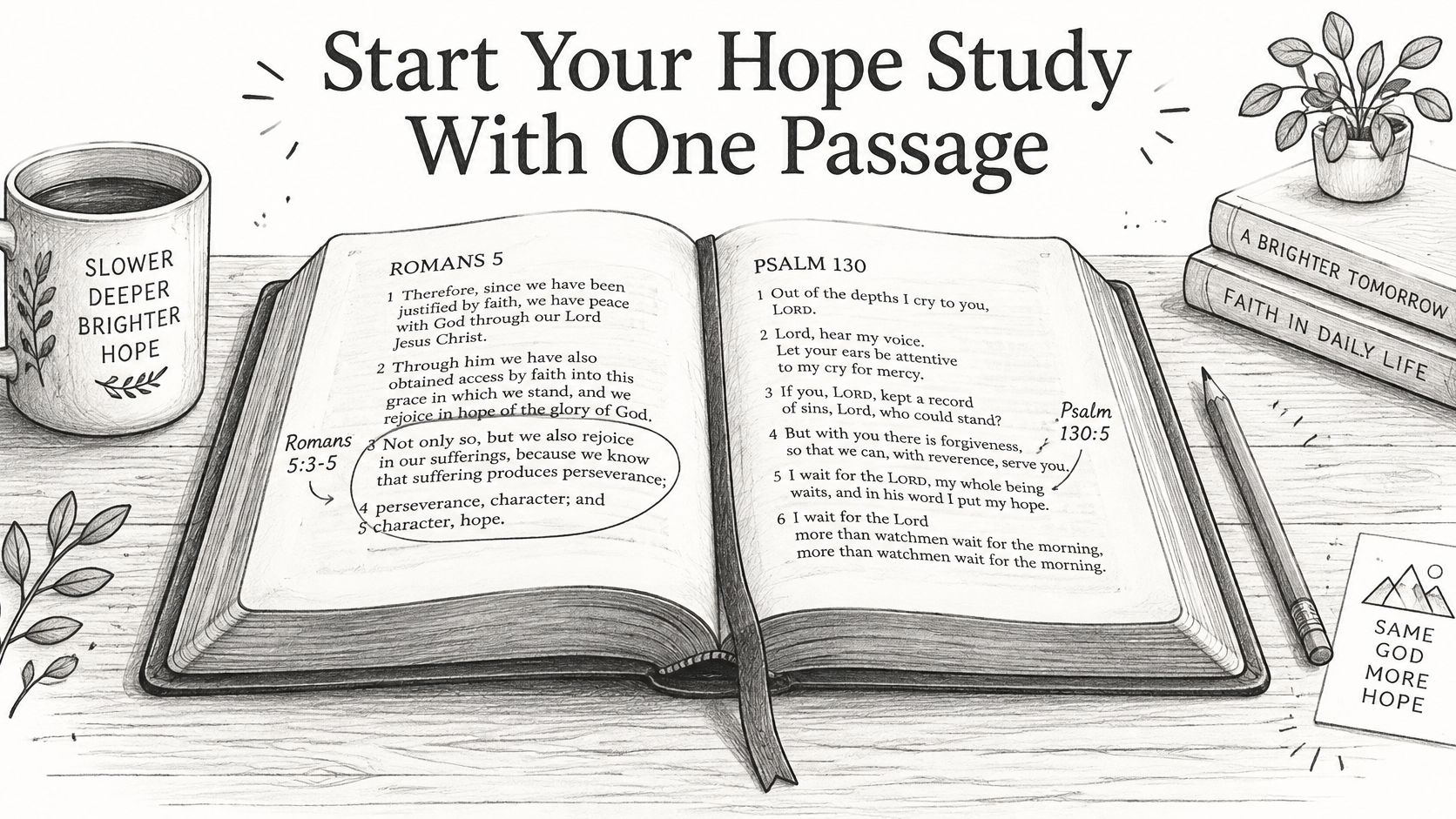
Return to the central definition as you study: hope is confidence in God's faithfulness while the outcome remains unseen. Test it with three questions: What is the basis of my hope? What promised good am I looking toward? How can I wait faithfully today?
Scroll With God offers Scripture, context, and prayer in a focused reading experience, including a Hope collection to explore passages about waiting and trust. Visit Scroll With God to begin a hope study with one verse and one practical response.