
What Does the Bible Say About Gratitude? a Guide
What does the Bible say about gratitude? Scripture frames thanks as a whole-life response to God, even in hardship. See key verses and a simple practice.

In this article
- What Scripture Means by Gratitude
- Thanks Has a Covenant History
- Memory and Trust Belong Together
- Key Passages on Giving Thanks
- Read the Instruction in Its Setting
- Choose a Passage You Can Attend To
- Thanksgiving in Prayer Worship and Daily Life
- Where Thanks Takes Shape
- What Behavioral Evidence Can Tell Us
- Giving Thanks When Life Is Not Good
- Leave Room for Lament
- Thanks Isn't a Cure or a Test
- How to Practice Thanks Without Pretending
- Make the Prayer Concrete
- Why the Order Matters
- A Medical-Wait Example
- Psalms and Prayers That Model Thanks
- Let the Ache Remain Audible
- Prayer Forms You Can Adapt
- Begin a Week of Scripture and Thanks
- Keep a Simple Daily Rhythm
- Keep the Practice Honest
The advice to count your blessings can sound like a command to stop hurting. But the Bible doesn't ask you to manufacture a cheerful mood before approaching God. Biblical gratitude is a practice of recognizing God's gifts and faithfulness while speaking plainly about what remains painful or unresolved.
So, what does the Bible say about gratitude? Give thanks to God throughout life, let that thanks shape your relationships, and don't confuse thanksgiving with pretending that everything is good.
What Scripture Means by Gratitude
Gratitude in Scripture is a whole-life response to God, not just a holiday feeling. You can practice it when appreciation comes easily, but you don't have to wait until you feel thankful to begin.
Paul's instructions belong to a shared life, not merely an individual's inner world. As a theological study of Colossians explains, he wrote to Christian communities in the first century as believers formed a distinct identity within the Roman world, connecting thanksgiving with salvation and life under Christ's lordship.
Colossians 3:15 calls the church to be thankful. Colossians 3:17 extends thanksgiving into whatever believers say or do, while 1 Thessalonians 5:18 places it within every circumstance.
Thanks Has a Covenant History
Paul didn't invent this practice. Psalm 100:4 pictures worshippers entering God's gates with thanksgiving and his courts with praise. Leviticus 7:12-15 connects a thanksgiving offering with a shared meal before the Lord, giving gratitude a table and neighbors.
Psalm 107 repeatedly connects thanks with remembered deliverance from desert wandering, imprisonment, sickness, and storms. Psalm 136 rehearses creation and the exodus through the repeated acknowledgment of God's enduring love. These texts give Christian thanksgiving a history: God's people remember his acts together.
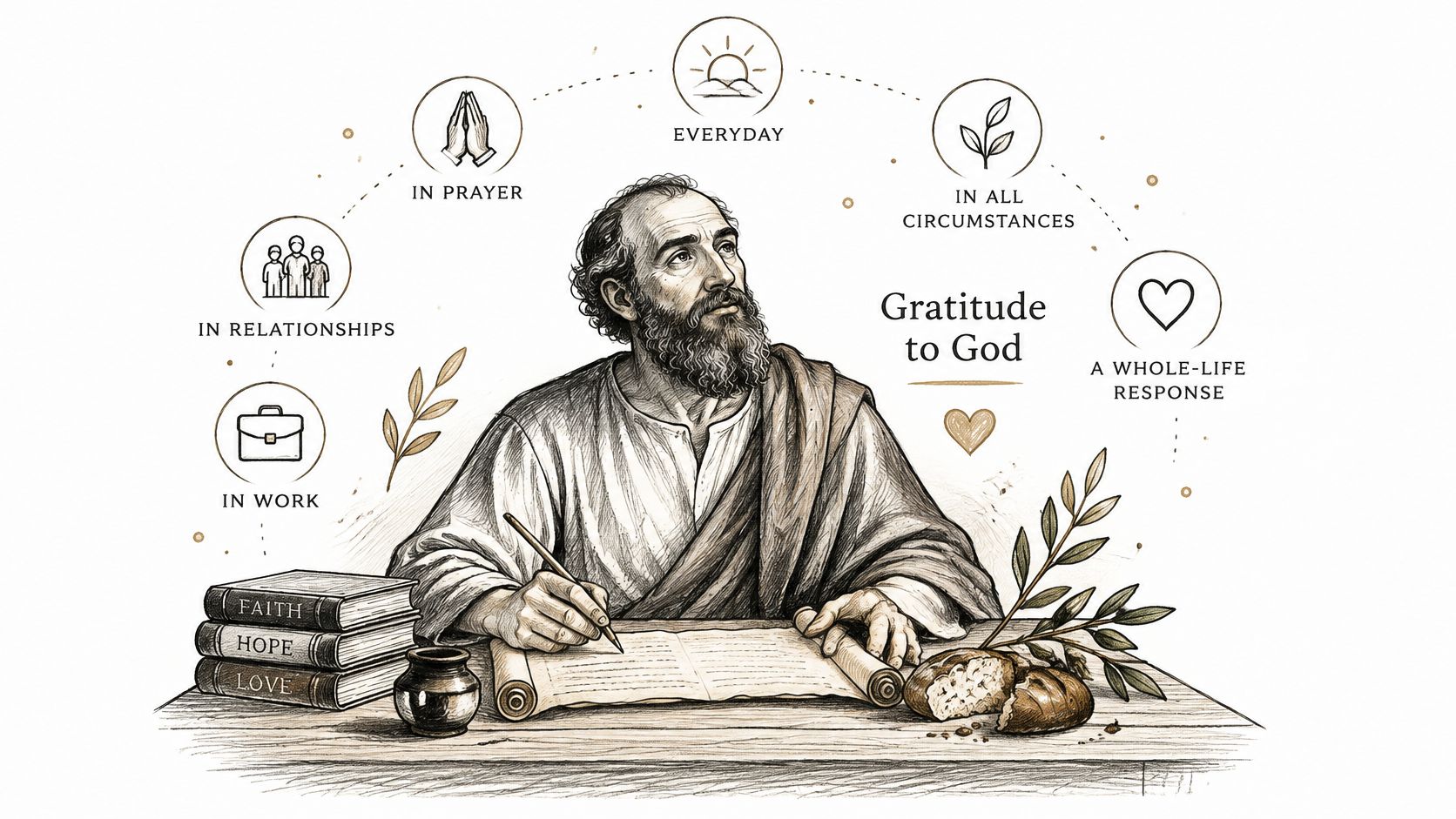
The illustration captures that connection between Scripture and ordinary conduct.
Memory and Trust Belong Together
Think of gratitude as traveling with a trustworthy guide. Looking back means rereading the record of where God has brought you. Looking ahead means trusting him while the road remains unfinished.
Colossians gives that memory concrete content: redemption, spiritual growth, fellow believers' work, and hope for continuing ministry. Thanks isn't an empty instruction to feel better.
Biblical thanks remembers what God has done and trusts him with what isn't finished.
That distinction matters most when the road is painful. Thanking God during a hard season doesn't require calling the hard event good.
Key Passages on Giving Thanks
What major gratitude passages teach
| Passage | Setting | What it teaches | Misuse to avoid |
|---|---|---|---|
| 1 Thessalonians 5:18 | Paul to the Thessalonian church | Give thanks in every circumstance. | Treating the painful event itself as the thing you must celebrate. |
| Colossians 3:15 | Paul to the church at Colossae | Be thankful as Christ's peace rules the community. | Reducing thanks to a private mood with no shared life. |
| Colossians 3:17 | Paul addressing the same church about daily conduct | Speak and act in Jesus' name with thanksgiving. | Limiting gratitude to worship services. |
| Colossians 4:2 | Paul's closing call to prayer | Stay watchful and persistent in prayer, including thanksgiving. | Replacing honest requests with thank-you lines only. |
| Psalm 103:1-5 | A hymn in which the singer addresses his own soul | Remember forgiveness, healing, redemption, and steadfast love. | Offering vague thanks without naming any benefit. |
| Philippians 4:6-7 | Paul writing to the Philippian church under constraint | Bring requests to God with thanksgiving. | Using the passage to shame anxiety or forbid petition. |
| Luke 17:11-19 | Jesus encounters men seeking healing | The healed man who returns makes gratitude an action toward Jesus. | Scoring who feels grateful enough instead of attending to Jesus. |
Read the Instruction in Its Setting
These passages aren't interchangeable slogans. A command about life together in Colossians has a different emphasis from a psalm in which a worshipper deliberately remembers God's benefits. Both teach gratitude, but each helps you notice something particular.
In Colossians 3, thanksgiving belongs beside peace, teaching, singing, and conduct. A person who says grateful prayers but speaks contemptuously to others has separated thanks from the life Paul describes. The question isn't only whether you felt appreciative today, but whether your words fit the Lord you thank.
Philippians 4 keeps petition in the prayer. Paul doesn't tell anxious believers to conceal their concerns behind religious language. They bring those concerns to God, with thanksgiving, rather than treating thanks as a replacement for asking.
Luke's account adds bodily movement. The man turns back toward Jesus and expresses thanks. Gratitude becomes something he does, not merely something a reader assumes he must have felt.
Choose a Passage You Can Attend To
Choose a row that meets your present need, then read the surrounding chapter. If your prayers have become only requests, Colossians 4 offers a useful starting place. If you struggle to remember anything specific, spend time with Psalm 103.
Ask what the passage directs your attention toward: God's character, a past act of care, or people through whom he is working. Notice the verbs too. Remembering, speaking, returning, praying, and acting keep gratitude concrete.
Don't try to extract a promise the passage doesn't make. A thanksgiving instruction isn't a guarantee that circumstances will change immediately, and a healing remembered in a psalm isn't a timetable for your recovery.
Thanksgiving in Prayer Worship and Daily Life
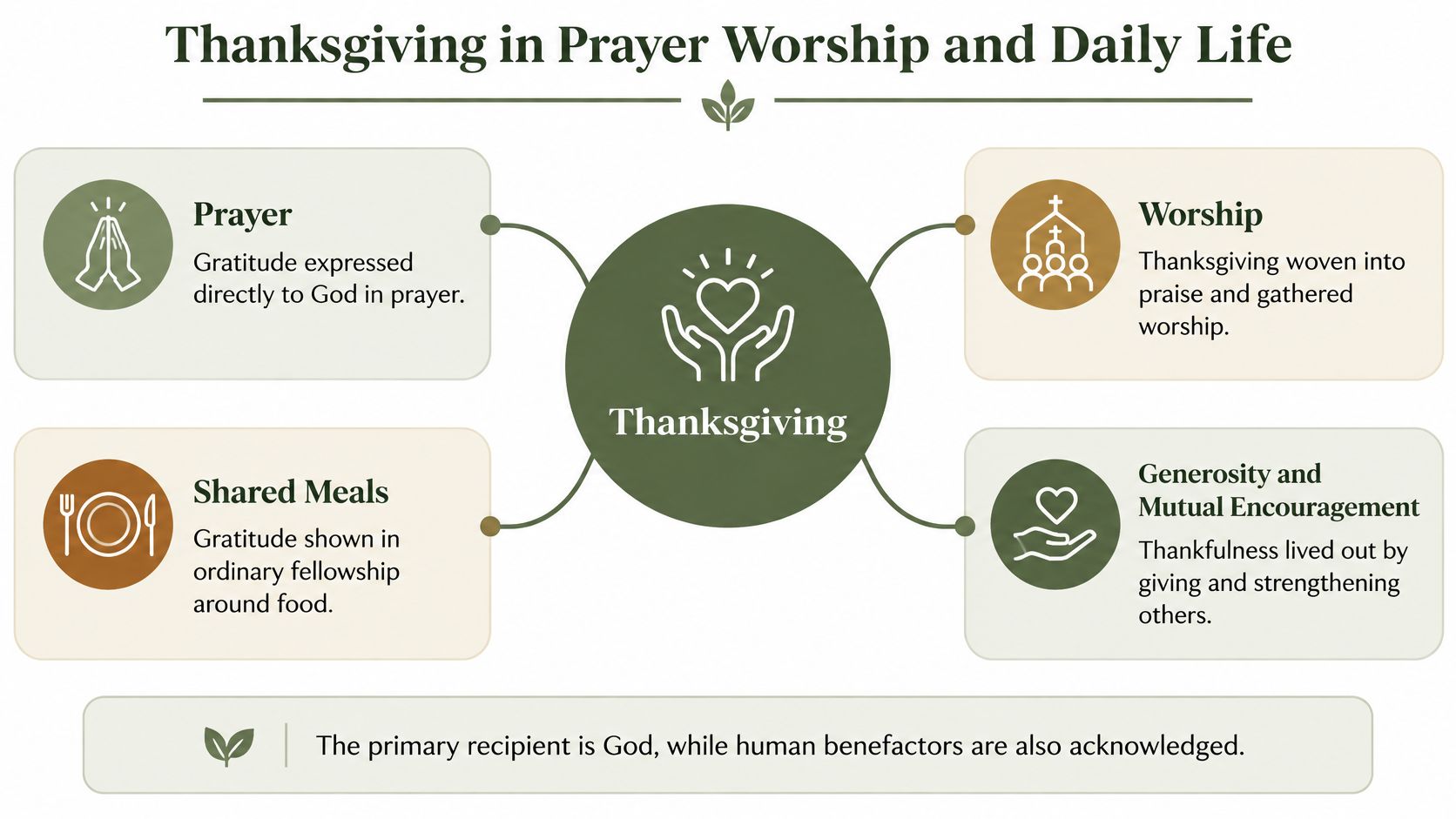
The New Testament places thanksgiving in settings where people speak, eat, worship, and care for each other. Its primary recipient is God, but acknowledging God doesn't require ignoring the people who helped you.
This diagram shows the main settings in which thanksgiving becomes visible.
Where Thanks Takes Shape
- Prayer: Speak directly to God about the care you've received. You can thank him for help while asking for wisdom about what comes next.
- Worship: Sing and speak with the gathered church. Other believers' words can help you remember what fatigue or disappointment has made difficult to name.
- Shared meals: Pause to acknowledge provision, then welcome the people at the table. Thanks for food should make you attentive to who needs feeding.
- Generosity and encouragement: Recognize another person's service, share what you have, or respond patiently when someone needs help.
God is the giver you worship; a friend, nurse, teacher, or neighbor may be the person whose effort you should acknowledge. Thanking God for a meal doesn't make thanking the cook unnecessary.
Practical rule: Biblical gratitude has a recipient, and it often has a neighbor.
What Behavioral Evidence Can Tell Us
A meta-analysis of gratitude and prosociality covering 91 studies and 18,342 participants found a moderate association between gratitude and prosociality, meaning behavior intended to benefit others, with r = 0.374.
That association doesn't establish that gratitude caused the helpful behavior. Nor can a psychological finding prove a theological claim or promise that thanksgiving will remove anxiety or depression. It does fit the practical wisdom of expressing appreciation rather than leaving it unspoken.
Saying thank you doesn't cook the meal. It does help people acknowledge the provider and consider passing food to someone else. Mature thanksgiving looks more like generosity, encouragement, and patience than a performance of cheerfulness.
For a Scripture-focused starting point, praying before reading the Bible can help you approach a passage with both appreciation and honest questions.
Use the accompanying video as a pause for reflection, keeping your own prayer specific.
Giving Thanks When Life Is Not Good
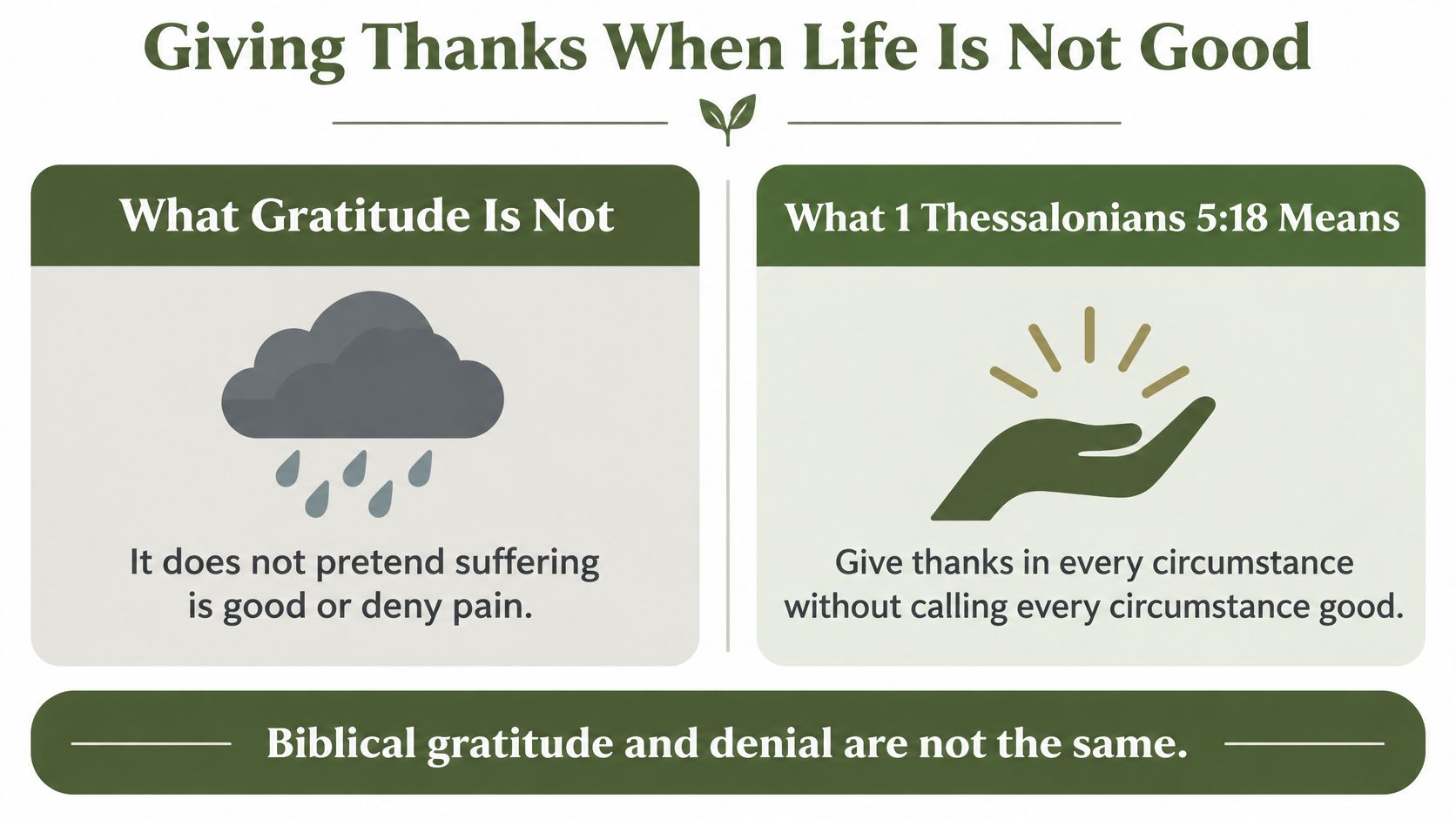
Biblical gratitude can name a real wound and still offer thanks to God. The command to give thanks in every circumstance does not mean every circumstance is good, or that grief must be hidden.
A person can thank God for mercy, presence, or help received while also mourning a death, facing illness, or asking for justice. Gratitude is not a lid placed over pain. It is one honest part of prayer.
Leave Room for Lament
The Psalms make room for both thanksgiving and lament. Some praise God's faithfulness; others give words to fear, sorrow, and protest. A worshipper can bring all of these to God without pretending.
That distinction matters when someone else is hurting. Listen instead of supplying a lesson they must appreciate. Offer practical help, and let them describe their own experience.
Thanks in hard circumstances without calling them good
| Situation | Do not thank God for | Can still thank God for | Keep asking |
|---|---|---|---|
| Bereavement | The death or the absence as something you must celebrate | Presence, mercy, and a specific gift of that person's life | Comfort and help for those who remain |
| Illness | The disease or pain as though you must call it a blessing | Care received, a named provision, God's steadfast love | Healing, strength, and wise medical help |
| Injustice | The wrong itself | God's justice and the courage or companions you've received | Protection, justice, and endurance |
| Unanswered prayer | The silence as something you must enjoy | A known past act of faithfulness | The original request, spoken honestly |
These examples are safeguards, not rules about what a person may thank God for in their own experience. They keep gratitude from becoming pressure to celebrate harm.
Thanks Isn't a Cure or a Test
Candler School of Theology's discussion of gratitude in hard times through the Psalms considers how gratitude may relate to hardship. Such reflection does not make gratitude a cure or a measure of faith.
Gratitude cannot replace medical treatment, mental-health care, or support from a pastor or trusted friend. If you continue to struggle, that does not mean you have failed to give thanks.
Biblical peace, as explained in what peace means in the Bible, need not mean constant emotional calm. You can say, “I can thank God in this, and I don't have to call this good.”
How to Practice Thanks Without Pretending
Psalm 103 offers a usable starting point: remember God's benefits rather than trying to produce a mood. Give your attention something specific before asking your emotions to follow.
You don't need polished language or an impressive journal entry. Use the following sequence slowly enough to mean what you say.
Make the Prayer Concrete
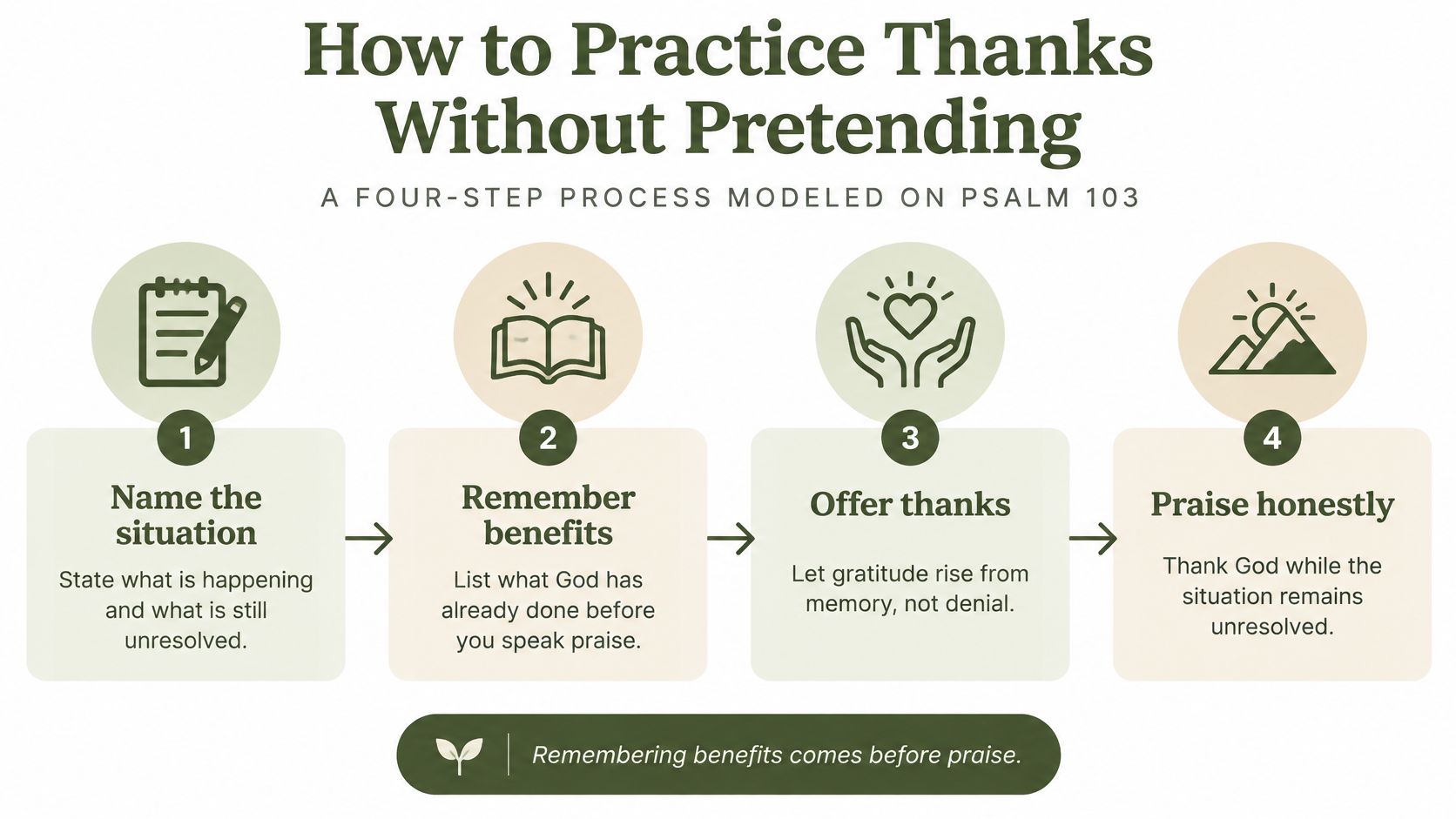
Name the situation clearly. State what's happening and what remains unresolved. For example: You're waiting for medical results, you're frightened, and you don't know what treatment may be needed. This keeps the prayer from rewriting the facts.
Retrieve a specific gift or act of faithfulness. Remember the friend who drove you to the appointment, the meal someone brought, or a past occasion when you received needed help. Specific memory gives thanks substance. A general acknowledgment of everything can be sincere, but naming an actual benefit helps when your attention is scattered.
Express the thanks to God. Say it aloud or write it down. Address God rather than just recording that something pleasant occurred. You might thank him for the friend's presence and the practical relief of not traveling alone.
Attach the next request or action. Ask for healing, wisdom, or strength, or choose a response such as encouraging someone or sharing what you have. The prayer can remain open-ended. You haven't resolved the situation just because you've offered thanks.
This visual summarizes the movement from honest attention to remembered benefits and praise.
Why the Order Matters
Remembrance supports praise because you have something real to acknowledge. As you praise God for known faithfulness, you have grounds for trust rather than pressure to feel optimistic. Trust can then support the next faithful action, even when you can't predict the outcome.
Two common slips interrupt that movement. The first is jumping straight to a desired mood without remembering anything concrete. The second is stopping at appreciation without making the request you still need to make or responding to another person.
Don't measure the prayer by how cheerful you feel afterward. Ask whether you spoke truthfully, remembered specifically, and turned toward God.
A Medical-Wait Example
Say you're waiting for a diagnosis. You thank God for the appointment becoming available and for your sister staying beside you, then ask for healing and clear guidance for the medical team.
You can also tell your sister what her presence meant. None of those actions requires you to appreciate the illness itself.
If you can't retrieve a specific gift immediately, don't invent one. Sit with a passage, borrow its language about God's mercy, and ask for help noticing what you've overlooked. Honest difficulty is a better starting point than a thank-you sentence you don't mean.
Psalms and Prayers That Model Thanks
The speaker in Psalm 103 addresses his own soul rather than waiting passively for gratitude to arrive. He names benefits and returns to them, deliberately resisting forgetfulness. You can imitate that pattern without pretending every benefit feels equally close today.
Psalm 13 adds a different voice. The psalmist begins with questions about God's apparent absence, describes sorrow, and asks God to answer. He then states his trust in God's steadfast love and anticipates singing because of God's care.
Let the Ache Remain Audible
Psalm 13 doesn't provide a neat explanation for the delay. The singer's movement toward trust doesn't make his opening questions improper. His distress is addressed to God, not edited out before prayer begins.
That gives a tired believer permission to speak plainly. You can name loneliness before thanking God for a friend's message, or admit fear before asking for courage. The prayer doesn't need to sound emotionally uniform.
In a 2025 study of 93 Christians, researchers analyzed 1,118 spoken prayers over two weeks and found that gratitude was frequently expressed in prayer, according to the study indexed in PubMed.
That observation isn't a quota. You don't need to count thank-you statements or compare your prayer with someone else's. The useful point is that gratitude belongs in actual spoken prayer, not only in an idealized description of Christian life.
Prayer Forms You Can Adapt
For a straightforward thanksgiving prayer, name benefits rather than reaching for grand language:
Father, thank you for forgiveness when I confessed my sin, for the food on my table, and for the friend who checked on me. Help me receive these gifts with humility and care for someone else today. Amen.
For a prayer that includes unresolved pain, keep the ache and the request:
God, I'm worn out by this uncertainty. Thank you for the mercy I received through someone who stayed with me. Please help me, guide my next decision, and bring the relief I'm asking for.
Use only details that are true for you. Replacing an example with your own concrete memory matters more than copying the wording exactly.
Paul also regularly thanks God for people, which prevents gratitude from shrinking into a list of personal comforts. Remember the person growing in faith, serving faithfully, or encouraging the church.
If you need help staying with a passage, meditating on Scripture can give you a way to return to its words without rushing to produce a response.
Begin a Week of Scripture and Thanks
Begin with the passages in the chart rather than searching for more material. Follow a seven-day rhythm, but treat it as an aid to attention, not a test you can fail.
Keep a Simple Daily Rhythm
- Morning: Read a chart passage within its chapter. Notice whether thanksgiving concerns God's character, a past act, or people through whom he's working.
- Midday: Write a short prayer that names your situation, remembers a specific gift, expresses thanks, and keeps your next request or response attached.
- Evening: Put appreciation into action. Send encouragement, share a meal, or offer a patient word where irritation would have been easier.
Give each day a focus. Begin with God's past acts, then people, then ordinary provision. On the next day, bring a difficult circumstance into prayer without separating thanksgiving from lament.
For the remaining days, return to whichever focus felt least familiar. You don't need a fresh insight every time. Repeated attention can be sincere.
Keep the Practice Honest
If the exercise turns into forced positivity, pause and say what hurts. Keep your request for help in the prayer, and don't treat an unfinished journal entry as a spiritual failure.
If scattered phone time is your obstacle, our Scroll With God app is an optional place to keep Scripture and prayer together. Each verse comes with a prayer drawn from it, and each Discover topic includes related passages and a short collection to walk through over a week.
Begin tonight with a verse and an honest response, not a perfect journal.
Scroll With God pairs Bible passages with context and prayers, helping you give thanks with attention to what Scripture says. Visit Scroll With God to begin a reading and prayer habit that leaves room for gratitude, grief, and the help you're still asking for.