What Is a Topical Bible? Subject Index for Scripture
Wondering what is a topical Bible? It groups Scripture by subject, not just by word, and shows how to use one without misreading verses.
In this article
- What a Topical Bible Is and Where It Came From
- Why subject indexing is needed
- Who reaches for one
- Topical Bible Compared With Concordances and Commentaries
- Judgment versus string matching
- How Topic Entries and Cross-References Connect
- The chain reference model
- One traced path on peace
- How to Use a Topical Bible Step by Step
- The seven-step routine
- A worked example with anxiety
- Where Topical Lookups Mislead and How to Check Them
- Five mistakes and the check for each
- Start One Topical Study This Week
- Picking a format you'll actually use
A topical Bible is a reference work that groups Bible passages by subject, so you can start from a life theme rather than a verse reference. What do you do when you know your question, maybe about peace, grief, or wisdom, but you don't know a single chapter to open? Most Bible tools wait for you to bring a word or a reference. A topical Bible starts where you are, with the issue in front of you.
What a Topical Bible Is and Where It Came From
Say you're sitting up late, anxious about money, and you want what Scripture says about worry and trust. You don't have a verse in mind. You have a situation. That's the gap a topical Bible fills, because it gathers passages under subject headings instead of waiting for you to find the right reference first.
Think of a library. A title list tells you what each book is called, which helps only if you already know the title. A subject catalogue is different. It shelves everything about gardening together, whatever the individual titles happen to be, so you can walk in with a problem and walk out with the right shelf.
Why subject indexing is needed
A theme can run through Scripture without the same modern English word appearing in every relevant passage. Anxiety, mercy, and wisdom are all discussed in places that never use those exact terms. So a topical entry pulls together synonyms, related concepts, and passages whose meaning fits the subject, even when the wording differs.
Here's a simple picture of starting from a life question like peace and letting the subject index lead you to passages.
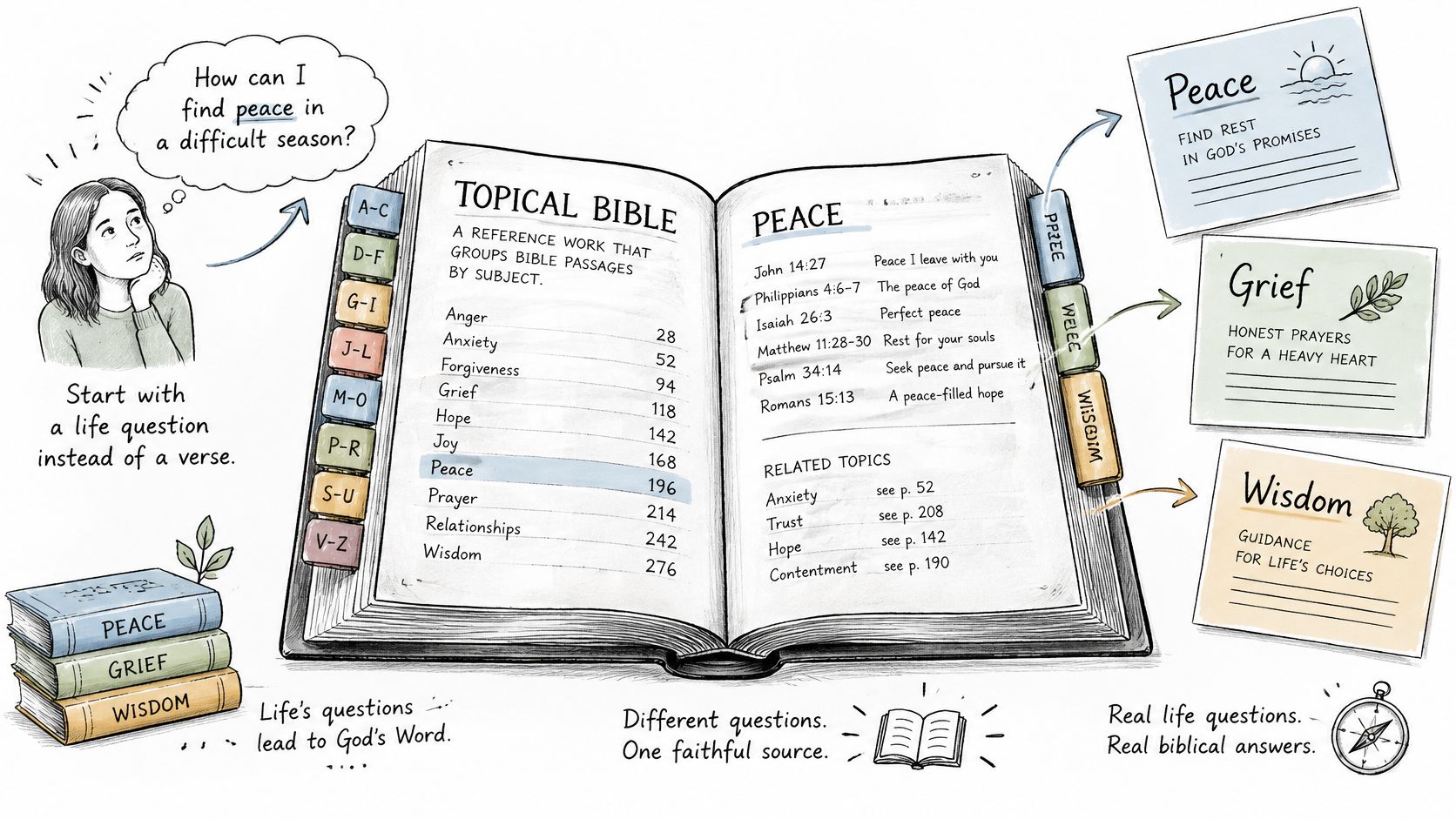
That gathering work is what makes the tool a thematic map rather than a word list. You're not collecting every verse that contains one English word. You're collecting passages that speak to one idea, wherever they sit in the canon.
The idea grows out of much older navigation tools. According to the Logos guide to Bible concordances, a concordance was developed under the Dominican scholar Hugh of Saint-Cher around AD 1230, the first printed Bible concordance appeared in Strasbourg in 1470, and the first English concordance is generally associated with John Marbeck's 1550 publication, with modern verse divisions arriving in AD 1551. Concordances indexed words. Topical works then took the next step and classified ideas.
Who reaches for one
- Thematic study: You want to trace one subject, such as forgiveness, across both testaments.
- Devotional reading: You want a short set of passages on hope or gratitude for the week ahead.
- Sermon preparation: You're preaching on courage and need the spread of relevant texts before you choose one.
- Starting from a need: You know the issue you want to explore, but not where the relevant verses sit.
In each case, the topic is the doorway. The passages behind it still need to be read properly, in their own chapters.
Topical Bible Compared With Concordances and Commentaries
These four tools sit side by side on many shelves, and they're easy to mix up. Each row below is one tool, and the columns show what it indexes, where your search starts, and what it's best for. Reading down the middle column is the quickest way to feel the difference, because where you start changes everything.
| Tool | What It Indexes | Where a Search Starts | Best For |
|---|---|---|---|
| Exhaustive concordance | Every word occurrence | A Hebrew, Greek or English word | Tracing how a specific word is used |
| Topical Bible | Subjects and ideas | A life theme such as peace or grief | Thematic study and devotional entry points |
| Bible dictionary | Names, places and terms | A person, place or term | Background definitions |
| Verse-by-verse commentary | Explanation of each passage | A book and chapter | Reading one passage in depth |
A concordance is a word tool. You bring a term, in English or in the original languages, and it lists where that term occurs, so you can trace its usage carefully. If you're learning that skill, a walkthrough of how to do a Bible word study shows the slower, word by word route in detail.
A Bible dictionary and a commentary answer different questions again. The dictionary explains who a person was, where a place sat, or what a term meant. The commentary stays with one passage and explains it in depth, verse by verse. Neither one starts from your life theme.
Judgment versus string matching
Here's the difference that matters most. A concordance retrieves textual matches, so it can only find a verse if your word is in it. A topical system works differently, because editors can link passages that express the same idea even when the topic word is absent.
The Olive Tree topical Bible description gives the example of linking John 3:16 with grace, even though the verse doesn't use that term. No search for the letters g, r, a, c, e would find it. A person had to read the verse, understand what it's about, and file it under grace.
A concordance finds your word. A topical Bible finds your subject, including in verses where your word never appears.
That filing is semantic judgment. Curators classify passages by doctrinal, historical, ethical, and practical relationships, not by simple string matching. One editor might file a passage under comfort, another under God's presence, and both could be defensible.
So keep the categories straight in your head:
- A translation renders the biblical text into your language.
- A commentary explains a passage you've already chosen.
- A topical Bible is an interpretive index laid over the text, pointing you toward passages someone judged relevant.
That last point carries a quiet consequence. Every verse on a topic page is there because an editor decided it belongs. That's helpful, and it's also worth noticing. As you read a list, ask why each verse appears. Sometimes the link is obvious. Sometimes it's a judgment call you'll want to weigh for yourself.
How Topic Entries and Cross-References Connect
Open a typical entry and you'll see four parts working together. There's a topic heading at the top, subtopics beneath it that narrow the idea, a list of verses with short notes, and cross-references pointing sideways to related topics. The heading gets you in the door. The other three parts decide whether you stay oriented or get lost.
This diagram lays out those four parts and how they connect inside a single entry.
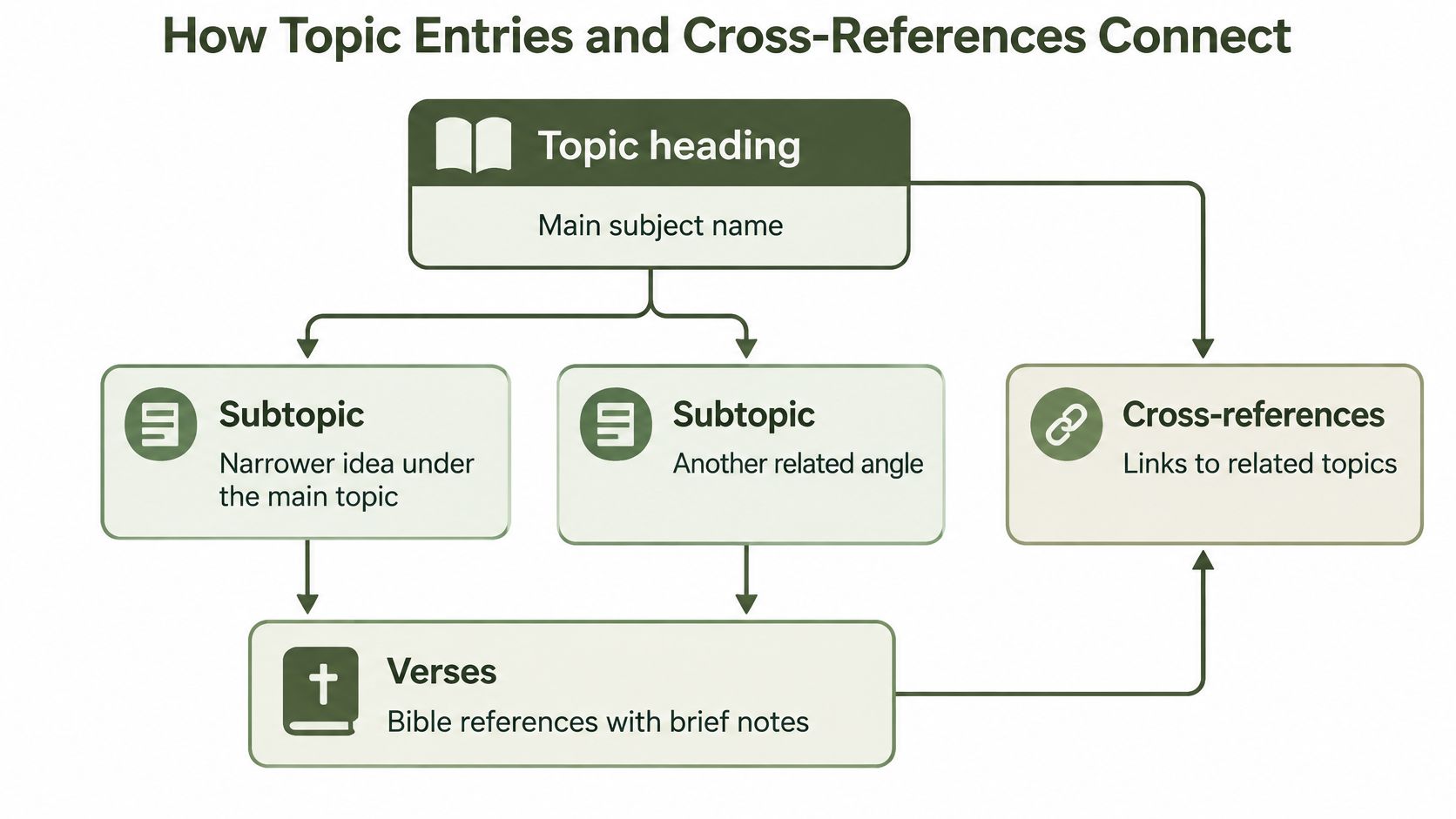
Subtopics do the narrowing work. Under a broad heading like prayer, you might find narrower angles such as prayer for enemies or prayer in trouble, each with its own shorter verse list. That structure saves you from wading through hundreds of general references when your need is specific.
The chain reference model
Some systems go further and link everything into chains. According to the BibleGateway guide to the Thompson Chain-Reference Bible, that model combines more than 100,000 topical entries across over 8,000 topics. It assigns topic numbers to verses, connects those numbers to indexes, and points you forward through chains of related passages.
You reach those chains by three routes:
- Alphabetical index: The discovery layer, where you look up a subject by name.
- Numerical index: Reportedly organizes more than 4,200 topics and subtopics by their assigned numbers.
- Verse links: The numbers printed beside verses, tying each passage back to its topic and forward to the next link.
Watching someone work through a chain makes the structure easier to grasp than describing it in the abstract.
One traced path on peace
Start with peace in the alphabetical index and note its topic number. That number leads you to the entry, where John 14:27 appears, Jesus speaking to his disciples on the night before the cross. Follow the chain forward and you reach Philippians 4:7, where Paul ties peace to prayer, and then Isaiah 26:3, where peace is linked to a mind that stays on God.
Now compare the three. One is a gift Jesus leaves behind, one follows thankful prayer, and one rests on trust. Same heading, three distinct angles, and the chain let you see the theme develop across books and testaments. If the mechanics of those links are new to you, this explainer on what a cross-reference in the Bible is breaks the idea down gently.
Why structure matters: Without stable topic numbers and links, a topical Bible is a flat list you can only read top to bottom. With them, it becomes a multi-step study route you can follow, retrace, and check.
How to Use a Topical Bible Step by Step
You don't need a complicated system. You need a routine you can repeat in about twenty unhurried minutes, with a notebook open and your Bible beside the topical index. Each step below has a reason attached, so you'll know what to skip only when you understand what it was protecting.
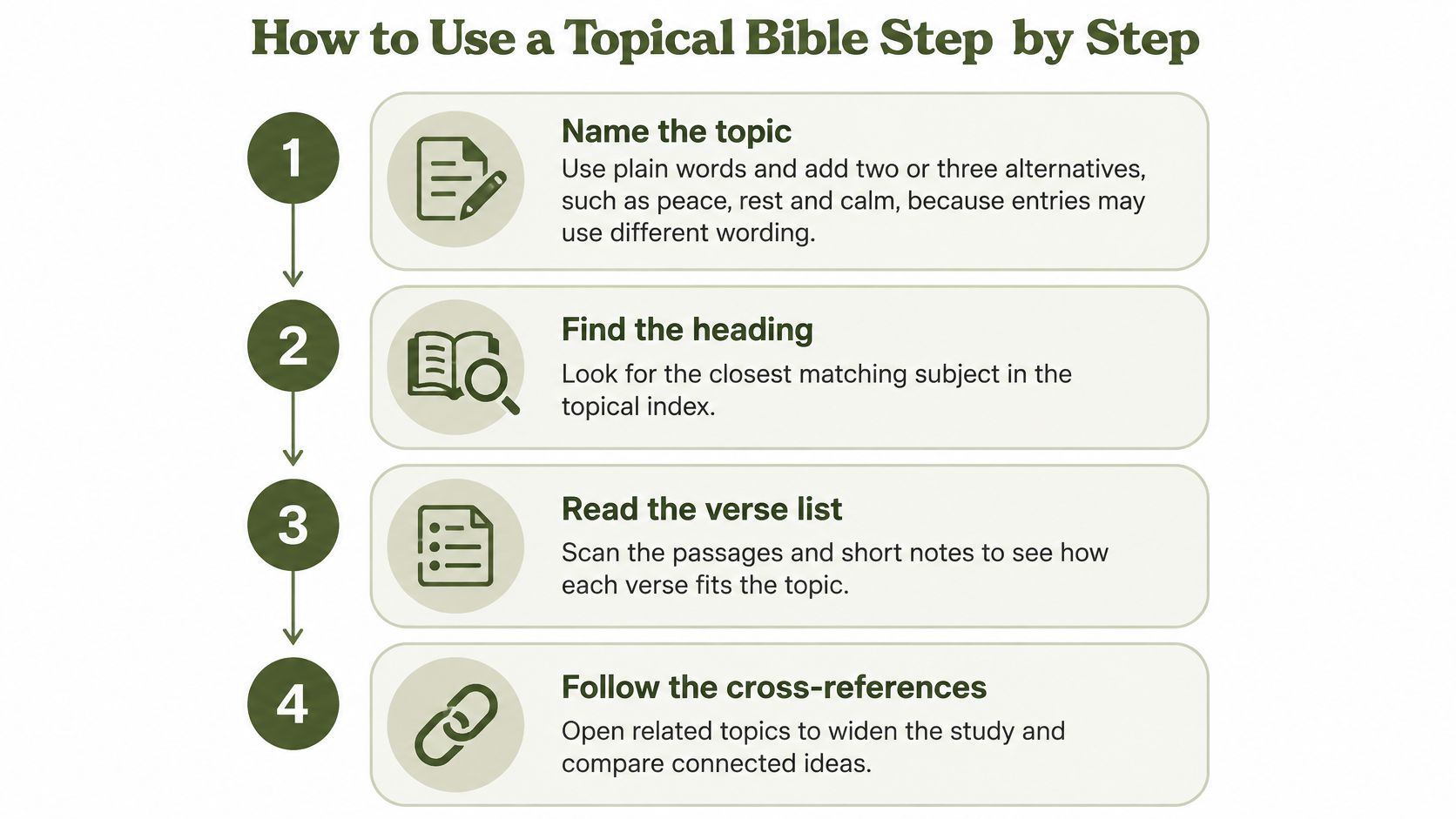
This infographic condenses the opening moves of the routine into four quick stages.
The seven-step routine
- Name the topic in plain words, then add two or three alternatives, such as peace, rest, and calm. Entries may use different terms than the ones in your head, and synonyms keep you from missing the right heading.
- Find the topic in the alphabetical index and note its numbered entry. The number is your anchor, because subtopics and cross-references will point back to it.
- Read the listed verses and mark the ones that address your situation. Don't try to absorb every reference. A short, relevant shortlist beats an exhausting one.
- Open each chapter and read the paragraph before and after your marked verses. Meaning depends on context, and the surrounding sentences often change what a verse can say to you.
- Compare the wording in two translations, such as the NIV and ESV. Where they differ, you've found a place to slow down rather than a problem to panic about.
- Follow two or three cross-references to see how the theme develops across books. Stop there for one sitting, or the chain will happily eat your whole evening.
- Write one sentence on what the passage says about God, people, or your situation, and one sentence on what it does not say. That second sentence is the one that keeps your conclusions honest.
A worked example with anxiety
Say you search anxiety. A typical entry leads you to Philippians 4:6-7, 1 Peter 5:7, and Matthew 6:25-34. All three belong on the list, but they aren't saying identical things.
Paul writes to a church he loves and connects freedom from anxiety with prayer and thanksgiving. Peter tells suffering believers to cast their anxiety on God because he cares for them, inside a passage about humility and standing firm. Then you open Matthew 6 and read the whole flow, and you see Jesus addressing worry about food and clothing, teaching his hearers to seek God's kingdom first and trust their Father's provision.
That context matters for how you apply it. Matthew 6 really does inform trust, and its logic reaches beyond groceries. But it doesn't promise relief from every fear, and it isn't a diagnosis of why you're anxious. Reading the chapter kept a good passage from being stretched into a guarantee it never made.
Write down what a passage doesn't say. It's the fastest way to stop a verse list from turning into a pile of promises nobody made.
Notice what the routine did for you. The topical entry found three passages in under a minute, which is exactly its job. The chapter reading then separated them, so each one could speak to your situation in its own voice instead of being blended into a single vague reassurance.
Where Topical Lookups Mislead and How to Check Them
What if the verse you found doesn't mean what it seems to say once it's back in its paragraph? That's the risk of topical reading. A verse separated from its literary, historical, and theological context can end up saying something different from what the passage means, and urgent searches about grief or anxiety make that risk harder to see, because you want reassurance more than interpretation.
Selective reading is also how many people read. A 2025 Lifeway survey found that 34% of Americans who had read at least part of the Bible looked up verses or sections suggested by others, while 33% searched for passages when they had a specific need. There's nothing wrong with starting from a need. The trouble comes from stopping at the verse list.
Five mistakes and the check for each
| Common Mistake | Why It Misleads | Check Before Applying |
|---|---|---|
| Treating a listed verse as a promise | A listing shows topical relevance, not guaranteed application | Read the surrounding paragraph and chapter |
| Assuming one word equals one topic | Passages on the same theme may use different words | Compare related topics and synonyms |
| Applying a description as an instruction | Narrative describes what happened, not always what to do | Identify whether the verse is a command, promise or description |
| Reading only one translation | Wording varies across translations | Compare NIV, ESV and KJV |
| Stacking similar verses as proof | Verses may address different problems | Ask what situation each verse addresses |
Run down the right-hand column before you act on any verse from a topic page. Read the surrounding paragraph and chapter, identify the original audience and situation, and consult cross-references before you apply the verse personally. If you want a slower companion method, learning how to study the Bible verse by verse builds exactly that checking habit.
One more limit is worth stating plainly. Study material reflects interpretation and is not a substitute for reading the surrounding passage or seeking trusted spiritual guidance. Notes and topic lists are the work of editors, however careful, and your pastor or a wise friend can catch what a printed list can't.
A short rule: Use a topical entry as a starting point, then return to the chapter before you decide what a verse means for you.
That single habit keeps topical study in its proper place. It's an entry point, a very good one, and never the whole study.
Start One Topical Study This Week
Start with one topic and one week. That's the whole assignment. Choose a single life theme such as peace, grief, or courage, then read five verses from its entry, each one inside its chapter rather than skimmed off the topic page.
For peace, begin with John 14:27 and read the surrounding paragraph, noticing who Jesus is speaking to and what is about to happen. Then compare Philippians 4:7 and Isaiah 26:3 with the same care. For each verse, write one sentence on what it says about God and one on what it asks of you, and let the differences between the passages stand instead of smoothing them into one message.
Picking a format you'll actually use
- Print topical Bible: Works well as a long-term reference on your shelf, easy to browse with a coffee in hand.
- Digital topical Bible: Faster for a quick lookup on your phone when a question hits midday.
Whichever you use, check that its entries show verse context and cross-references, so you can see why each verse is listed. In our app, the daily verse and the full Bible are free, and you can use the Scroll With God app without creating an account, which makes a small daily start easy to keep.
Before you share a verse with someone else or build a plan around it, reread the paragraph around it and confirm the situation it addresses. A topical Bible becomes more useful each time you check a result against the chapter. One topic, five verses, seven days. That's a study you can finish.
Pick your topic for this week, then open Scroll With God to read each verse one screen at a time, with its prayer, context, and the full chapter right there when you're ready to check the surrounding paragraph. Start with peace, courage, or hope, walk through a short collection over the week, and save the verses that hold up under a careful second reading.