A Bible Verse That Talks About Love: 1 Corinthians 13
Looking for a Bible verse that talks about love? Read 1 Corinthians 13 in context, with its meaning, the Greek word agape, and how to apply it.

In this article
- The Verse Most People Mean When They Ask
- What 1 Corinthians 13 Asks You to Do
- The Corinthian Conflict Behind the Wedding Reading
- A three-part argument
- What Agape Means and What It Does Not Mean
- A practical diagnostic
- Picking the Right Love Verse for Your Situation
- Read the Chapter and Practice One Quality This Week
1 Corinthians 13:4–7 is the Bible verse people often mean when they ask for a verse about love. It describes patient, self-giving conduct rather than romantic feeling. But if love is more than a feeling, what does it look like in an ordinary conversation, especially when people disagree?
The Verse Most People Mean When They Ask
The passage begins, in the King James Version, “Charity suffereth long, and is kind; charity envieth not; charity vaunteth not itself, is not puffed up,” (1 Corinthians 13:4). In many modern translations, “charity” is rendered as “love.” The verses that follow keep defining love through what a person does: how they respond to other people, how they handle conflict, and whether they remain committed to another's good.
That practical quality helps explain why 1 Corinthians 13:4–7 is often chosen as a Bible verse about love. Patience, kindness, humility, and endurance are recognizable actions, not abstract ideas. You can carry them into a difficult conversation or use them to reflect on how you treated someone during the day.
Other familiar verses speak to different aspects of love. John 3:16 shows the scale of God's love through the gift of his Son for the world. 1 John 4:8 offers a concise statement about God's nature: “God is love.” Both are meaningful choices, but neither gives the same detailed description of how love behaves toward another person.
The important caveat is that Paul first wrote this passage about love within a community, not as a romance text. The wedding reading is a later application, and the original setting helps clarify the advice.
In this passage, love is what a person does for another's good, shown through steady conduct.
What 1 Corinthians 13 Asks You to Do
| Quality | What it looks like today |
|---|---|
| Patient | Waits without punishing the other person, even when delayed |
| Kind | Acts with warmth and helpfulness rather than sharpness |
| Not envious | Is glad when someone else receives good things |
| Not boastful | Doesn't seek attention for personal achievements |
| Not proud | Doesn't treat others as beneath them |
| Not rude | Speaks and acts with courtesy, even under pressure |
| Not self-seeking | Doesn't insist on personal advantage in decisions |
| Not easily angered | Lets irritation pass without an explosive response |
| Keeps no record of wrongs | Forgives and doesn't keep bringing up past failures |
| Doesn't delight in evil | Feels no satisfaction at another person's failure |
| Rejoices with the truth | Takes pleasure in honesty and right conduct |
| Protects | Defends others' dignity and reputation |
| Trusts | Gives others reasonable benefit of the doubt |
| Hopes | Keeps a good outlook on people and situations |
| Perseveres | Stays committed through difficulty and delay |
The table turns familiar words into choices you can notice. Patience might mean waiting in a slow queue without sighing at the person serving you. Kindness could mean answering a stressed coworker with help instead of a sharp reply. Not envying someone's success might mean congratulating a colleague who received the opportunity you wanted.
Paul's list moves from positive actions to habits love refuses, then back to positive commitments. It warns against making yourself the center through envy, boasting, pride, rudeness, or self-interest. It also asks you to choose truth and stay hopeful and steady when a relationship is under strain. Love isn't a feeling you have to manufacture on command; it's a pattern of conduct you can practice.
Paul places this passage within his wider discussion of spiritual gifts in chapters 12–14. The Bible Gateway passage for 1 Corinthians 13 presents the chapter in that context: impressive abilities, including speech, knowledge, faith, and self-sacrifice, have no lasting value when they aren't governed by love. Its sequence of fifteen qualities gives readers concrete behaviors to examine instead of asking only whether they feel loving.
Try this today: Choose the quality that feels hardest this week, and watch for one moment in a conversation when you could practice it.
The Corinthian Conflict Behind the Wedding Reading
A church can have gifted speakers, generous members, and passionate worship, yet still struggle when people compete for attention or treat one another as rivals. That kind of tension helps explain why Paul's words about love appear where they do. He likely wrote to the Christian community in Corinth around A.D. 55, amid conflict over spiritual gifts and status, as a study of 1 Corinthians 13's context explains.
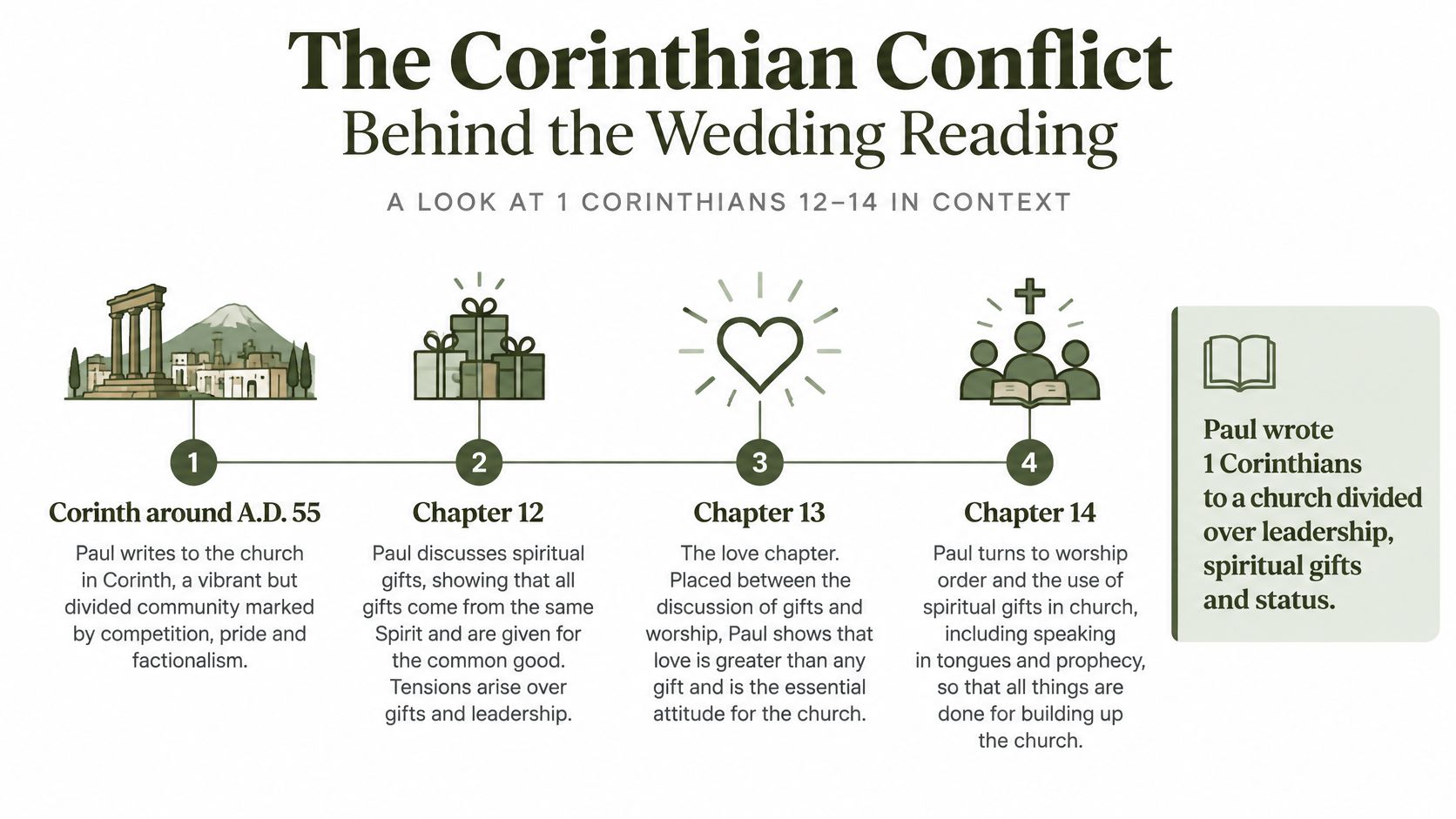
Chapter 13 sits between chapters 12 and 14. Those neighboring chapters discuss spiritual gifts and worship, so the placement gives love a specific role: it becomes the standard for how people use their abilities and treat one another. Paul wasn't asking the church to admire love as an ideal while carrying on as before. He was challenging them to make love the rule for shared life.
A three-part argument
The chapter develops in three stages:
- Verses 1–3: Speech, knowledge, faith, generosity, and even extreme self-sacrifice are worthless without love.
- Verses 4–7: Love is described through its conduct, including patience, kindness, humility, and perseverance.
- Verses 8–13: Love lasts, while spiritual gifts are temporary.
The conflict behind the letter included factions, lawsuits, disputes, and competition over gifts. In that setting, patience and refusing to boast weren't decorative qualities. They were instructions for how a divided congregation could stop using religious status to push others aside.
The chapter's use at weddings came later. Marriage is a fitting place to practice patience and kindness, but Paul's first concern was the health and unity of a church. Reading the passage as a letter to a quarrelling community makes its everyday force clearer. Its verbs sound like guidance for a difficult meeting, a family disagreement, or a church discussion where people are tempted to prove who matters most. For a careful reading of the passage in context, use a verse-by-verse Bible study approach.
What Agape Means and What It Does Not Mean
The word agape doesn't mean romantic chemistry. In 1 Corinthians 13, it describes self-giving regard that places another person's needs ahead of personal advantage. The Bible Odyssey explanation of Paul's love passage notes that the King James Version translates the term as “charity.” Modern readers may hear that word mainly as giving money, but the passage is about a much broader way of treating people.
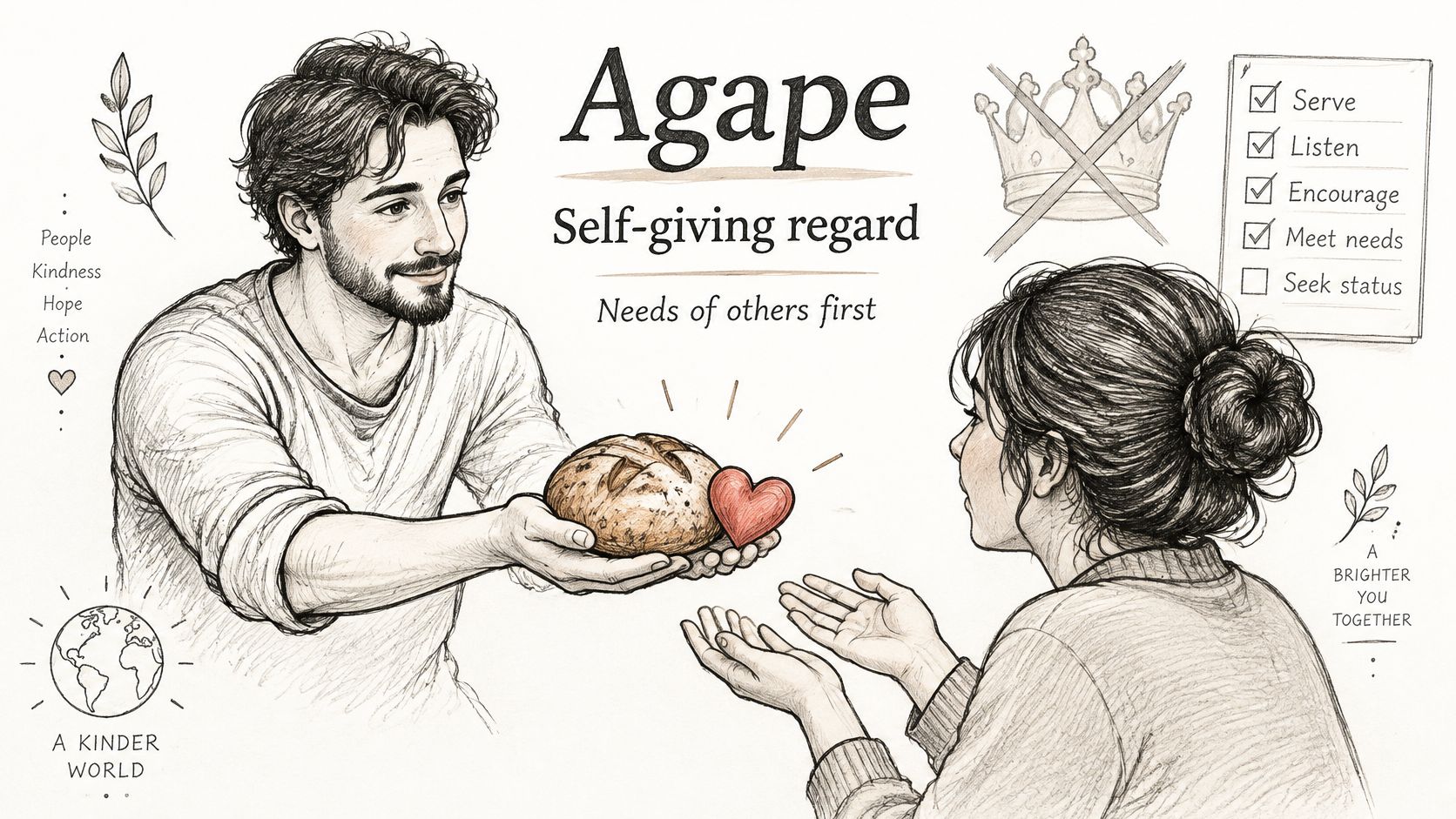
That distinction matters because love is often reduced to a private feeling. Feelings may be present, but Paul's description focuses on how a person acts, especially when relationships are difficult. The passage also isn't a command to approve of every choice or ignore truth. It says love rejoices with the truth and doesn't delight in wrongdoing.
A practical diagnostic
Before acting, ask yourself:
- Am I seeking personal advantage? For example, am I trying to win the exchange at the other person's expense?
- Am I feeding resentment or taking pleasure in someone's failure? That can include replaying an old mistake to shame them.
- Does my response protect, trust, hope, or endure for their good? This doesn't require pretending a problem isn't real.
At work, a colleague might take credit for your idea. Agape doesn't require pretending that was fair, but it does rule out sabotaging them in return. You can address the issue directly without turning retaliation into your goal.
At home, a family member might repeat an old mistake. A loving response can include clear correction and a firm boundary, without contempt or a running list of past failures. For more help thinking through the role of forgiveness in a relationship, see this guide to a Bible verse on forgiveness.
The wedding reading is one application, but this test works for church leaders, spouses, friends, and strangers. Agape asks what your actions are doing for another person's good, not what emotion you feel toward them.
Picking the Right Love Verse for Your Situation
Different situations call for different passages. This guide pairs a common need with a verse and the kind of love it describes.
| Situation | Verse | Kind of love |
|---|---|---|
| Wanting to know God loves me | John 3:16 | Self-giving love from God |
| Doubting my worth | Romans 5:8 | Love shown while we were still sinners |
| Learning what God is like | 1 John 4:8 | God is love |
| Loving people at home or at work | 1 Corinthians 13:4–7 | Patient, non-competitive conduct |
| Hurt by someone | Matthew 5:44 | Love for enemies, including prayer for those who hurt us |
| Costly friendship | John 15:13 | Laying down one's life for friends |
A verse about love isn't automatically a verse about romance. Scripture speaks about God's self-giving love, love of neighbor, loyalty, friendship, love for enemies, and affection within relationships. A guide to Bible verses about love highlights why it helps to identify the kind of love you're seeking before choosing a passage.
If you feel rejected or unsure of your worth, John 3:16 and Romans 5:8 focus on God's love and what it gives. If you're learning what God is like, 1 John 4:8 gives a brief statement to reflect on. These verses offer a different kind of reassurance from instructions about how to behave toward another person.
For tension at home or work, 1 Corinthians 13:4–7 gives you conduct to examine: are you acting with patience and kindness, or turning a disagreement into a contest? If someone has hurt you, Matthew 5:44 calls for love and prayer for enemies. Loving a person doesn't mean staying exposed to harm; pair the verse with wise boundaries and trusted support.
For a friendship involving sacrifice and loyalty, John 15:13 offers a fitting reflection. You can explore more passages on what the Bible says about friendship. Whichever verse you choose, read it with its audience and setting in mind. For the practical question of how love acts, start with the full chapter of 1 Corinthians 13.
Read the Chapter and Practice One Quality This Week
A short reading habit can help move a verse from an encouraging line to a choice you make in real life. Try these three steps:
- Read the surrounding chapters. Read 1 Corinthians 12–14 in one sitting so chapter 13 remains connected to Paul's discussion of gifts and worship.
- Choose one quality. Pick the behavior you find hardest, then name the situation where it may be tested this week. If patience is difficult, for example, watch for a moment when someone is late or needs you to repeat an explanation.
- Use the agape test. Apply the questions from the previous section to one real decision, then write down what you chose and why. A brief note can help you notice whether your actions matched the quality you selected.
In its 2025 analysis, the American Bible Society reported that 66% of people who used the Bible four or more times per week strongly agreed that the Bible influenced them toward more loving behavior, compared with 22% of monthly users. The finding points to a practical reason to return to Scripture regularly: repeated reading gives you more chances to reflect on how its guidance shapes your conduct.
Scroll With God lets readers keep reading the chapter a verse came from without leaving the app. Its Discover section includes Love with 24 verses, alongside topics for Peace, Courage, and Hope, so you can explore related passages while keeping the full chapter in view.
Open 1 Corinthians 13 first, read it in context, then choose one quality to practice in a specific conversation this week. If the situation involves serious harm or a difficult decision, seek guidance from a trusted spiritual leader or other appropriate support.
Scroll With God pairs Bible verses with context, prayer, and a way to continue reading the full chapter, making it easier to explore what love means in Scripture. Start with the Love collection and visit Scroll With God to read and reflect on passages at your own pace.