How to Do a Bible Word Study: A Step-by-Step Guide
Learn how to do a Bible word study: find the original Hebrew or Greek word, compare translations, trace usage, and check context before you draw conclusions.

In this article
- Identify the Original Word Before You Study It
- Establish the word's identity
- Reference tools for a word study
- Run the Seven Steps and Catch the Skews
- Follow the sequence without choosing early
- Catch the interpretation you brought with you
- Compare Translations and Lexicon Ranges
- Translation approaches for word studies
- Compare entries, not isolated glosses
- Trace Every Occurrence Through Its Context
- Turn search results into evidence
- Preserve the difficult examples
- Confirm the Sense Before You Teach It
- Put the conclusion through a written check
- Use prepared notes without outsourcing judgment
You're reading a passage before your small group meets, and one word seems to settle the whole discussion. Then you check another translation. It uses a different word, and suddenly you're not sure whether your explanation comes from the passage or from the English wording you started with.
Learning how to do a Bible word study begins with that uncertainty. Treat the English word as a question, not an answer. A disciplined study helps you explain what the author means in this passage without turning a dictionary gloss into a doctrine.
Identify the Original Word Before You Study It
Start with the verse that raised the question. Write down its reference and the exact interpretive problem before opening a dictionary. If you're studying love, for example, ask what the author is commanding, describing, or contrasting in that sentence, rather than trying to define love throughout Scripture.
Name the language before naming the meaning. As BiblicalTraining's overview of biblical languages explains, the Old Testament is overwhelmingly Biblical Hebrew, with smaller sections in Biblical Aramaic, while the New Testament was transmitted in Greek and preserves some Hebrew and Aramaic expressions.
The same English word can represent different original-language words. Your search must therefore begin with the term in your chosen verse, not every English occurrence that happens to look familiar.
Establish the word's identity
- Copy the translated wording. Put several translations beside your reference. Include enough of the sentence to see what the word modifies or relates to.
- Locate the lemma. Open an interlinear Bible and find the original-language entry aligned with the English expression. A lemma is the dictionary headword, not necessarily the exact form printed in the verse.
- Record the grammatical form. Copy the parsing information into your notes. For a Greek verb, that may include tense, voice, mood, and person; for Hebrew, note the stem and relevant inflection.
You don't need to master the grammar before beginning. You do need to distinguish what the tool reports from what you think that form implies. If a parsing label is unfamiliar, mark it for checking rather than attaching a theological claim to it.
Reference tools for a word study
| Tool | What It Gives You | When to Use It |
|---|---|---|
| Interlinear Bible | Word-by-word English aligned with Hebrew or Greek | Step 2: locate the lemma behind the English word |
| Morphology parsing guide | Tense, case, stem, and person | Step 3: record the form in the verse |
| Hebrew lexicon, such as BDB or HALOT | Possible meanings for Hebrew words with cited uses | Step 4: map the range of senses |
| Greek lexicon, such as BDAG | Possible meanings for Greek words with cited uses | Step 4: map the range of senses |
| Strong's Exhaustive Concordance | Numbered index connecting KJV words with original-language entries | Step 5: list other occurrences, not establish a definition |
| Bible atlas or commentary | Historical and cultural background | After step 7: consult if the setting still affects the choice of sense |
An interlinear is convenient, but its aligned English words aren't a substitute for understanding a sentence. Likewise, a Strong's number gives you a searchable identifier, not an interpretation.
Stop here until your notes identify the verse, the lemma, and its grammatical form. Otherwise, you may spend the rest of the study investigating the wrong word.
Run the Seven Steps and Catch the Skews
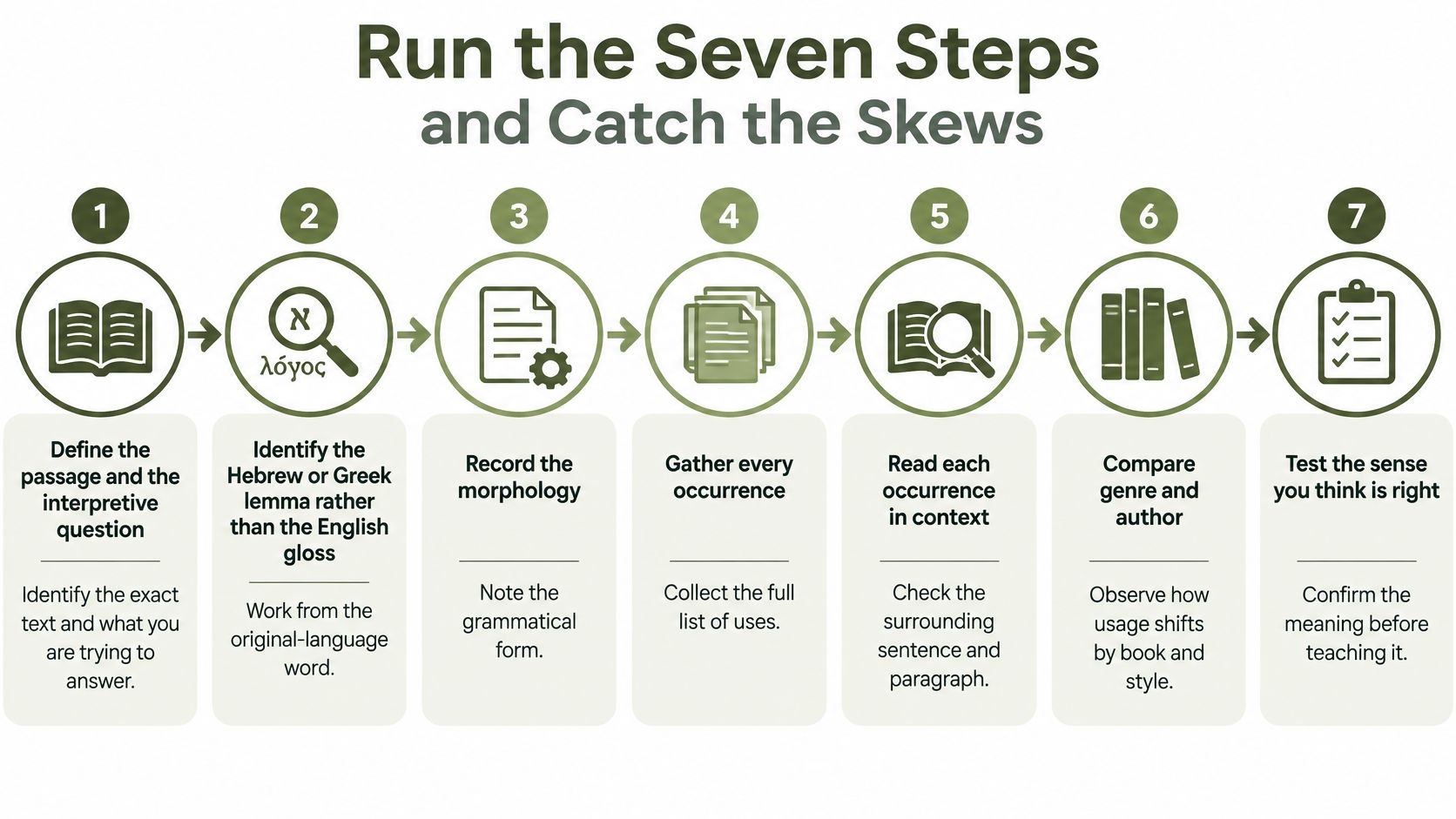
Use a fixed sequence so your preferred interpretation doesn't determine which evidence you collect. The University of Toronto's Trinity College word-study guide distinguishes a word's possible meanings from its meaning in context and recommends consulting two or three lexicons rather than relying on a single entry.
Keep the process visible while you work.
Follow the sequence without choosing early
Define the passage and the interpretive question. Write a question the text can answer: Does this expression describe an attitude, an action, or a relationship? Avoid starting with a conclusion you want to defend. If you can't explain the surrounding passage, use a verse-by-verse Bible study approach before narrowing your attention to a word.
Identify the original-language lemma. Transfer the verified headword into your worksheet. Keep the English rendering beside it for reference, but search by the original-language entry. The matching mistake is collecting English look-alikes and treating them as evidence about the same biblical term.
Record the morphology before interpreting it. Note the form used in this verse, including anything that could affect how the word functions. Don't turn a tense label into a claim about duration or a Hebrew stem into a fixed intensity rule without checking the construction. Grammar needs interpretation too.
Map the possible senses with lexicons. Read the entry's divisions, examples, and grammatical notes, not just its first English equivalent. Build a provisional list of candidate senses. Choosing the most spiritually appealing definition at this stage reverses the process: you're supposed to test possibilities, not adopt one because it would preach well.
Gather occurrences with a concordance. Save the references associated with the lemma, keeping the search settings visible. Note whether the tool searches a particular translation, original-language text, or collection. Don't assume an English keyword search produces the same results, and don't assign one dictionary gloss to every hit.
Classify the results. Separate occurrences by author, genre, and corpus, meaning the relevant collection of writings. An occurrence in a similar construction deserves closer comparison than one that merely shares a headword. Record awkward examples as carefully as agreeable ones, especially when they challenge a doctrine you already prefer.
Test the candidate senses in context. Read the relevant sentences and their surrounding arguments before choosing. Ask which sense explains the author's wording without adding an idea the passage never develops. When ancient translation evidence enters the discussion, distinguish a translator's interpretation from direct evidence about the original expression.
Catch the interpretation you brought with you
The most revealing part of the worksheet may be the evidence you're tempted to omit. A passage that doesn't fit your preferred sense isn't an inconvenience to hide. It may show that the word has a broader range, that the construction differs, or that your proposed reading needs revision.
Practical rule: A lexical possibility becomes a credible interpretation only when you can explain why it fits this sentence better than the alternatives.
For a short study, keep the question narrow rather than promising yourself a complete theology of the term. Difficult words, disputed grammar, and extensive occurrence lists require more work; a timer can limit your session, but it can't certify your conclusion.
End the worksheet with a sentence in this form: In this passage, the word means [chosen sense] because [contextual reason], rather than [alternative], which would conflict with [specific feature of the argument].
Compare Translations and Lexicon Ranges
Agreement across translations can strengthen an observation; disagreement identifies something to investigate. Neither result settles the meaning by a vote. Translators may agree because the construction is clear, while differences may reflect ambiguity, English style, or different judgments about how explicitly to express an idea.
This comparison has a long history. The Hebrew Scriptures were translated into Koine Greek in the third and second centuries BCE in the Septuagint, followed by traditions including Aramaic Targums, Syriac translations, and Jerome's Latin Vulgate, as described in the overview of Bible translation history.
Those versions represent work across linguistic communities. They can help you investigate how readers understood a passage, but an ancient rendering still needs evaluation rather than automatic acceptance.
Translation approaches for word studies
| Translation | Approach | What to Check in a Word Study |
|---|---|---|
| English Standard Version | Essentially literal, retaining word-for-word correspondence where possible | Useful for tracing a repeated term, but verify that the original lemma remains the same |
| New International Version | Balances close correspondence with meaning-focused, readable English | Notice how translators understand the sentence; check key wording against a more formally corresponding rendering |
Use the comparison to formulate questions. If one translation uses an abstract noun and another describes an action, ask whether the difference comes from grammar or an attempt to clarify the sense. Don't assume the more literal-looking English expression is automatically easier to interpret.
Compare entries, not isolated glosses
In your lexicon notes, separate shared senses from senses mentioned by only one resource. Check the examples under each category and whether an entry discusses your passage directly. A minority option deserves examination, not immediate rejection or special status.
A lexicon entry is a range of possibilities, not a definition you can paste whole into a verse.
For a topic such as what joy means in the Bible, resist merging every related expression into one expanded meaning. Ask what the particular author communicates here.
Finish this comparison by writing the unresolved translation difference as a question. That gives you something concrete to test against the passage instead of another collection of definitions.
Trace Every Occurrence Through Its Context
Suppose your search finds a term used in Psalms as a cry for help and in Proverbs within instruction. That's a hypothetical comparison, not a claim about a particular lemma. Its value is the question it raises: are you importing the emotional force of a prayer into a teaching passage?
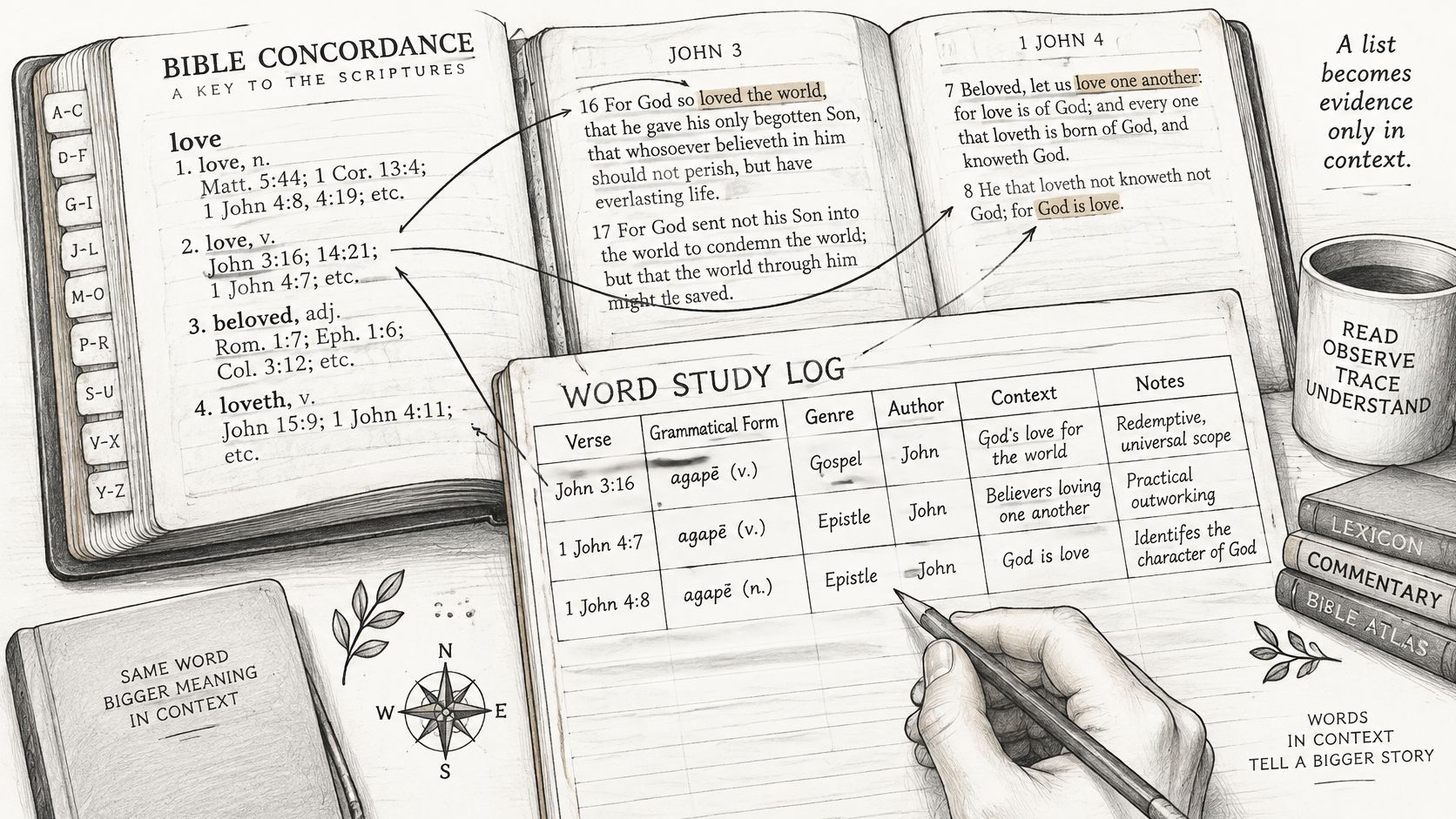
Keep an occurrence log open beside the text so you can distinguish the settings.
Turn search results into evidence
| Log field | What to record |
|---|---|
| Verse | Reference and enough wording to recognize the construction |
| Grammatical form | The form actually used, including relevant differences |
| Genre | Narrative, prophetic poetry, wisdom, Gospel, or epistle |
| Author or corpus | The relevant writer or collection, noting uncertainty |
| Local sense | Your provisional paraphrase of the term in that setting |
| Relationship to the target passage | Supporting, challenging, or not closely comparable |
Read outward from the sentence, identifying the subject, action, object, and nearby contrasts. Then read the paragraph to establish what the speaker or writer is doing: requesting help, issuing a warning, explaining an event, or developing an argument.
Check the rest of the book before reaching for a distant parallel. Repeated wording within the same discussion can clarify a relationship that a loosely connected reference won't. Use Bible cross-references to find related passages, but distinguish shared vocabulary from a merely similar topic.
The embedded video provides an additional study resource.
Preserve the difficult examples
For a large result set, begin with the closest grammatical and literary parallels, then broaden the review. Label an initial selection as preliminary; don't describe it as every occurrence if you haven't checked the full list.
Frequency isn't importance. A common use elsewhere may not explain an unusual construction in your target passage. Record outliers with a reason for their difference rather than discarding them, and mark which examples support your proposed sense and which challenge it.
Confirm the Sense Before You Teach It
Close the tools long enough to write an explanation someone else can evaluate. If your conclusion depends on an impressive original-language label but you can't explain the connection to the sentence, it isn't ready for a small group.
Your final paragraph should name the chosen sense, identify the strongest supporting passages, and show how that reading contributes to the author's argument. Keep your confidence proportionate to the evidence. Sometimes the responsible conclusion is that related senses remain possible without changing the passage's main point.
Put the conclusion through a written check
- State the positive case. Explain why the chosen sense fits the wording and the immediate argument. Include the most relevant comparison passages rather than a long, undifferentiated reference list.
- Account for rejected senses. Give a sentence-level reason each serious alternative is less likely. Personal preference and an attractive application aren't textual reasons.
- Check the book's logic. Read your explanation alongside the surrounding discussion. Mark any place where your interpretation changes the subject or requires an assumption the author hasn't established.
- Invite informed disagreement. Compare your paragraph with trusted commentaries or a teacher. Record the reasons for agreement and conflict, not just the names of people who support you.
- Limit the application. Draw a personal or teaching point that follows from this passage. Don't build a complete doctrine from a single lemma.
Teaching safeguard: Tell the group what the passage supports, what remains uncertain, and what your word study cannot establish.
Use prepared notes without outsourcing judgment
At Scroll With God, our one-tap study sheets cover a verse's meaning, who wrote it and why, the Hebrew or Greek underneath, life in biblical times, cross-references, and application. Sources are cited at the bottom of each sheet, so you can inspect the material behind an explanation.
The screenshot shows the app as a study aid.
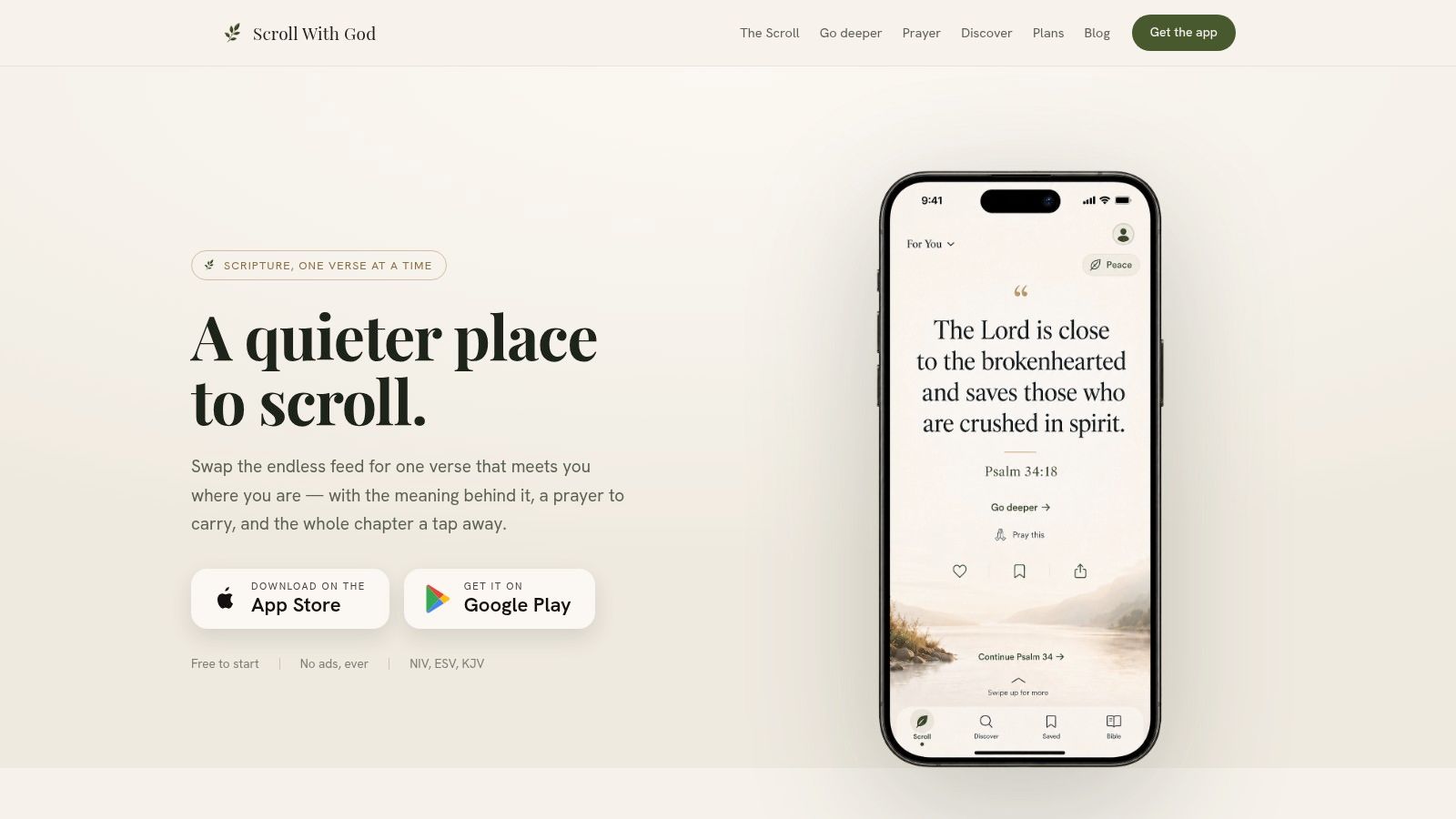
Prepared material can reduce the work of gathering background, but it still reflects interpretation. It doesn't replace reading the surrounding passage or seeking trusted spiritual guidance when a conclusion remains unstable.
Choose a word from this week's reading and complete the written check before teaching it. You're finished when you can explain the sense plainly, defend it from the passage, and acknowledge its limits.
Scroll With God pairs Scripture with study sheets, original-language explanations, and access to the surrounding chapter. Visit Scroll With God, choose a passage from your current reading, and use its study material alongside your own word-study notes.