What Is a Cross Reference in the Bible and How to Use It
Learn what is a cross reference in the Bible, how these links connect related passages, and how to judge whether each one actually helps your reading.
In this article
- What a Cross Reference Means in Plain Terms
- What following a reference looks like
- How Cross References Differ From Other Bible Tools
- Choose the tool for your question
- Five Types of Links and How Strong Each Is
- Similarity isn't always influence
- How to Read a Cross Reference Step by Step
- Read before drawing conclusions
- If the connection still seems unclear
- Why Different Bibles Show Different Cross References
- What changes between editions
- When a Cross Reference Does Not Settle the Question
- Assumptions that lead readers astray
- Can a reference change what a verse means?
- Use Cross References in Your Next Study Session
- Keep a useful study note
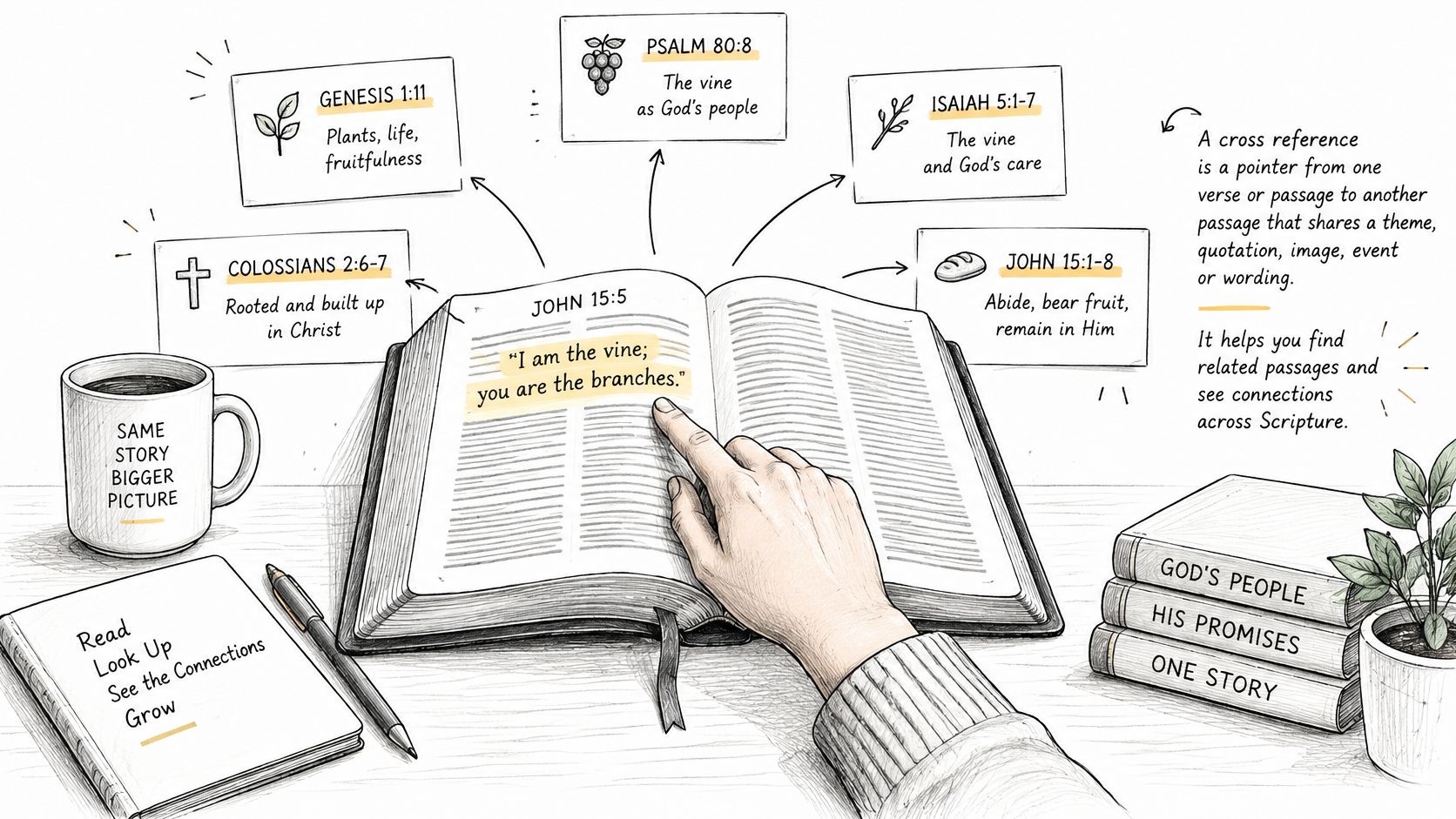
A Bible cross reference is a pointer from one verse or passage to another passage that shares a theme, quotation, image, event or wording.
You're reading your Bible when a tiny letter beside a verse catches your eye. You follow it to a note, find another passage, and wonder whether you're supposed to understand the connection immediately. You aren't missing a secret code. The useful question isn't just where the reference leads, but what kind of connection you've been invited to investigate.
What a Cross Reference Means in Plain Terms
Think of a cross reference as a see-also card in a library catalogue. It directs you toward related material, but it doesn't explain that material for you. A hyperlink in an article works much the same way: following it gives you something else to read and evaluate.
In a printed Bible, you'll usually encounter a small letter or number beside the text. Find the matching marker in the margin or footnote, and you'll see a chapter-and-verse address. That address tells you where to turn, not what conclusion to reach.
What following a reference looks like
Say you're reading the account of the bronze serpent in Numbers. A margin note directs you to Jesus' conversation with Nicodemus in John. You turn there and discover that Jesus explicitly connects Moses lifting up the serpent with the Son of Man being lifted up.
The illustration below shows how a single passage can connect with other parts of Scripture.
Cross references commonly help you do these jobs:
- Connect a prophecy and a later quotation. Notice how a biblical writer uses an earlier passage.
- Compare parallel accounts. Examine what different writers include when describing an event.
- Trace a recurring idea. Follow subjects such as covenant, sacrifice, or shepherding across Scripture.
When someone asks, “What is a cross reference in the Bible?” the distinction that matters most is between finding a connection and explaining it.
A cross reference invites you to compare two texts; it does not decide what either one means.
How Cross References Differ From Other Bible Tools
Bible study tools compared
| Tool | What It Gives You | Example | Best For |
|---|---|---|---|
| Cross reference | One pointer to one related passage | Numbers 21:4–9 linked to John 3:14–16 | Following an idea or quotation across books |
| Concordance | Every verse containing a chosen word | Every verse using the word shepherd | Finding where a word appears |
| Topical index | Verses grouped under a subject | Verses listed under grief | Starting from a life situation |
| Parallel passages | The same event told in more than one book | Accounts of one event in Matthew, Mark and Luke | Comparing details |
| Commentary | Written explanation of a passage | Verse-by-verse notes | Understanding what a passage says |
A cross reference sends you to another biblical text, usually selected by an editor. A concordance searches vocabulary within the translation it indexes. That distinction matters because related passages don't always use identical words, and identical words don't always express related ideas.
A topical index starts with a subject rather than a particular verse. Parallel passages help you compare accounts of an event, while a commentary offers an explanation rather than another address.
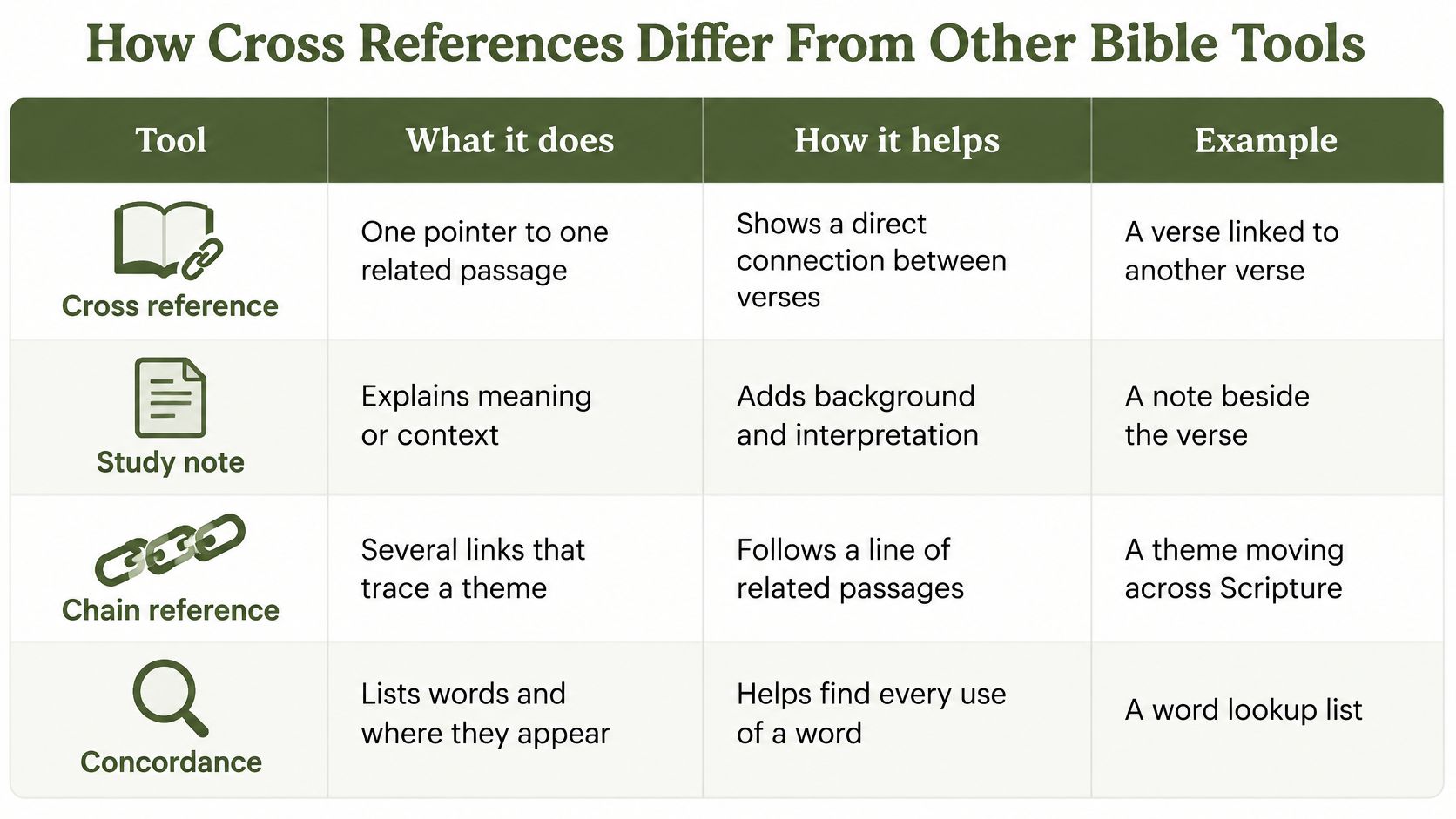
The visual comparison also includes study notes and chain references, which you may encounter in a study Bible.
Choose the tool for your question
A study note gives a compact explanation beside the text. A chain reference leads through a sequence of related passages. Neither should be confused with the biblical wording itself.
The Treasury of Scripture Knowledge is a classic example of a collection of passage links assembled from earlier editors' judgments. Its usefulness comes from directing readers toward comparisons, not supplying a final explanation of every connection.
Use a concordance when you remember a word, a cross reference when you want to follow an idea, and a commentary when you need help understanding a passage. If you're choosing a digital starting point, this guide to a Bible study app for beginners can help you identify useful reading tools.
For a video introduction, use the player below.
Five Types of Links and How Strong Each Is
Not every connection supports the same conclusion. Before relying on a link, identify whether you're looking at an explicit statement, distinctive shared wording, or a resemblance.
Five types of cross-reference links
| Relationship | What It Looks Like | Example | Strength of Evidence |
|---|---|---|---|
| Quotation | A later text quotes an earlier one word for word or nearly so | Matthew 1:23 quotes Isaiah 7:14 | Strong |
| Verbal parallel | Shared distinctive wording without a formal quotation | Two passages using the same rare phrase | Moderate when wording and context support the connection |
| Thematic parallel | The same idea or image expressed in different words | Psalm 23 and John 10 shepherd imagery | Interpretive aid |
| Prophecy-fulfillment claim | A later text says an earlier promise was fulfilled | Micah 5:2 and Matthew 2:6 | Strong where the text makes the claim explicitly |
| Possible allusion | A faint echo of an earlier story, image or event | A later writer echoing the imagery of an earlier event | Tentative; needs careful evidence |
These categories aren't a rigid ladder. An explicit prophecy-fulfillment statement can offer stronger evidence than a verbal parallel, even though it appears farther down the table.
A quotation is checkable because the later writer reproduces recognizable wording, sometimes with translation differences. A verbal parallel needs more investigation: distinctive phrasing matters more than an ordinary word appearing twice.
Similarity isn't always influence
A thematic parallel can enrich your reading without showing that a writer deliberately referred to another passage. A possible allusion makes a more tentative claim: the writer may be inviting readers to remember an earlier text.
The Oxford Academic discussion of biblical intertextuality distinguishes investigating whether an earlier text influenced a later writer from examining how texts resonate when read together. In plain language, “these passages help me understand each other” isn't the same claim as “this author intentionally referred to that passage.”
Practical rule: Name the type first, then judge the link.
Write the category beside the reference in your notes. That small habit keeps a faint echo from turning into supposed proof just because you've copied it into a study sheet.
How to Read a Cross Reference Step by Step
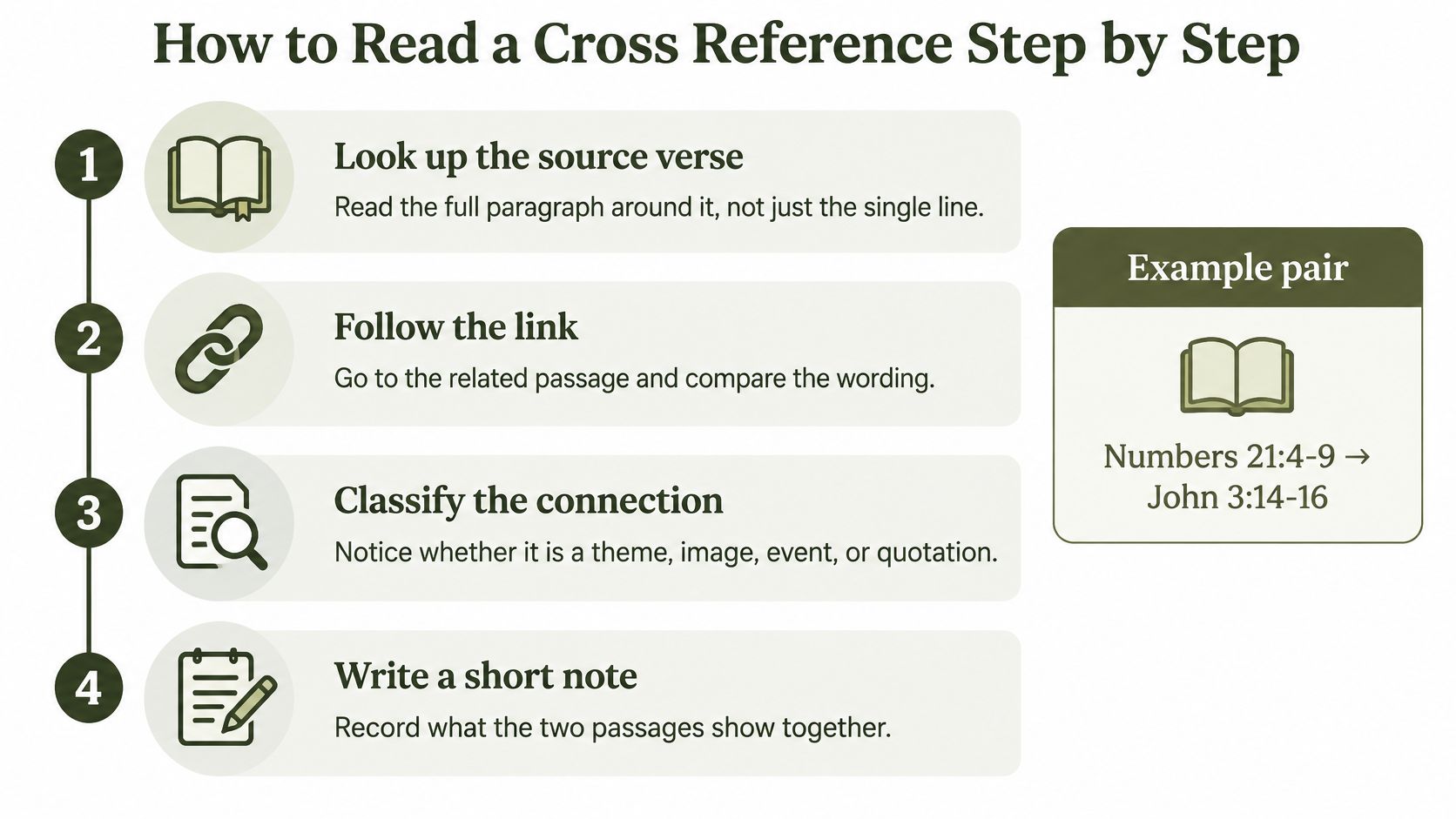
Use Numbers 21:4–9 and John 3:14–16 as a practice pair. Keep your Bible open and make a short note as you compare them, rather than trying to settle every theological question at once.
Read before drawing conclusions
Start with the source passage. Read the whole paragraph in Numbers, noticing the people's complaint, the judgment, Moses' intercession, and God's provision. These details keep the serpent from becoming an isolated symbol.
Follow the reference into its setting. Read John's surrounding chapter, including Jesus' conversation with Nicodemus. You're listening to an argument about heavenly things, belief, and life, not merely finding another mention of Moses.
Name the relationship. John makes an explicit comparison with the earlier event, so this isn't a faint allusion or a shared word. Describe it as an explicit reference and theological comparison rather than forcing it into the category of verbatim quotation.
Compare translations. Read the passages in the NIV and KJV, paying attention to the wording that carries the comparison. Translation differences may clarify a phrase, but neither translation's margin notes belong to the biblical sentence itself.
Ask what the later passage adds. John connects the earlier lifting up with the Son of Man and eternal life. Record that development instead of assuming the earlier audience already understood everything the later passage reveals.
Rank the evidence for your claim. Give explicit quotations and stated comparisons more weight than possible echoes; treat broad themes as study aids. Here, the connection is explicit, but you still need to explain which features Jesus compares.
Write a bounded conclusion. For example: John uses the lifting up of the serpent to explain the lifting up of the Son of Man; this doesn't make every detail of the wilderness event a prediction about Jesus.
The graphic offers a compact version to keep beside your Bible.
If the connection still seems unclear
- Check the address. Make sure you've followed the right marker and read the full verse range.
- Try another translation. Look for an image or phrase that your usual translation expresses differently.
- Reread both chapters. An editor may have linked a broader situation rather than matching vocabulary.
- Leave uncertainty visible. Write possible thematic connection if you can't establish anything stronger.
You don't have to rescue every editorial suggestion. A careful unresolved note is more useful than a confident explanation the passages won't support.
Why Different Bibles Show Different Cross References
One Bible may point you to a passage that another leaves unmarked. That difference usually reflects editorial choices: what connections to include, how much space is available, the wording of a translation, and the scope of the reference collection.
Cross-reference counts across editions and datasets
| Source | Year | Cross-References Listed |
|---|---|---|
| King James Bible, first edition, documented by Real Bible Study | 1611 | Approximately 9,000: 6,588 Old Testament, 885 Apocrypha, and 1,527 New Testament |
| Treasury of Scripture Knowledge historical account | Around 1830 | Estimated roughly 380,000 to 381,775; advertised as 500,000 |
| Thomas Nelson NKJV edition, as advertised in the edition listing | 2023 | 43,000 advertised cross-references |
| OpenBible.info dataset, reported by Biblical Connections | November 2024 | 344,799 mapped links across 142,082 chapter pairs |
Treat these totals as records of different editorial projects, not as a contest. A printed Bible's reference notes and a dataset mapping links between chapters have different purposes. A larger total does not show that any particular connection is stronger. To assess a link, read the passages and consider what kind of relationship the editor is suggesting.
What changes between editions
Editors may select quotations, doctrinal themes, historical parallels, or repeated phrases. One may leave out a connection that seems uncertain; another may point to a passage range instead of one verse. So an NIV, ESV, or KJV edition can differ in both its wording and its cross-reference notes.
Digital tools can make the difference harder to spot. Similar-looking buttons may open a translation's cross references, a topical collection, or a broader study resource. First identify what you are reading.
- Identify the resource. Check the edition name or the collection credited in the app.
- Inspect the relationship. Does the destination offer a quotation, a parallel account, or a shared topic?
- Compare the passages. Don't treat a link as proof just because several Bibles include it. Look for evidence in the passages themselves.
A missing reference does not automatically mean an error. The editor may have chosen a narrower set, served a different study purpose, or judged the proposed connection too uncertain to include. Use the link as a lead, then classify the relationship you can see: a direct quotation is clearer evidence than a faint thematic echo.
When a Cross Reference Does Not Settle the Question
A cross reference is evidence to interpret, not a proof-text.
A proof-text is a passage used to establish a claim, often without enough attention to its setting. Following a reference can become proof-texting when you collect supporting phrases but stop asking what each writer is saying.
Assumptions that lead readers astray
A linked verse automatically explains the original. In Numbers, the wilderness account has its own sequence of rebellion, judgment, intercession, and deliverance. Jumping straight to John can cause you to overlook that sequence instead of understanding it.
The passages must say the same thing. John develops a theological interpretation of the earlier event rather than repeating its meaning, a distinction addressed in Themelios on interpreting texts within the whole Bible. The later comparison adds understanding without erasing the earlier narrative's setting.
More links mean stronger proof. A long list of serpent references wouldn't necessarily explain Jesus' comparison better. Some might concern unrelated situations, so the quality of the connection matters more than the size of the list.
Every Bible should show the same links. If another edition omits this reference, examine the passages themselves. The explicit comparison in John remains available regardless of what an editor puts in the margin.
Can a reference change what a verse means?
A reference can change your understanding of a passage by revealing something you hadn't noticed. It doesn't authorize you to replace the passage's wording or import every feature of another story into it.
Before drawing a conclusion, consider the immediate chapter, the historical situation, and the wider canon, meaning the Bible read as a whole. A verse-by-verse Bible study approach helps you follow the writer's argument rather than assembling isolated statements.
For difficult questions, bring your notes to a trusted pastor, teacher, or study group. Study material reflects interpretation and isn't a substitute for reading the surrounding passage or seeking trusted spiritual guidance.
Use Cross References in Your Next Study Session
Choose a passage you already know, such as a familiar psalm or Gospel paragraph. Familiarity makes it easier to notice what the linked passage contributes without losing track of your starting point.
Follow a manageable reference rather than opening every available link. Read both chapters, assign the relationship type, and write a sentence explaining what the comparison helps you see and what it doesn't establish.
Keep a useful study note
- Starting passage. Record the reference and the question you brought to it.
- Connection type. Choose quotation, verbal parallel, thematic parallel, prophecy-fulfillment claim, or possible allusion; describe an explicit comparison in your own words when needed.
- Conclusion and limit. State your insight alongside anything the connection leaves unresolved.
If you're still choosing a reading routine, use this guide on how to start reading the Bible to select a manageable starting passage.
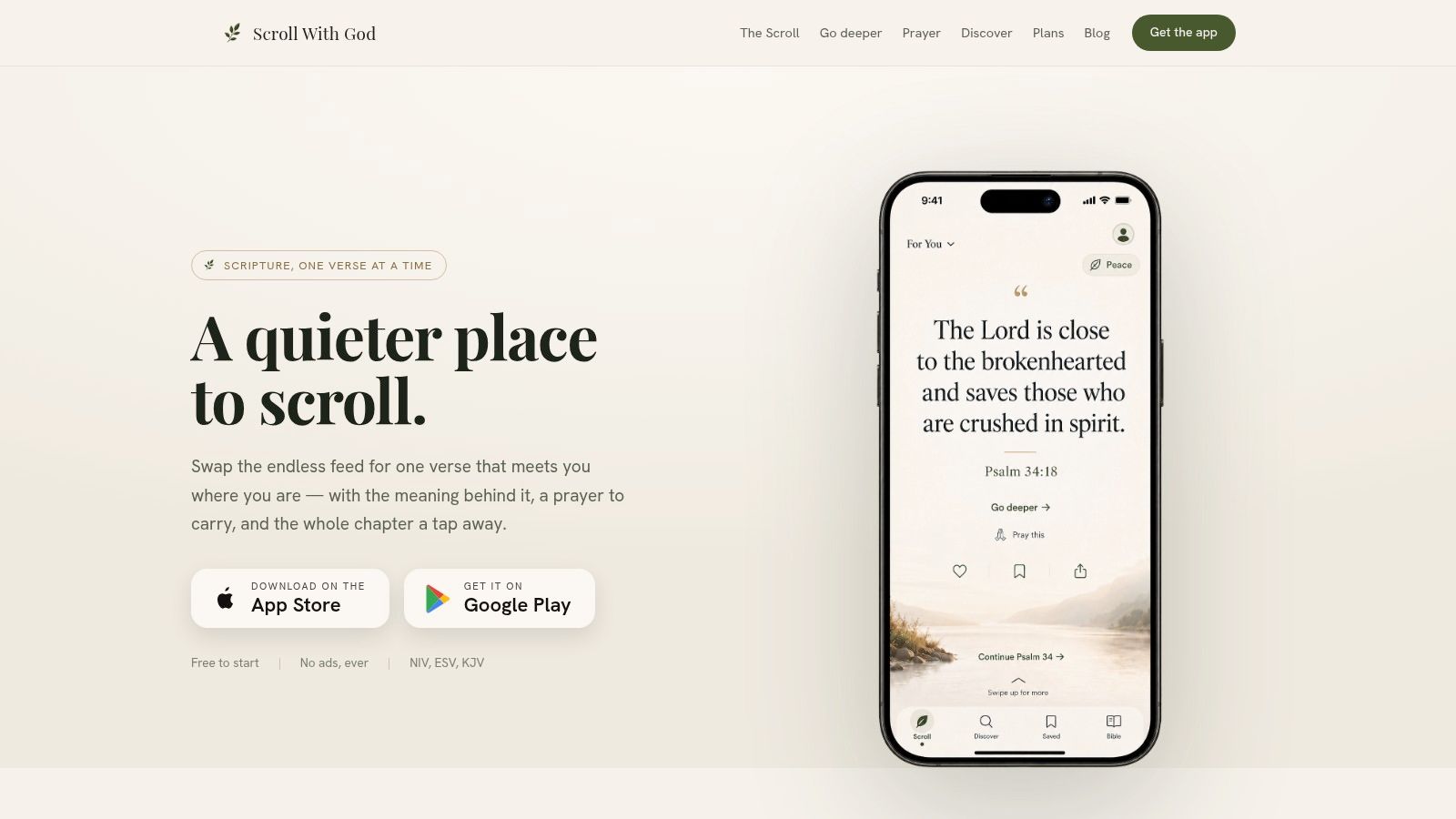
In our app, a study sheet opened with one tap includes meaning, authorship and purpose, Hebrew or Greek, historical context, cross references, and application. We cite the NIV, Bible Project, and GotQuestions.org at the bottom of each sheet, and you can continue reading the source chapter without leaving the app.
The screenshot shows the mobile reading experience.
Pick a verse today, follow its reference, and record the relationship before drawing your conclusion. Return to the passage next week and see whether you can explain the connection more clearly.
Our study sheets bring cross references together with explanations and historical context, while keeping the surrounding chapter within reach. Visit Scroll With God to practice comparing related passages without losing your place in Scripture.