
What Does the Bible Say About Anxiety? Verses in Context
Wondering what does the Bible say about anxiety? Key passages in context, prayer guidance, and when to seek professional help.
In this article
- Why Scripture Speaks Directly to Anxiety
- The Word Behind the Warning
- Key Bible Verses on Anxiety at a Glance
- What Each Passage Is Doing
- How to Read Them Well
- What Jesus Taught About Worry in Matthew 6
- Birds, Lilies, and Real Needs
- Putting the Passage to Work Tonight
- How Philippians 4:6-7 Turns Worry Into Prayer
- Five Steps You Can Follow
- What the Promise Does and Doesn't Say
- Which Prayers Help and Which Feed Fear
- What the Research Adds
- When Prayer Becomes Reassurance Seeking
- Separating Ordinary Worry From Clinical Anxiety
- Three Experiences That Get Blurred Together
- Matching the Response to the Situation
- Taking Your Next Step With Scripture and Support
If a verse tells you not to be anxious, does that mean feeling anxious shows weak faith, or that prayer should replace every other kind of help? That's the question many short answers skip, and it's where confusion starts. When you ask what does the Bible say about anxiety, you'll find comfort, honest lament, and practical direction, but you won't find Scripture treating every form of anxiety as the same problem with the same fix.
Why Scripture Speaks Directly to Anxiety
The Bible addresses anxiety often and consistently, through a pattern rather than a single verse. That pattern moves from fear toward trust, prayer, and God's provision, without promising a life without hardship.
You'll see it in Hebrew poetry, where danger and death are named plainly, and in the Gospels, where Jesus speaks to ordinary needs like food and clothing. The concern isn't imaginary. The question is what a person does when the concern keeps circling and won't settle.
The Word Behind the Warning
One New Testament word helps here. According to Vision's explanation of what the Bible says about anxiety, Greek μεριμνάω (merimnaō) is broader than modern clinical anxiety, since it can mean anxious preoccupation but also responsible concern for another person's welfare, and context determines the meaning.
That's an important distinction. Caring that your child gets home safely isn't the same as replaying every possible disaster for three hours. The first is responsible concern that leads to a phone call. The second is a loop that leads nowhere.
- Responsible concern: You notice a real need, take the step that's yours to take, and ask for help where you need it.
- Anxious preoccupation: You keep rehearsing the same unanswered question, hoping that thinking harder will finally control the outcome.
Worry keeps replaying the same unanswered question. Trust hands that question to someone who can answer it, then returns to today's work.
In Matthew 6:25-34, Jesus uses the term for repetitive worry about necessities such as food and clothing, linking anxiety to divided attention, perceived lack of control, and diminished trust in God's provision. In Philippians 4:6, Paul doesn't tell readers to suppress the feeling. He gives a replacement process. Bring each concern to God through prayer and petition, add thanksgiving, and articulate the request.
That framing matters for how you read the verses ahead. Prayer is presented as a structured way to direct your attention and interpret your need, not as a promise that symptoms will immediately disappear. Merimnaō also shouldn't be equated with medically diagnosed anxiety disorders, which require appropriate mental health evaluation and care.
So keep three threads in mind as you read. First, what the key passages say in context. Second, how Jesus and Paul turn worry toward trust and prayer. Third, when persistent anxiety calls for professional support alongside spiritual care.
Key Bible Verses on Anxiety at a Glance
These six passages cover the main ground, each speaking to a different kind of fear.
| Passage | Anxiety Theme | Core Message |
|---|---|---|
| Jeremiah 17:8 | Fear during drought and hardship | Trust keeps a person rooted and fruitful in a dry year |
| Psalm 23 | Danger, uncertainty and death | The Lord walks with the believer through the valley |
| Psalm 91 | Threat and exposure to danger | God offers shelter and protection to those who trust him |
| Matthew 6:25-34 | Worry about food, drink and clothing | Seek God's kingdom first and do not worry about tomorrow |
| Philippians 4:6-7 | Anxious concerns of any kind | Bring requests to God with thanksgiving and receive his peace |
| 1 Peter 5:7 | Cares and burdens | Cast all anxiety on God because he cares for you |
What Each Passage Is Doing
Jeremiah 17:8 uses an image his first readers would've felt in their stomachs. A person who trusts God is like a tree planted by water that stays green in a year of drought. Drought wasn't a metaphor for a bad mood. It threatened crops, income, and survival, which is why the picture speaks to resilience during a season you can't shorten.
Psalm 23 and Psalm 91 work differently. They don't explain anxiety. They place God's presence inside the danger, whether that's a valley, an enemy, or a threat you can't see coming. Readers who feel exposed rather than merely busy often reach for these two first.
Matthew 6:25-34 and Philippians 4:6-7 are the two teaching passages. Jesus addresses worry about daily provision and points to birds and lilies. Paul gives anxious readers something to do with a specific concern. Bring it to God, with thanksgiving, and expect God's peace to guard heart and mind.
1 Peter 5:7 is the shortest and the most personal. Casting your anxiety on God rests on a reason, not a technique. He cares for you. That makes it a verse for the moment when you're carrying something heavy and need to know you're not handing it to someone indifferent.
How to Read Them Well
Read each passage with the verses before and after it. A single line lifted out can sound like a guarantee its author never made.
Then ask one simple question. Is this text mainly a promise, a command, or a comfort? A psalm of comfort shouldn't be read as an order to feel calm. A command from Jesus shouldn't be read as a promise that nothing hard will happen.
Use the table as a starting point, not a shortcut. Find the row whose theme matches the worry you're facing today, read that passage in full, and sit with it before you go looking for another verse. One passage read slowly usually helps more than six read in a hurry.
What Jesus Taught About Worry in Matthew 6
Say a parent wakes at two in the morning and checks the bank balance again. Rent is due Friday, a shift got cut, and the numbers don't add up. Checking a third time won't change them, but lying awake feels like doing something.
Jesus was speaking to people who knew that feeling. The image below shows him teaching during the Sermon on the Mount.
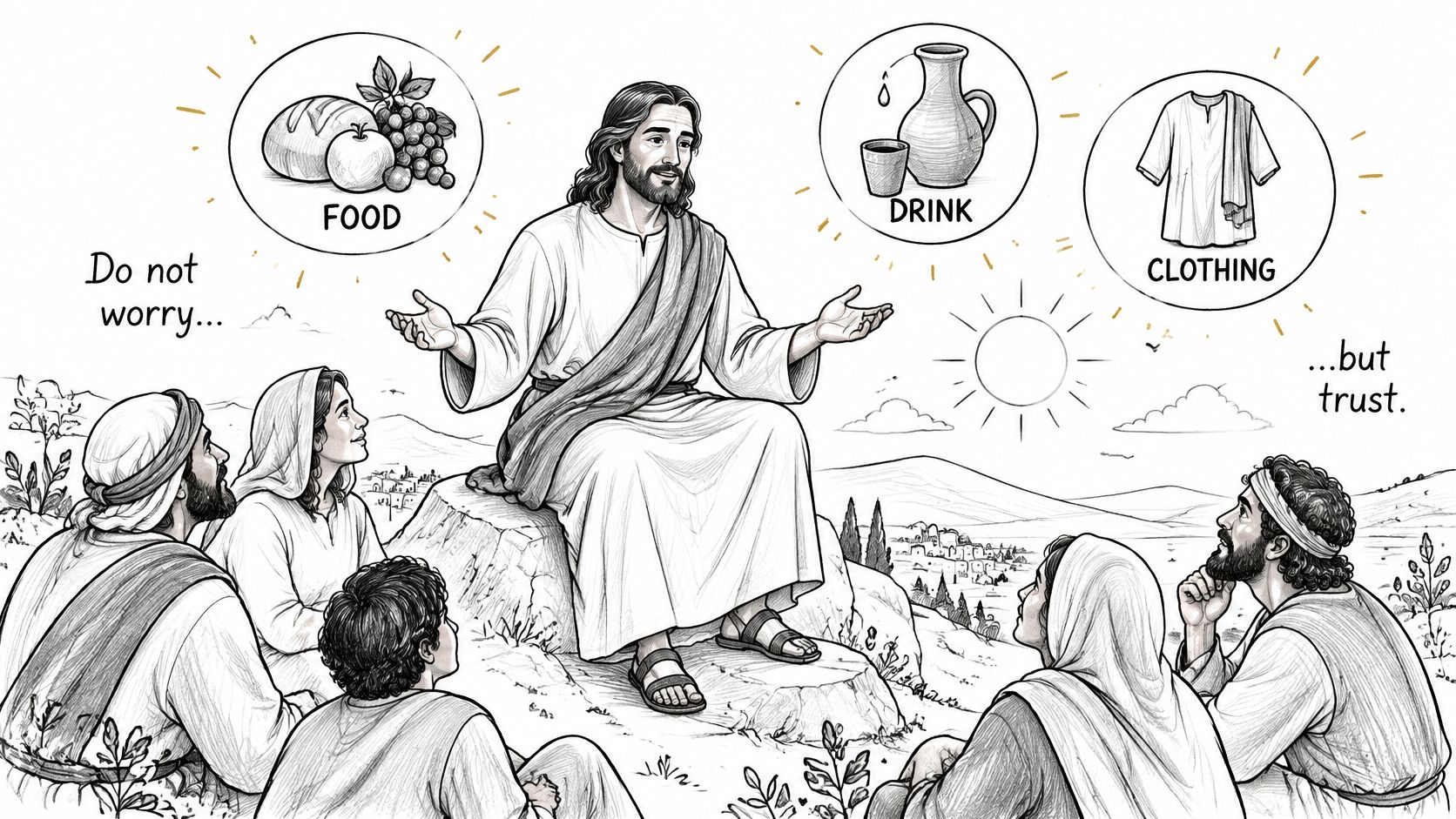
As Bible Gateway's Encyclopedia of the Bible entry on anxiety notes, Jesus gives anxiety one of its most extended treatments in Matthew 6:25-34, within the Sermon on the Mount. He names at least three ordinary concerns, food, drink, and clothing.
Birds, Lilies, and Real Needs
His examples are drawn from the fields around his listeners. Birds don't sow or store, yet they're fed. Lilies don't spin cloth, yet they're dressed more finely than a king. The point isn't that work doesn't matter. It's that provision doesn't rest entirely on your fretting.
Notice what Jesus doesn't say. He doesn't promise a life without hardship, and he doesn't tell anyone to ignore responsibility. He challenges the attempt to control future necessities through persistent worry.
His closing line is about time as much as trust. Disciples shouldn't worry about tomorrow because "today has enough trouble of its own" (Matthew 6:34). Worry pulls tomorrow's unfinished problems into tonight, where you can't act on them.
For a fuller picture of the calm Jesus describes, see what peace means in the Bible.
This short video walks through the passage and its setting.
Putting the Passage to Work Tonight
Back to that parent at two in the morning. Matthew 6 doesn't offer a bigger bank balance. It offers a smaller horizon. What's really due today? Who can be called in the morning? What's the one honest prayer underneath the arithmetic?
Try this before the day ends.
- List today's responsibilities only. Write what belongs to today, and cross off anything that can't be acted on until tomorrow.
- Mark one concern to hand over. Name it in a sentence and pray it plainly, rather than circling it.
- Take one concrete action. Send the email, make the call, or set out what morning requires.
That sequence keeps faith and responsibility together. You act where you can. You stop rehearsing where you can't.
How Philippians 4:6-7 Turns Worry Into Prayer
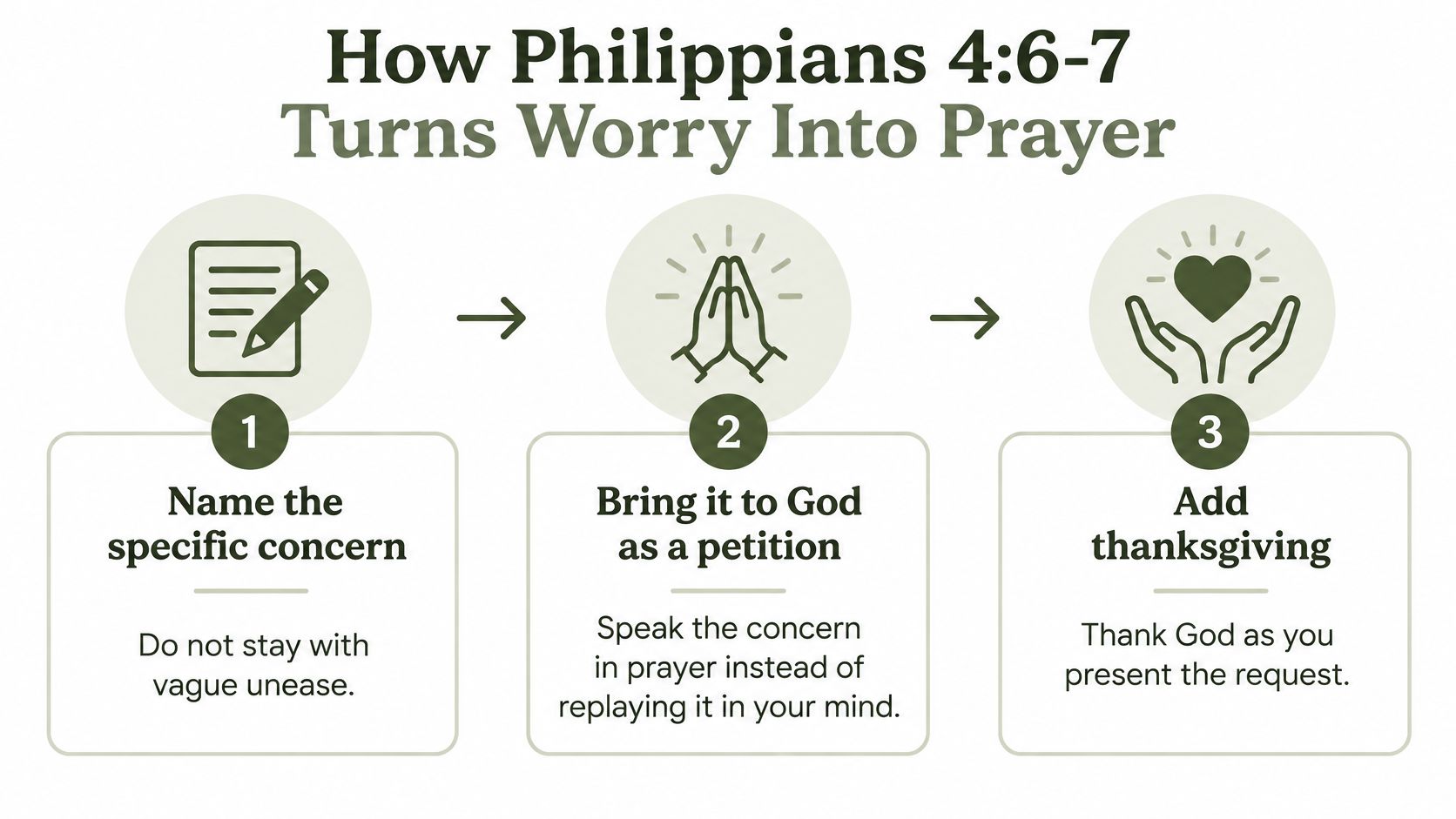
Philippians 4:6-7 gives prayer a clear movement: bring requests to God, include thanksgiving, and receive the promise of God's peace guarding the heart and mind. Paul is not telling readers to pretend they feel calm. He gives worry somewhere to go.
The infographic below summarizes that movement.
Five Steps You Can Follow
- Name the concern. “I'm worried about Thursday's scan results” gives the fear specific words. Naming it can help you bring the actual concern to God rather than circling around a vague sense of dread.
- Bring it to God as a petition. Say what is troubling you and ask for help. Rehearsing the worst possible outcome is different from making a request.
- Include thanksgiving. Recall something you are grateful for, even if your mood is low. Thanksgiving sits alongside the request; it does not require you to deny what is hard.
- Ask clearly for what you need. You might ask for wisdom, provision, courage, or help from another person. A direct request gives your prayer focus.
- Return when the worry comes back. Repeating a prayer does not mean you have failed. A concern can return, and you can bring it to God again.
Paul's words “prayer and supplication” describe bringing concerns and requests to God. Read more about the meaning of prayer and supplication in the Bible.
What the Promise Does and Doesn't Say
Paul promises that God's peace will guard the believer's heart and mind. A guard watches over a place; it does not make every threat disappear. So the promise points to care and steadiness, not an instant end to anxious thoughts or symptoms.
Read it this way: Paul describes a guarded heart and mind, not a guarantee that anxiety will never return.
A randomized prayer study also reported reductions in participants' self-rated anxiety. That finding concerns a specific prayer intervention, not the meaning of Philippians 4:6-7, and it does not establish prayer as a treatment for clinical anxiety. Prayer can accompany professional care, including psychotherapy, medication, crisis support, or an assessment when anxiety persists or disrupts daily life.
Which Prayers Help and Which Feed Fear
Many readers assume more prayer automatically produces more peace. If that were always true, nobody who prayed often would ever feel anxious, and plenty of faithful people do.
Part of the reason is that prayer isn't one thing. Scripture itself includes petition, lament, thanksgiving, confession, and communal intercession. Lament alone tells you something important. The Bible gives you words for grief and protest, so prayer was never meant to be a way of suppressing anxious thoughts until they quiet down.
What the Research Adds
According to Everyday Health's summary of a 2023 Journal of Religion and Health study, devotional prayer and prayer expectancy were associated with lower anxiety, while prayers focused on forgiveness and support were associated with higher anxiety.
That isn't an argument against prayer. It's a reminder that prayer content, emotional state, and interpretation may matter. Someone praying about forgiveness may already be carrying guilt. Someone asking for support may be in a harder week than someone who isn't. Association isn't the same as cause.
When Prayer Becomes Reassurance Seeking
Watch for one pattern in particular. A person repeatedly asking, "Please prove that nothing bad will happen," may reinforce uncertainty rather than relieve it. Each repetition promises relief, delivers a little, then leaves the same doubt waiting an hour later. The prayer has become a way of demanding certainty life doesn't offer.
Other ways of praying tend to sit differently.
- Name the fear plainly: "I'm frightened about the results, and I don't know what I'll do." That's lament, and it's biblical.
- Ask for wisdom for the next step: You're asking for something you can receive today, rather than a guarantee about next month.
- Include gratitude and surrender: Both loosen the grip of the question you're trying to force closed.
- Let other people pray with you: Communal intercession means you aren't the only voice in the room when your own words run out.
If prayer seems to increase your anxiety, shorten it. One honest sentence, spoken once, can be healthier than twenty anxious repetitions. Then do the next ordinary thing. Eat something, step outside, text a friend.
Prayer isn't a substitute for emergency care or treatment. If symptoms persist, or you feel unsafe, that calls for clinical help alongside whatever you're praying.
Separating Ordinary Worry From Clinical Anxiety
Seeking therapy or medication does not show weak faith. Prayer and professional care can work together, and asking for help does not mean you have failed to trust God.
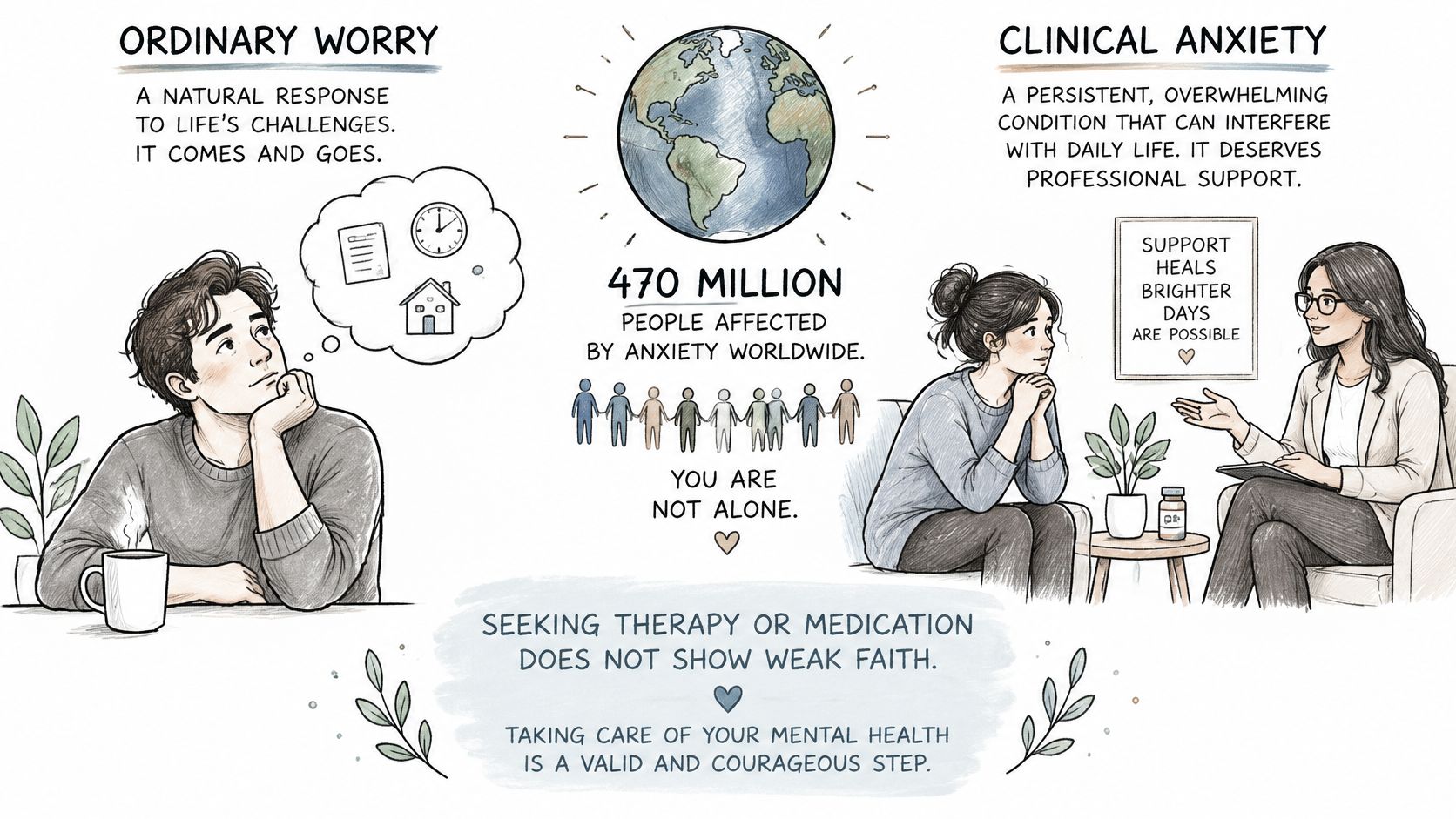
Anxiety disorders are among the most common mental-health conditions worldwide, according to the World Health Organization's fact sheet on anxiety disorders. That context can help loosen shame, but it does not tell you what any one person is experiencing.
Three Experiences That Get Blurred Together
Ordinary worry is often tied to a specific concern and eases as you make a plan or take action. You might feel nervous before a presentation, then feel that worry settle afterward.
Spiritual distress can involve feeling distant from God, struggling with guilt, or questioning what you believe. Lament, honest conversation, and community can help you give those concerns words.
Clinically significant anxiety may persist after the triggering event has passed and interfere with daily life. Sleep and concentration can suffer, while the body remains on alert.
These experiences can overlap, but they are not interchangeable. Persistent anxiety is not proof of a moral failure. In 1 Kings 19, Elijah asks to die while sitting under a broom tree. God responds with food, sleep, and presence before giving him further direction. The Psalms, too, include laments from people who felt abandoned and said so plainly.
Elijah rested and ate before returning to his work. Caring for the body can be part of faithful care.
Lament, prayer, community, and rest can sit alongside professional treatment, safety planning, and medical evaluation. A counselor may help you understand panic, while a pastor or trusted spiritual guide supports you through grief.
Matching the Response to the Situation
| Situation | Helpful Response |
|---|---|
| Occasional worry before a deadline or exam | Name the concern in prayer, take a practical next step, and talk with a trusted friend |
| Recurring worry that disrupts sleep, work, or relationships | Continue spiritual practices and seek support from a doctor or licensed counselor |
| Persistent panic, inability to function, or thoughts of self-harm | Contact a doctor, crisis line, or emergency services now, alongside prayer |
Repeated disruption to sleep, work, relationships, or daily functioning is a reason to seek qualified mental-health support. Spiritual care and professional care address different needs, and they can be part of the same response.
Taking Your Next Step With Scripture and Support
Here's a plan you can finish this week, in about ten minutes a day.
- Pick one passage from the table that matches your current worry.
- Read it with the verses around it, so you hear the whole argument or prayer.
- Write down the specific concern and one thing you're thankful for.
- Pray it through once, naming the fear and asking for the next step instead of repeating the same worry.
- Tell one trusted person, whether that's a friend, pastor, or small group, within the week.
- Contact a doctor or licensed counselor if symptoms persist or disrupt sleep, work, or relationships, and use a crisis line or emergency services if you feel unsafe.
If you want a steady daily rhythm alongside those steps, Scroll With God can help you keep one. Our feed shows verses tuned to the seasons of peace, strength, grief and gratitude, and you can tap a topic pill to steer the feed. The daily verse and the full Bible are free. Our study material reflects interpretation and isn't a substitute for reading the surrounding passage or seeking trusted spiritual guidance.
For a related starting point, read what hope means in the Bible. Scripture and professional care can work together, and no single verse replaces a proper assessment.
When anxiety is loud, one verse read slowly beats a dozen skimmed in a panic, and Scroll With God gives you a single passage at a time with context and a prayer drawn from it. Steer your feed toward peace, return to the verses that steady you, and keep building the habit alongside the people and professionals who support you.