What Does Peace Mean in the Bible? Shalom Explained
What does peace mean in the Bible? Explore shalom, wholeness, reconciliation and peace with God, with key verses and a way to read them in context.
In this article
- Biblical Peace at a Glance
- Begin with the relationship or situation
- Why Shalom Means More Than Calm
- From soundness to a flourishing life
- Blessing, covenant, and conduct
- Peace With God as the Foundation
- A relationship set right
- Hope fulfilled in Christ
- Peace Between People and in Community
- Peacemaking requires action
- Responsibility has limits
- Inner Peace Without Pretending Everything Is Fine
- Feelings aren't the whole measure
- A grieving person can still trust
- How to Read a Peace Verse in Context
- A method for careful reading
- Worked example with Philippians 4:7
- Common Misreadings of Biblical Peace
- Test the interpretation, not just its appeal
- Start a Seven-Day Peace Reading Plan
- Keep the daily routine simple
In the Bible, peace (shalom in Hebrew, eirēnē in Greek) means wholeness, safety, and right relationship with God and others, not merely the absence of conflict or a calm feeling.
If peace only means feeling relaxed, can someone who's grieving still have it? That question exposes the gap between everyday English and biblical usage. Scripture speaks about peace as something God gives, people pursue, and communities experience when broken relationships begin to be restored.
Biblical Peace at a Glance
Scripture's language of peace concerns a whole life in right relationship with God, others, and oneself. The Hebrew shalom and Greek eirēnē can describe different aspects of that life, so the surrounding passage matters.
Dimensions of peace in the Bible
| Dimension | What it covers | Key passage | Original word |
|---|---|---|---|
| Wholeness and completeness | Life made intact, sound, and undivided | Isaiah 26:3 | shalom (Hebrew) |
| Safety and well-being | Protection, health, and provision | Numbers 6:24–26 | shalom (Hebrew) |
| Right relationship with God | Reconciliation and a secure standing before God | Romans 5:1 | eirēnē (Greek) |
| Reconciliation between people | Hostility ended and divided groups joined | Ephesians 2:14 | eirēnē (Greek) |
| Inner steadiness | Calm that holds under pressure | John 14:27 | eirēnē (Greek) |
| Justice and right order | Fairness and an ordered community | Psalm 85:10 | shalom (Hebrew) |
| Covenant faithfulness and blessing | God's promises kept and good given | Isaiah 54:10 | shalom (Hebrew) |
These categories are a reading aid, not separate dictionary definitions that fit neatly into isolated boxes. Isaiah 26:3, for example, concerns steadfast trust and peace, rather than offering an abstract definition of completeness. The table identifies an emphasis while keeping the broader picture in view.
A passage may connect personal confidence with God's faithfulness, or public well-being with righteousness. Don't assume every use of peace contains every possible meaning. An English word can have a broad range without expressing its entire range in each sentence.
Begin with the relationship or situation
Ask what's happening to the people in the passage. Are enemies being reconciled? Is someone receiving a blessing? Are frightened disciples being reassured?
Reading question: What kind of brokenness, danger, or hostility does peace address in this passage?
English speakers often use peace for quiet surroundings or an undisturbed mood. Biblical writers also use it for conditions that extend beyond an individual's feelings. When asking, “What does peace mean in the Bible?” begin with the dimension the verse describes, then consider how that meaning applies to your life.
Why Shalom Means More Than Calm
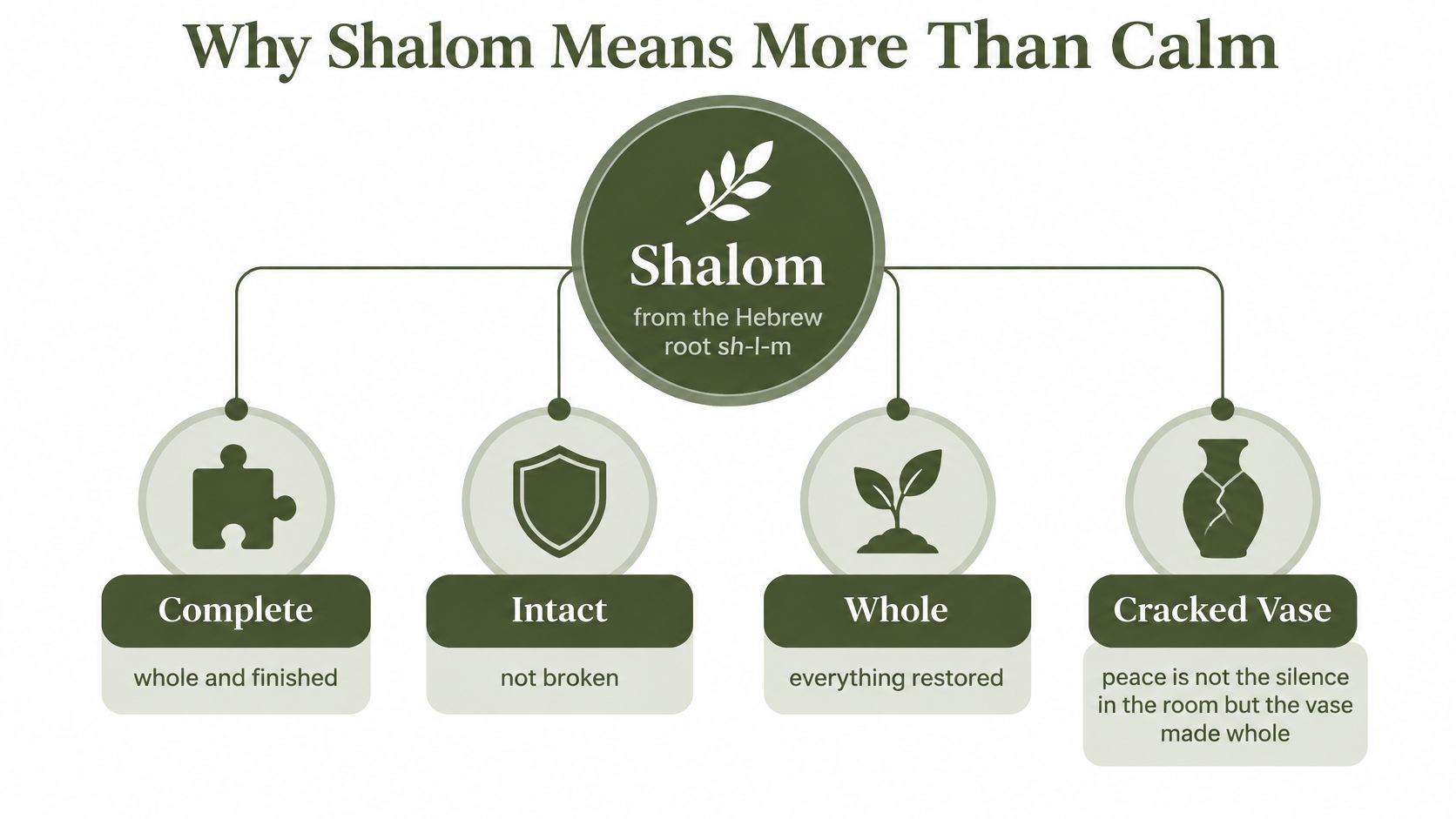
A cracked vase can sit in a perfectly silent room and still be broken. Repairing it so it can hold water offers a better analogy for shalom: peace isn't merely the silence around something damaged, but its restoration to soundness.
The analogy has limits, since people aren't objects to be fixed. Still, it helps explain why biblical peace can involve health, protection, trustworthy relationships, and a community's welfare, not just reduced tension.
From soundness to a flourishing life
Shalom is associated with the Hebrew root sh-l-m, linked with completeness, soundness, and wholeness. Context determines whether the emphasis falls on physical well-being, security, prosperity, contentment, moral integrity, harmonious relationships, or fellowship with God.
A lexical and theological study hosted by Andrews University reports approximately 397 Old Testament occurrences of the concept, while the word is translated as “peace” in about 113 places in the NIV. Those figures illustrate the limits of a single English equivalent, not a rule that every occurrence means the same thing.
The underlying connection is easier to see through a visual comparison.
Prosperity in this range of meanings shouldn't become a promise that faithful people will always be wealthy. Likewise, references to well-being don't mean that illness proves someone lacks faith. A word's possible meanings must be distinguished from what a particular passage promises.
Blessing, covenant, and conduct
Consider how the emphasis changes across these passages:
- Numbers 6:24–26: The priestly blessing places peace within God's gracious care for his people. It's something received from God, not an atmosphere people manufacture.
- Isaiah 54:10: Peace belongs to an enduring covenant relationship. The emphasis falls on God's steadfast commitment when other sources of security seem unstable.
- Psalm 34:14: People are called to turn from evil, do good, and pursue peace. Here peace involves ethical action rather than passive enjoyment.
These uses belong together without becoming interchangeable. A blessing, a covenant assurance, and a command each ask something different of the reader.
The diagnostic question is therefore broader than whether an argument has ended. Ask what has been repaired, protected, or set in right order. A household where nobody speaks may be quiet, but a household where people tell the truth, take responsibility, and protect one another is moving toward something closer to biblical peace.
Peace With God as the Foundation
The New Testament carries this broad understanding into Greek through eirēnē. A theological study hosted by Andrews University counts 91 occurrences in the New Testament; another lexical counting method identifies 92, so a small difference in totals needn't imply a disagreement about its meaning.
A repaired vessel offers an illustration of restoration, while the cross places Christian peace within Christ's reconciling work.

Some passages use eirēnē for the opposite of war, including Luke 14:32 and Acts 12:20. Other passages concern welfare, harmony, and reconciliation. The word alone doesn't tell you which emphasis the writer intends.
A relationship set right
Romans 5:1 connects peace with God to justification by faith. Paul's starting point isn't a technique for settling your nerves. It's God putting people into a right relationship with himself through Jesus Christ.
Think of an estranged child welcomed home. Relief may follow, but the welcome isn't created by the child's ability to feel relieved. The relationship has changed even if the child still feels overwhelmed.
Peace with God is a standing received through Christ, not a mood a believer earns.
Colossians 1:20 describes reconciliation through Christ's blood shed on the cross. Ephesians 2:14 then presents Christ himself as the one who makes peace, including between divided peoples. Christian peace therefore has consequences beyond private spiritual reassurance.
The following video offers another way to consider the biblical theme.
Hope fulfilled in Christ
Isaiah 9:6 names the coming ruler Prince of Peace. Christians read this royal hope in light of Jesus: his work establishes reconciliation and points toward the fullness of God's restored order.
That's why peace with God shouldn't be measured by a believer's most difficult afternoon. Confidence can grow from reconciliation, but confidence and reconciliation aren't identical.
Peace with God doesn't promise:
- Trouble-free circumstances: Opposition and hardship can remain.
- Freedom from grief: Love and loss can still bring deep sorrow.
- The disappearance of every doubt: Believers may need patient teaching, prayer, and support.
Peace Between People and in Community
Jacob approaches Esau in Genesis 33 with reason to fear their meeting. Their history includes deception, anger, and estrangement. When Esau runs to embrace him, the encounter becomes more than the cancellation of a fight: the brothers meet again as brothers.
The story doesn't give a formula that guarantees every family reunion will end well. It does show that reconciliation involves people approaching one another, receiving one another, and responding differently to a painful history.
Peacemaking requires action
In Matthew 5:9, Jesus calls peacemakers children of God. Peacemaking isn't the same as staying agreeable. It may require an apology, a truthful conversation, restitution, or refusing to repeat a damaging accusation.
Ephesians 2:14 addresses hostility between divided peoples, particularly Jews and Gentiles in the passage's argument. Applying it only to personal relaxation misses the social significance of Christ joining people who had been separated.
Joseph's reunion with his brothers in Genesis 45 offers another family example. He acknowledges their wrongdoing while making a way for the family to live. Forgiveness doesn't require pretending the betrayal never happened; this guide to a Bible verse on forgiveness can help readers consider that distinction.
Responsibility has limits
Romans 12:18 calls believers to live peaceably with everyone insofar as it's possible and depends on them. Those qualifications matter. You can choose honesty, restraint, and willingness to repair harm, but you can't make another person repent or become safe.
Pursuing peace doesn't require giving an unsafe person unrestricted access to you.
In a harmful relationship, seeking protection, setting boundaries, or involving appropriate authorities may be necessary. Reconciliation requires more than one person's desire for a pleasant outcome.
Psalm 34:14 calls people to pursue peace, while Psalm 85:10 pictures righteousness and peace meeting together. Community well-being involves how neighbors are treated, not just whether public disagreement has become quieter.
Use these checks when evaluating a proposed resolution:
- Hostility: Are people stopping threats, contempt, or retaliation?
- Repair: Is wrongdoing being acknowledged and addressed?
- Community welfare: Are vulnerable people safer, and are relationships becoming more trustworthy?
Inner Peace Without Pretending Everything Is Fine
A common assumption says that if you still feel anxious or sad, you haven't received God's peace. John 14:27 gives a more careful starting point: Jesus gives peace differently from the world, while speaking to disciples facing separation and uncertainty.
His reassurance isn't based on everything becoming comfortable. The disciples are being asked to trust him when their circumstances will challenge them.
Feelings aren't the whole measure
Philippians 4:6–7 connects prayer, petition, and thanksgiving with God's peace guarding the heart and mind. Paul invites believers to bring their concerns to God rather than hide them. The passage isn't a license to judge someone whose distress persists.
Isaiah 26:3 connects peace with steadfast trust. Yet trust needn't mean emotional numbness or uninterrupted composure. In Psalm 13, the psalmist voices abandonment and sorrow while continuing to address God.
These distinctions help prevent confusion:
- Emotional state: Your feelings can change with exhaustion, loss, illness, or frightening news.
- Relational standing: Your relationship with God isn't something you recreate whenever your mood improves.
- Direction of trust: You can turn toward God while still struggling to understand what's happening.
A grieving person can still trust
Say someone has lost a loved one. They cry during prayer, struggle to concentrate, and ask God why the loss happened. They also continue to seek God's presence and entrust the next difficult task to him.
Their lament isn't necessarily the opposite of faith. It may be the form faith takes when easy words no longer fit. A study of what hope means in the Bible can help distinguish reliance on God from expecting an immediate emotional improvement.
Practical care belongs alongside prayer. A grieving or anxious person may need companionship, rest, pastoral support, or professional mental health care; seeking help isn't a confession of spiritual failure.
Biblical inner peace can include felt calm, and that's a welcome gift. But it's often steadiness within trouble: enough trust to pray, accept help, and take the next faithful step without pretending everything is fine.
How to Read a Peace Verse in Context
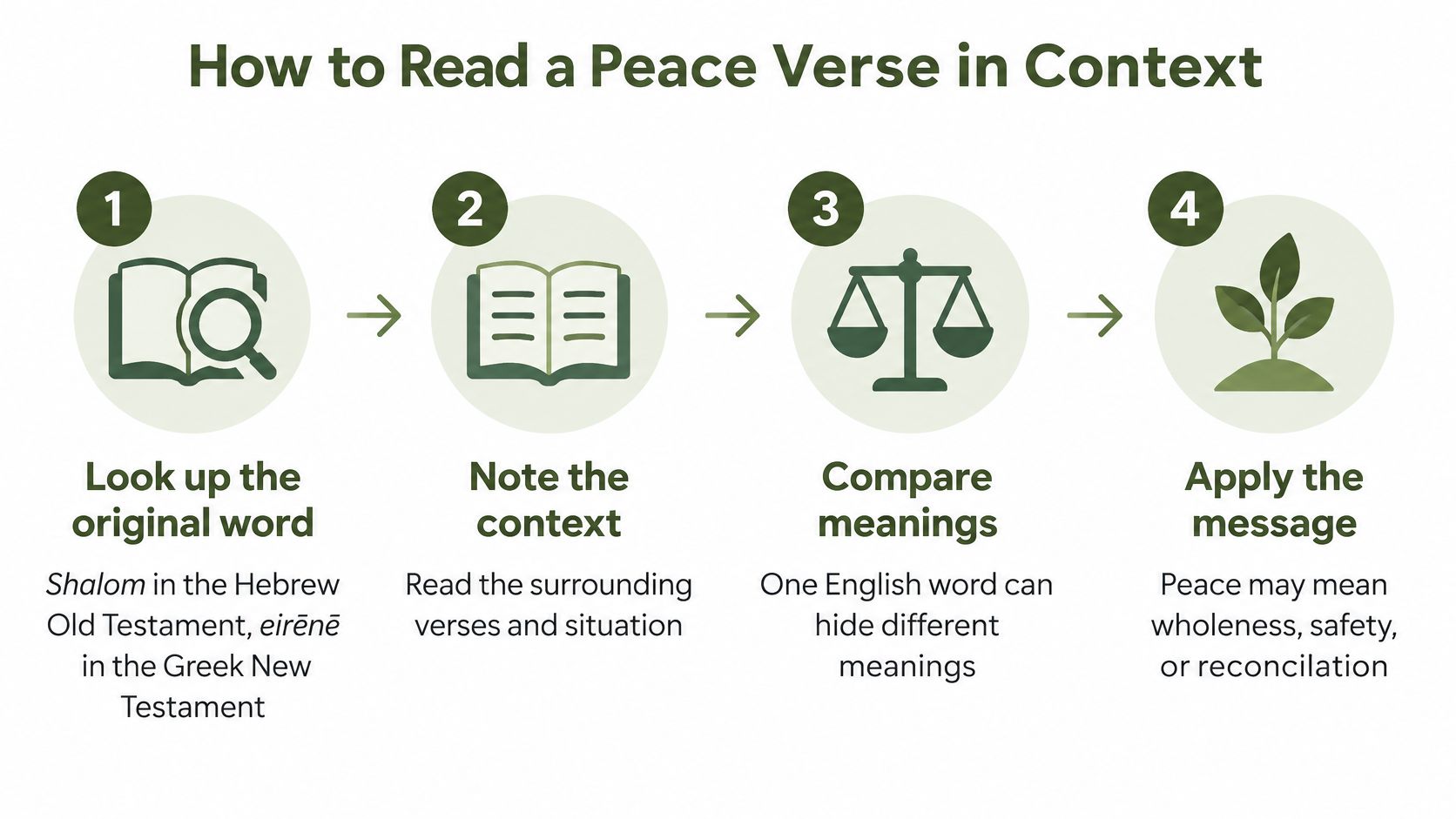
English gives you one word. Scripture draws on more than one. A technical study of eirēnē and biblical peace describes the connection between conventional Greek usage and the Hebrew understanding transmitted through the Septuagint, the Greek translation of the Hebrew Scriptures.
That translation history explains why a New Testament verse about peace may concern reconciliation, conduct, or communal welfare rather than a private feeling. So before you decide what a peace verse means for your life, find out which dimension of the word the writer is using. A verse about restored relationship calls for a different response than a verse about inner steadiness, and confusing the two produces mistaken applications.
A method for careful reading
Look up the original word. Use a Bible app with a reliable lexicon or a concordance to identify whether the underlying term is shalom, eirēnē, or another expression. Don't assume every English appearance of peace translates the same word.
Identify the main dimension. Decide whether the passage emphasizes safety, reconciliation, trust, justice, blessing, or another aspect. Treat that as a working interpretation to test, not a conclusion the dictionary has already proved.
Read the surrounding paragraph. Identify the speaker, audience, problem, and line of thought. Read further when the paragraph depends on an earlier argument or story.
Notice what the passage is doing. Is the writer announcing God's gift, commanding action, offering a greeting, or describing an outcome? A promise and an instruction shouldn't be applied in identical ways.
Compare related passages. Follow cross references and examine relevant Old Testament background. Use clearer parallels to test your reading, rather than collecting verses that merely sound similar.
Consider the levels of application. Ask what the passage means for your relationship with God, personal integrity and health, relationships with others, and the wider community. Not every level will be equally prominent.
The visual guide condenses these habits into a simple reading flow.
Worked example with Philippians 4:7
Apply the steps in order. The word is eirēnē, and the surrounding paragraph instructs believers to bring requests to God with prayer and thanksgiving. The verse is a promise rather than a command: God's peace guards hearts and minds in Christ Jesus. The main dimension is protection within a relationship, with the writer describing what God does for anxious people who pray. He does not promise that every external problem will disappear.
An appropriate application might be to name a specific worry in prayer and ask for help responding faithfully. It wouldn't be appropriate to conclude that continuing anxiety proves God has rejected someone, since the verse assigns the guarding work to God rather than to your emotional performance.
For a fuller reading routine, use this guide to studying the Bible verse by verse. The common slip is selecting a comfortable meaning for peace before checking what the writer says.
Common Misreadings of Biblical Peace
Peace means no conflict
A room without arguments may still contain fear, resentment, or exploitation. Reducing peace to silence allows unresolved harm to remain hidden, whereas biblical wholeness calls for attention to what's damaged.
Peace means a good feeling
John 14:27 shouldn't be used to demand constant emotional ease, especially when the lament psalms give believers words for distress. This misreading can make grieving people feel guilty for emotions Scripture allows them to express.
Peace at any price
Jeremiah 6:14 condemns reassurance that announces peace without addressing the people's real condition. Harmony that requires denying sin or injustice protects appearances rather than people.
Peace is a reward for spiritual performance
Romans 5:1 locates peace with God in justification by faith, not in a flawless devotional record. Turning peace into a prize for good behavior can leave believers endlessly checking their performance instead of relying on Christ.
Test the interpretation, not just its appeal
A comforting interpretation can still be mistaken. Conversely, a faithful interpretation may be comforting and demanding at the same time, reassuring someone of God's care while requiring them to make amends.
Use this checklist before applying a peace passage:
- Reconciliation: Does the reading take damaged relationships seriously?
- Honest emotion: Does it allow grief, fear, and lament without automatically labeling them unbelief?
- Truth and harmony: Does it address wrongdoing rather than merely discourage disagreement?
- Context: Does it fit the audience, purpose, and surrounding passage?
You don't need to force every answer into every verse. The purpose is to notice when an interpretation has become too narrow, especially when it makes peace convenient for the powerful or burdensome for someone who's hurting.
Start a Seven-Day Peace Reading Plan
Use this plan to practice noticing the particular emphasis of each passage. The daily question gives you a starting point, not a substitute for reading the text.
| Day | Dimension | Passage | Reflection question |
|---|---|---|---|
| One | Wholeness | Isaiah 26:3 | Where am I being invited to steadfast trust? |
| Two | Safety and well-being | Numbers 6:24–26 | What does receiving God's blessing mean here? |
| Three | Reconciliation between people | Ephesians 2:14 | What hostility does Christ overcome? |
| Four | Right relationship with God | Romans 5:1 | What is the basis of peace with God? |
| Five | Inner steadiness | John 14:27 | How does Jesus' gift differ from worldly security? |
| Six | Justice and right order | Psalm 85:10 | How do righteousness and peace belong together? |
| Seven | Covenant faithfulness and blessing | Isaiah 54:10 | What assurance rests on God's commitment? |
Keep the daily routine simple
Read the verse and its surrounding paragraph, then check the original word. Write a sentence applying the passage to a relationship or worry, and pair it with a short prayer.
If you prefer reading on your phone, our Scroll With God app is an option, though this plan works with any Bible. Our study material reflects interpretation and doesn't replace reading the surrounding passage or seeking trusted spiritual guidance.
The screenshot shows the mobile reading experience.

Today, choose a verse from the table, read its paragraph, and return to it tomorrow.
Scroll With God pairs Scripture with context and a prayer, with access to the full chapter so you can examine what a peace passage means. Visit Scroll With God to explore peace-focused reading and build a habit of responding to Scripture with understanding and prayer.