How to Pray Before Reading the Bible: A Simple Routine
Learn how to pray before reading the Bible with a five-minute routine, sample prayers for each passage type, and fixes for a distracted mind.
In this article
- A Five-Minute Routine Before Each Reading
- Prepare your attention
- Pray, observe, and begin
- Sample Prayers Matched to Each Kind of Passage
- Sample prayers by passage type
- What to Pray When Your Mind Is Scattered or Dry
- Make the next move smaller
- Let dryness remain honest
- Where Prayer Stops and Study Must Begin
- Check an interpretation before applying it
- Start Your Seven-Day Routine
- Choose a manageable time window
You open your Bible, but your mind is still on the message you haven't answered. You reread the opening line, wonder whether you should pray first, and then wonder what you're supposed to say.
Learning how to pray before reading the Bible doesn't require special wording or a peaceful mood. A short, honest prayer can mark the moment you stop doing everything else and begin listening. Pair that prayer with careful reading, and you have a practice you can return to even on an unsettled day.
A Five-Minute Routine Before Each Reading
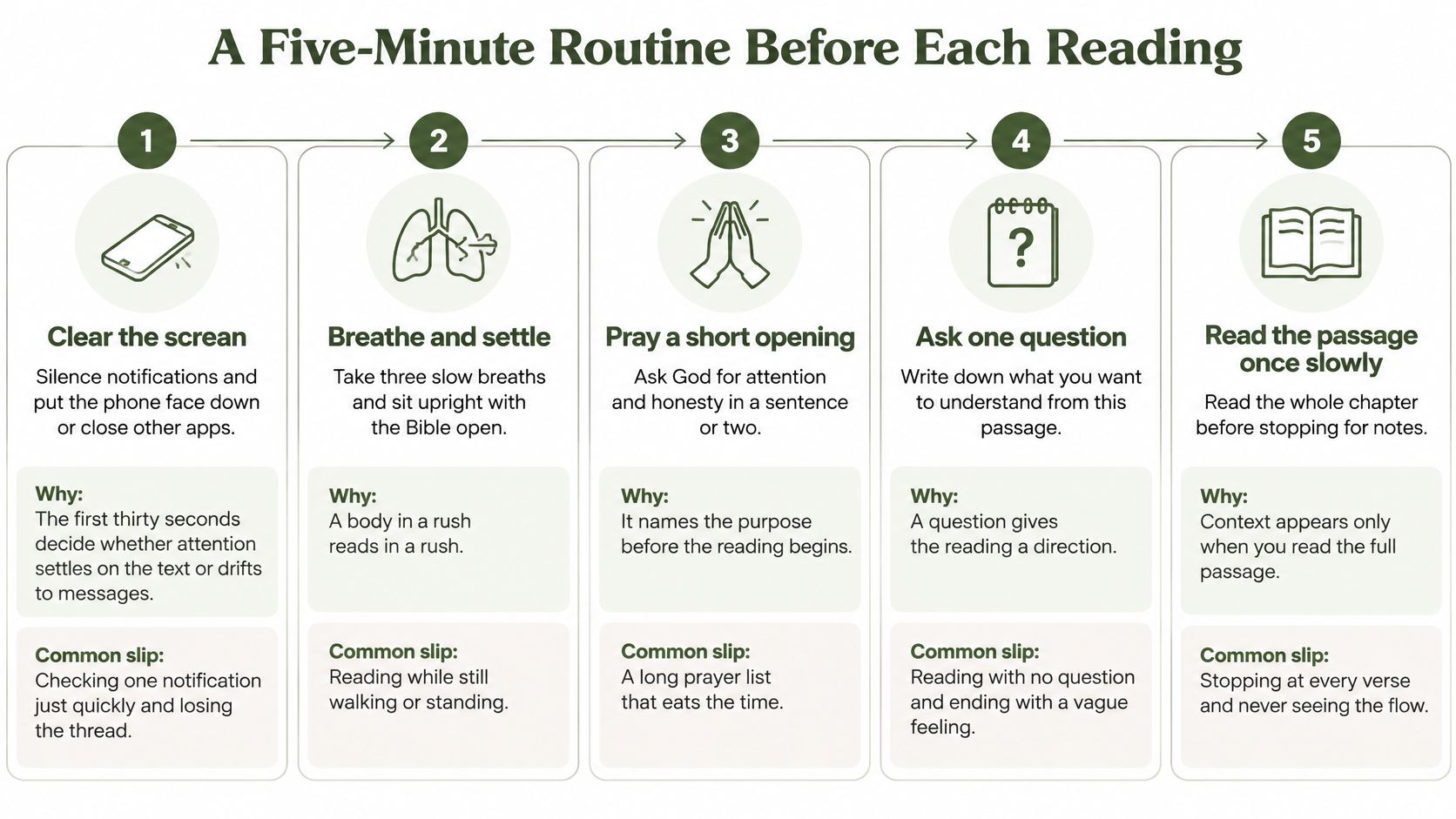
Treat this as a suggested five-minute opening, not a test you must finish on schedule. You'll settle your attention, name what you're reading, pray, and make an initial pass through the passage.
The American Bible Society's guide to Lectio Divina separates reading, meditation, prayer, and contemplation, then encourages readers to let the experience shape daily life. That distinction helps beginners: you don't have to understand, feel, and apply everything at the same moment.
Prepare your attention
Clear the screen. Silence notifications and put your phone face down if you're using a printed Bible; if you're reading on your phone, close other apps and leave the passage open. This removes an immediate invitation to switch tasks, so avoid the common slip of checking a message before you begin.
Name the passage and its genre in a short line, such as a Gospel story, a lament psalm, or a letter to a church. Genre means the kind of writing, and naming it helps you approach a poem differently from an argument; don't assume every passage is a direct instruction addressed to you.
Sit still briefly and acknowledge God's presence. You might allow about half a minute, breathing comfortably and resting your hands rather than continuing to scroll. The point is to stop hurrying, not to produce a spiritual sensation; rushing through the pause turns it into another task to complete.
You don't need a special chair, candle, or notebook to begin. Use a place where you can read without having to keep moving things out of the way. If your phone is also your Bible, reducing distractions matters more than putting the device away.
The visual below condenses the preparation into a quick reminder.
Pray, observe, and begin
Say a short opening prayer, aloud or in your heart. Ask for attention, understanding, humility, and a faithful response, because these requests name how you want to read; the common slip is expanding into your whole prayer list before opening the passage.
Give yourself an observation question: who is speaking, to whom, and in what setting? This directs you toward what is really on the page; if you can't answer yet, keep the question open rather than guessing.
Read the passage slowly before deciding how to apply it. Follow the whole scene, paragraph, or poem so you can notice how its parts fit together; resist stopping at an appealing phrase and building your conclusion around it.
For the opening prayer, you could say:
God, help me pay attention to what I'm reading. Give me understanding, humility when I'm mistaken, and willingness to respond faithfully. Amen.
Saying Amen doesn't mean you should now feel different. It means you've finished asking and are ready to attend to the text. If the words become familiar, slow down enough to mean them rather than swapping them out for novelty.
A useful readiness check is whether you can state the speaker and setting in a plain sentence. For a letter, that might mean identifying the writer and the community being addressed. If the passage doesn't supply enough information, write down what remains unclear and consult the introduction or surrounding text.
Keep the opening attached to an existing activity, such as sitting down with your morning drink. These ways to build a daily prayer habit can help you choose a dependable cue without making the preparation more elaborate than the reading.
Sample Prayers Matched to Each Kind of Passage
Match the passage you're about to read to a prayer focus below, say the sample prayer, and begin. The focus tells you what to ask for; the sample gives you language when finding your own words feels difficult.
Sample prayers by passage type
| Passage type | Prayer focus | Sample prayer |
|---|---|---|
| Gospel narrative | Seeing Jesus clearly | Jesus, show me who you are in this story and what you are doing in it. |
| Psalm of praise | Joy and thanksgiving | Lord, let my heart answer what this psalm declares about you. |
| Lament psalm | Honest feeling | God, I bring you my honest words, including the hard ones, and ask you to hear them. |
| Proverb | Discernment | Give me wisdom to apply this short saying with care, not as a slogan. |
| Pauline letter | Doctrine and obedience | Teach me what this letter says about you and what it asks of me today. |
| Difficult Old Testament passage | Humility and context | Slow me down, help me hear what the first readers heard, and keep me from rushing to my own conclusion. |
You don't have to identify the genre perfectly before praying. A psalm may move from sorrow into praise, and a Gospel story may contain teaching as well as action. Start with the kind of writing you recognize, then let the passage refine your prayer.
- For Gospel narratives, watch Jesus. Ask to notice what he says, does, and responds to before deciding which person in the story resembles you.
- For Proverbs, seek discernment. Ask how a saying expresses wisdom in its setting rather than treating it as a slogan that settles every situation.
- For lament psalms, allow honest language. Don't edit out grief, protest, or uncertainty because you think prayer should sound cheerful.
Prayer before Scripture also has a public worship foundation: the Orthodox Presbyterian Church's discussion of Scripture reading describes Ezra blessing God before the people hear the scroll read in Nehemiah 8. Beginning with prayer places reading within worship, not merely information gathering.
These prayers are starting points, not required formulas. Rewrite them in words you'd naturally use, keeping the opening brief enough to say comfortably before you start reading.
What to Pray When Your Mind Is Scattered or Dry
Distraction is one of the most common obstacles to consistent prayer, and busyness and indifference usually compete with it for the top spot. Asking for wisdom can feel like a strange first request when your immediate problem is that you can't stay with a single sentence.
Begin by admitting the state you're really in:
Lord, my mind is scattered; meet me in the few verses I can read.
Say a nurse opens a Bible app during a short break. She's still replaying a difficult conversation, and she keeps glancing toward the door. The quiet room and uninterrupted morning she hoped for don't exist today.
She says that one-line prayer anyway and reads a short paragraph. When she notices she has lost the thread, she returns to the top of the paragraph the way you'd guide a wandering dog back onto the path, calmly and without scolding. She finishes by telling God what troubled or encouraged her.
Make the next move smaller
A scattered mind rarely needs more effort. It usually needs a smaller task that matches the attention you have.
- Try a brief silence. Set aside a minute and count comfortable breaths. When another thought interrupts, notice it and come back. Each return is the exercise doing its job.
- Read a small portion, then pray again. Begin with a few verses, then tell God what you noticed before continuing. Keep the surrounding paragraph in view so a short session stays anchored to context.
- Name the actual difficulty. For exhaustion, try: God, I'm tired; help me receive what I can today. For doubt, grief, or lack of desire, say that plainly instead of borrowing an emotion you don't have.
If a practical concern keeps returning, write it on paper. Putting it down gives you permission to stop rehearsing it while you read. If it involves an urgent responsibility, attend to it and come back when you can.
Let dryness remain honest
Spiritual dryness doesn't always mean you're doing something wrong. You can read carefully and still feel little, especially when you're tired, grieving, or carrying unresolved questions. A dry session works a bit like exercise on a low-energy day: showing up still counts even when nothing feels strong.
Measure the session by two questions. Did you attend to the passage? Did you speak truthfully to God? An ordinary-feeling ten minutes can still be a faithful ten minutes.
If lingering with a passage is unfamiliar, these practical ways to meditate on Scripture can help you work with its words directly. Meditation can be as simple as rereading, noticing a repeated phrase, or sitting with one honest question.
A distracted beginning is still a beginning. You don't have to become calm before you're allowed to pray, and you don't have to hide your reluctance before you're allowed to read.
Where Prayer Stops and Study Must Begin
Prayer prepares you to listen, but it doesn't replace context, questions, or responsible study. A sincere prayer doesn't guarantee that a passage will be easy to understand or personally flattering.
The common trap is turning every verse immediately into encouragement for your current situation. Crossway's principles for studying the Bible direct readers toward historical setting, literary meaning, God's character, and the passage's main point. Those questions require attention to the text, not just confidence in your first impression.
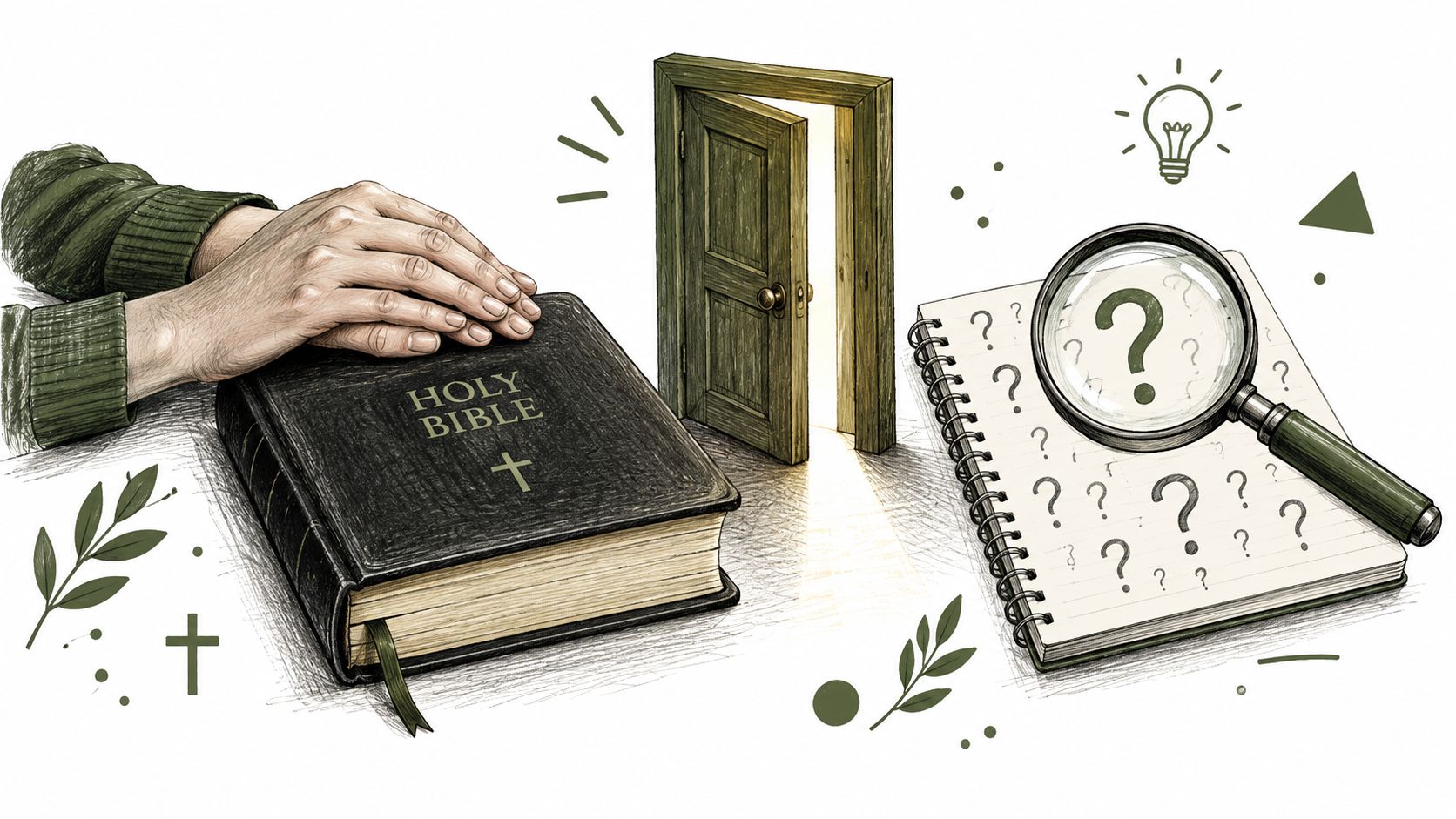
Keep a notepad beside your Bible for questions you can't yet answer.
Check an interpretation before applying it
- State the main point. Summarize what the passage communicates before describing what it means for your day. If your summary ignores most of the paragraph, reread it.
- Ask what it reveals about God. Notice his character, actions, and relationship with people, rather than looking only for advice about yourself.
- Read the surrounding chapter. Check who receives a command or promise, what problem the writer addresses, and whether nearby sentences qualify your interpretation.
For a difficult Old Testament passage, the humility you prayed for may mean leaving a question unresolved while you consult a study Bible or trusted teacher. For a Gospel narrative, attentiveness may mean noticing that Jesus challenges someone when you expected only reassurance.
A promise spoken to a particular person shouldn't automatically become a guarantee about your next decision. Likewise, a narrative describing someone's behavior doesn't necessarily approve of it.
Interpretive guardrail: A strong feeling may prompt a useful question, but it isn't proof of what a verse means.
When the argument is difficult to follow, a verse-by-verse Bible study method can help you trace connections without losing the larger passage. Record both your proposed meaning and the words that support it.
If the surrounding text doesn't support your impression, hold it loosely. Let your opening request for humility lead you to hear the author rather than confirm yourself.
Start Your Seven-Day Routine
You pick up your Bible app between meetings, but your thumb is already drifting toward a notification. Give that familiar moment a different next action: pause, pray, and open the passage you've chosen.
Set up the reading before you begin, so you aren't deciding what to do while other apps compete for your attention.

Pew Research Center reported that 22% of U.S. adults read Scripture outside religious services at least weekly and 61% seldom or never did, while a separate U.S. survey of 8,665 respondents summarized by the Center for Bible Engagement found that 54.7% had a designated prayer time every day. These figures don't show how many people pray before opening Scripture, and they don't establish that an opening prayer causes consistent reading. Treat the routine as a behavioral cue to try, not a proven result.
Choose a manageable time window
Use the five-minute version as your default. These are suggested practice windows, not required devotional lengths.
Routine length by time available
| Time available | Routine to use | What to keep |
|---|---|---|
| 2 minutes | Silent pause and one-sentence opening prayer | The silence and the prayer; read one short passage slowly |
| 5 minutes | Full six-step routine with the genre prayer | The observation question before any application |
| 10 to 15 minutes | Full routine plus a written question and one action | The written action, so the reading produces a behavior |
For the seven-day trial, choose a reading time you can realistically protect and set a daily reminder. Keep a simple record of the sentence you prayed and something you noticed in the passage.
In Scroll With God, each verse comes with a prayer drawn from it, and our app counts the days you say Amen. Our reminders can be set for morning, midday, or evening and show the verse or your plan; a paper Bible and a notebook work equally well for this routine.
If you prefer a video alongside your practice, you can use this one.
Commit to the five-minute opening-and-reading routine for seven days. Then check whether you began reading more often and whether your notes contain clearer questions, not whether every session felt inspiring.
Our verse-linked prayers offer words to begin with, and you can keep reading the surrounding chapter without leaving the app. Visit Scroll With God to try a short prayer alongside your next passage and make the wording your own.