8 Bible Verses for Patience to Pray in 2026
Explore 8 Bible verses for patience, with context, original-language notes, and practical ways to wait on God in hard seasons.
In this article
- 1. James 5:7–8 for a long hardship
- Practice patience without surrendering action
- 2. Romans 12:12 for grief and affliction
- Let prayer make room for lament
- 3. Galatians 6:9 for weary service
- Keep doing good, but notice your limits
- 4. Isaiah 40:31 for exhaustion
- Choose the pace you can sustain
- 5. Psalm 27:14 for uncertainty
- Turn the verse into a breath prayer
- 6. 1 Corinthians 13:4 for relational strain
- Practice love with clarity and boundaries
- 7. Psalm 37:7 for envy and comparison
- Interrupt the comparison loop
- 8. Hebrews 10:36 for costly perseverance
- 8 Bible Verses for Patience: Comparison Guide
- Choosing Your Verse for This Season of Waiting
What if the hardest part of waiting isn't the delay itself, but not knowing what patience is supposed to look like while you wait? Scripture doesn't treat patience as passive resignation. It describes a hope-anchored way of living that can include steady action, honest prayer, wise limits, and restraint toward others.
These Bible verses for patience speak to different kinds of waiting: enduring hardship, grieving, feeling worn down, facing uncertainty, struggling with envy, or trying to respond with love when a relationship is strained. The language behind the passages helps show why patience can mean both bearing with people and persevering through circumstances. Each verse below offers a practice you can try today, not just a line to read and move past.
A focused reading habit can help you stay with one passage long enough to hear its context. Scroll With God's single-verse feed, study sheets, and chapter continuity are designed to make it easier to pause with Scripture rather than skim a long list.
1. James 5:7–8 for a long hardship
James compares patient waiting to a farmer tending land and awaiting rain. The farmer can prepare the soil and care for the field, but can't command the crop to grow on demand. In the same way, James connects patience with hope in the Lord's coming and with standing firm in the present.
That picture suits a delayed job search, a long medical recovery, or another season when progress seems slow. Patience here doesn't mean doing nothing. It means continuing what is yours to do while accepting that some outcomes take time.
Practice patience without surrendering action
Read James 5:1–11 so the farmer image stays within the chapter's wider call to endurance. Then name one situation where you're waiting and one useful action you can take today. You might send the application, attend the appointment, or ask someone you trust for help.
Today's practice: Write one sentence in a prayer journal naming what you're waiting for, then one sentence about the next faithful step you can take.
A small group could read the chapter over several days and discuss what the farmer can control, and what remains beyond the farmer's control. If you keep a verse card at your desk or another place where you tend to feel rushed, let it remind you to act faithfully without demanding instant results.
2. Romans 12:12 for grief and affliction
Grief doesn't follow a tidy schedule. Romans 12:12 brings three responses together: joy in hope, patience in affliction, and faithfulness in prayer. Paul doesn't tell the reader to pretend pain is pleasant. The verse holds hope and hardship side by side, making room for honest sorrow while keeping prayer open.
The Greek term hypomonē is associated with endurance under pressure. It suggests remaining steady through difficulty, not just waiting without feeling. In grief, that may look like praying one honest sentence, accepting support, or getting through an ordinary day without asking yourself to feel better on command.
Let prayer make room for lament
Read Romans 12:9–21 to notice how the call to endure sits among instructions about love, peace, and responding to others. In the morning, name the particular loss or strain you're carrying, then pray the verse slowly. You can also explore a simple, repeatable rhythm with these ways to build a daily prayer habit.
A prayer might be as plain as, “God, I'm grieving this today. Help me stay close to you and receive the help I need.” Patience in affliction doesn't require suppressing sadness. It gives sorrow a place in a life still turned toward hope and prayer.
3. Galatians 6:9 for weary service
Some waiting seasons feel like planting without seeing a harvest. In Galatians 6:9, Paul urges believers not to grow weary in doing good and connects persistence with a future harvest. The surrounding passage speaks about restoring others and bearing burdens, so this isn't praise for individual grit. It's encouragement to keep practicing care within a community.
That can matter when a volunteer keeps showing up even though attendance is low, or when a parent teaches children a faith they may not yet understand. The results aren't always visible right away. But the verse directs attention to the good work in front of you, rather than only to the outcome you can't yet see.
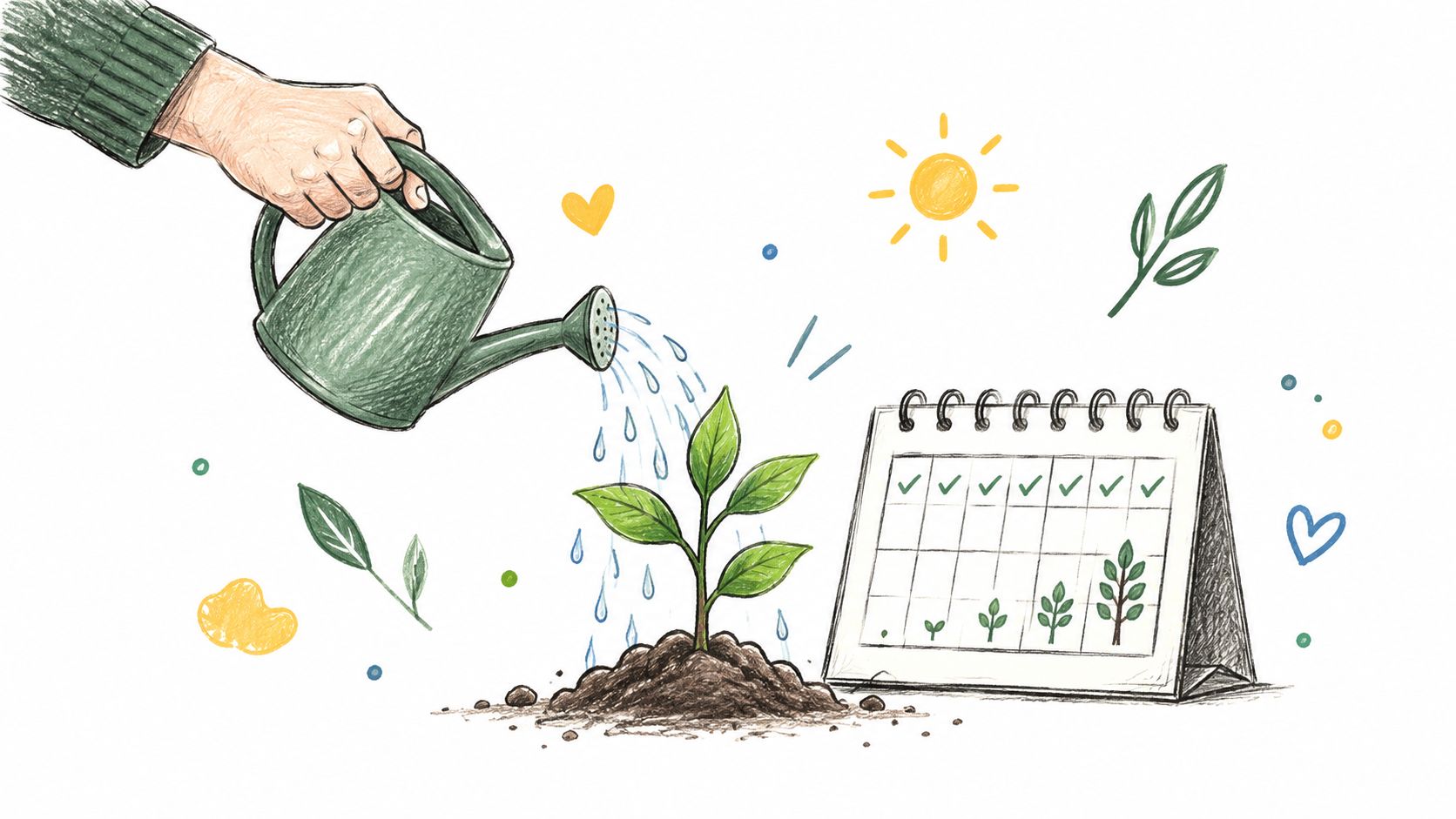
A hand watering a small plant beside a calendar can serve as a reminder that steady care and visible growth don't always arrive together.
Keep doing good, but notice your limits
Read Galatians 6:1–10 and pay attention to the passage's shared responsibilities. Choose one good act you can continue today, then write a short prayer for the people it serves. If you're exhausted, consider what support or rest would help you continue sustainably.
A useful distinction: Perseverance isn't the same as pretending you have unlimited energy. Ask for help when the work is too heavy to carry alone.
4. Isaiah 40:31 for exhaustion
Isaiah 40:31 offers images of soaring, running, and walking. The promise of renewed strength isn't limited to dramatic bursts of energy. The final image is ordinary and durable: walking without fainting. That can comfort a caregiver facing another long night, or a student who needs to pace study instead of pushing through exhaustion.
The Hebrew language used for waiting on God carries a sense of hope and expectation, not just sitting still until something changes. In Isaiah's message of comfort, waiting is directed toward God as the source of strength. It doesn't mean you'll never feel tired, or that practical help is unnecessary.
Choose the pace you can sustain
Read Isaiah 40 in full to hear the verse within its broader message of comfort. Pray through each image slowly, and ask what strength might mean for today: getting through the next task, accepting help, or making room to rest. If you're encouraging someone else, this Bible verse to encourage someone can help you think about offering Scripture with care.
A hiker's steady progress along a mountain trail offers a fitting picture of endurance that doesn't depend on sprinting.

Try praying, “Give me strength for the next step,” rather than demanding enough energy to solve the whole season at once. Waiting can include seeking medical care, talking with a trusted person, or changing an unsustainable routine.
5. Psalm 27:14 for uncertainty
Waiting for test results, a difficult decision, or news that may change your plans can make each day feel unsettled. Psalm 27 ends with a direct appeal to wait for the Lord, be strong, and take heart. The repeated call to wait makes the verse feel less like a quick slogan and more like a reminder a person may need to hear again.
The psalm moves between fear and confidence. Its closing words don't deny uncertainty; they speak courage into it. To “take heart” doesn't mean you must feel fearless. It can mean choosing to remain oriented toward trust while fear is still present.
Turn the verse into a breath prayer
Read all of Psalm 27 and notice how the speaker brings both danger and trust before God. Then repeat the verse slowly, pausing after the words about strength and taking heart. You could use the first phrase as you breathe in and the second as you breathe out.
Write a brief note about what you're waiting for and what you hope God will do. Keep the request specific, but don't treat the verse as a guarantee that events will unfold according to your preferred timeline. It's a prayer for courage and trust in uncertainty, not a promise that uncertainty will disappear today.
6. 1 Corinthians 13:4 for relational strain
Paul begins his description of love by saying that love is patient and kind. In context, patience isn't only a private ability to tolerate discomfort. It's a way of treating people, especially when they disappoint you, misunderstand you, or fall short of what you hoped for.
The Greek word makrothumia is commonly associated with forbearance toward people, a slowness to anger when someone provokes or frustrates you. That doesn't mean you have to excuse harmful behavior or stay in an unsafe situation. Patience can include speaking openly, setting a boundary, and refusing to retaliate in the heat of conflict.
Practice love with clarity and boundaries
Read 1 Corinthians 13 in full, then consider how patience and kindness belong together. Name one relationship where you want to respond differently, and pray for that person without denying what's difficult. A couple in counseling might use the passage to discuss what a patient response sounds like during disagreement.
A simple prayer could be, “Help me speak truth without cruelty, and help me recognize where I need a boundary.” The verse asks how love acts toward another person. It doesn't require you to accept mistreatment or silence a concern that needs to be addressed.

7. Psalm 37:7 for envy and comparison
Psalm 37 speaks to the frustration of seeing people do wrong and still appear to prosper. Verse 7 tells the reader to be still before the Lord, wait patiently, and not fret over others' success. This makes the verse especially relevant when a colleague is promoted ahead of you, or when someone else seems to receive the opportunity you've prayed for.
The Hebrew idea of waiting in this passage is connected with hope and expectation. It doesn't ask you to pretend injustice is harmless. Instead, it turns attention away from fixation on another person's apparent success and toward trust in God's justice.
Interrupt the comparison loop
Read Psalm 37:1–11 to follow the psalm's wider counsel. When you notice yourself fretting, pause, take a breath, and pray the verse's first phrase. Then identify one action that belongs to you, such as doing your work well, asking for feedback, or speaking up about an unfair situation.
For a quiet practice with a passage, use these steps for meditating on Scripture. The goal isn't to shame yourself for envy. It's to notice it, bring it to God, and choose a response that isn't controlled by resentment or comparison.
8. Hebrews 10:36 for costly perseverance
Hebrews 10:36 encourages its readers to persevere in doing God's will as they wait for what God has promised. The surrounding verses recall earlier hardship and faithfulness, so the encouragement isn't abstract. It speaks to people who have already faced pressure and need strength to continue.
The New Testament word hypomonē points toward endurance under difficult circumstances. It means more than letting time pass. In this passage, perseverance is tied to faithful action while the promised outcome remains unseen. A new believer facing family opposition might use the verse to stay rooted in Scripture while also seeking wise support.
Read Hebrews 10:32–39, then continue into Hebrews 11 to consider how the letter portrays faithful endurance. Write down a promise of God that gives you hope, and revisit it when the pressure rises. If opposition involves threats or harm, seek help and take practical steps toward safety. Patience doesn't demand that you face danger alone.
8 Bible Verses for Patience: Comparison Guide
| Passage | Patience focus | 🔄 Application effort and context | 📊 Expected outcome | 💡 Ideal use case | ⭐ Key advantage |
|---|---|---|---|---|---|
| James 5:7–8 | Active endurance while awaiting the Lord | Moderate; reading James 5:1–11 adds context; farming background is optional | Steadier patience grounded in future hope | Prolonged waiting or hardship | Memorable farming image links patience with standing firm |
| Romans 12:12 | Patience joined with hope and prayer | Low; brief enough to memorize or use as a prayer prompt | Prayerful endurance during affliction | Daily prayer and difficult seasons | ⚡ A compact, easy-to-recall three-part pattern |
| Galatians 6:9 | Persistence in doing good | Low to moderate; Galatians 6:1–10 adds context | Motivation to continue faithful service | Volunteering, caregiving, or slow progress | Encourages ongoing effort with the promise of a future harvest |
| Isaiah 40:31 | Hopeful waiting that renews strength | Moderate; reading Isaiah 40 provides the comfort context | Encouragement and renewed strength amid weariness | Burnout, fatigue, or anxiety | Uses vivid images of soaring, running, and walking |
| Psalm 27:14 | Waiting as an act of courage | Low; reading Psalm 27 clarifies its movement from fear to confidence | Courage and reassurance amid uncertainty | Fear, anxiety, or waiting for news | Brief, direct wording works well as a repeated prayer |
| 1 Corinthians 13:4 | Patience as an expression of love | Moderate; reading 1 Corinthians 12–13 clarifies the context | Greater patience and kindness in relationships | Family life, friendships, or conflict | Frames patience as practical, relational love |
| Psalm 37:7 | Stillness and trust instead of fretting | Moderate; Psalm 37:1–11 adds context; stillness takes practice | Greater calm and less comparison | Envy, unfairness, or frustration with others' success | Addresses fretting directly and emphasizes trust |
| Hebrews 10:36 | Perseverance in doing God's will | Moderate; Hebrews 10:32–39 and chapter 11 add context | Resolve to endure in faith | Long-term hardship or opposition | Connects perseverance with God's promise |
Choosing Your Verse for This Season of Waiting
The best verse to begin with depends on what kind of waiting is shaping your days. For a long hardship, start with James 5:7–8 and its picture of a farmer who keeps tending the field while waiting for growth. If exhaustion is the main struggle, Isaiah 40:31 offers the quieter image of continuing to walk with renewed strength.
If envy or frustration about other people's success keeps returning, try Psalm 37:7 as a prompt to redirect your attention toward God and the next right action. For a strained relationship, begin with 1 Corinthians 13:4 and ask what patience and kindness can look like alongside clear boundaries. If you're grieving, Romans 12:12 makes space for affliction, hope, and prayer in the same breath.
Choose one passage, rather than trying to use all eight at once. Read it in its full chapter so you can hear its setting and surrounding message. Then pray it daily for a week, naming what you're waiting for and what you can do today. A short note can help you see how your prayers, emotions, and next steps change over time.
Scroll With God can deliver a verse each morning, present Scripture one screen at a time, and keep your reflections in the Library. Its study sheets offer context and original-language notes, while chapter continuity lets you move from a single verse into its full passage. Those features can help turn a waiting season into a record of faithful attention, not because every delay becomes easy, but because you can keep returning to God's word within it.
Scroll With God pairs Scripture with context, a verse-linked prayer, and a focused reading experience that helps you stay with one passage during a season of waiting. Choose a verse, save your reflections in the Library, and explore Scroll With God for a steadier daily rhythm of reading and prayer.