How to Start Reading the Bible: A Beginner's Plan
Learn how to start reading the Bible with a simple plan. Choose the right starting point, build a daily habit, and understand passages in context.
In this article
- Why Starting Feels So Hard
- Make the task smaller and clearer
- Choosing the Right Starting Point
- Match your starting book to your purpose
- Building a Reading Habit That Sticks
- Give each part a clear job
- Keep prayer connected to reading
- Understanding Passages in Their Context
- Move from observation to application
- What to Do When a Passage Confuses You
- Name the kind of difficulty
- Leave room for further study
- Staying Consistent When Life Gets in the Way
- Restart without creating a backlog
- Your First Week of Bible Reading
- A gentle opening week
You open a Bible, find a page full of unfamiliar names, and wonder whether you've already started in the wrong place. Your phone buzzes, something needs your attention, and the quiet time you hoped for disappears. If you're wondering how to start reading the Bible, you don't need a perfect morning or an ambitious checklist. You need a clear starting point and a way to return when life interrupts.
Why Starting Feels So Hard
Wanting to read the Bible and knowing how to begin are different things. You might recognize a verse from church but feel lost when you read the surrounding chapter. Or you might begin enthusiastically, miss a few days, and decide you should restart from the beginning.
Neither experience means you're incapable of understanding Scripture. You're trying to learn unfamiliar material while making room for it in an already full life.
The American Bible Society's 2025 church research identifies having enough time and knowing where to start as the biggest barriers for people in its “Movable Middle” group. Those obstacles call for practical help, not another reminder to try harder.
Make the task smaller and clearer
Advice like “just read every day” leaves important questions unanswered. What should you read? Where should you stop? What happens when the passage makes no sense?
A more workable approach gives each reading session boundaries:
- Choose your place beforehand. Open to a bookmarked passage instead of making a fresh decision whenever you sit down.
- Set a modest stopping point. Finish a scene or paragraph rather than chasing an impressive page count.
- Allow an unfinished question. You can complete a useful reading session without resolving everything.
You don't need to understand the whole Bible before you can begin understanding a passage.
Think of starting as learning your way around a new neighborhood. You don't need every street memorized. You need a familiar entrance, a manageable route, and confidence that you can come back.
Choosing the Right Starting Point
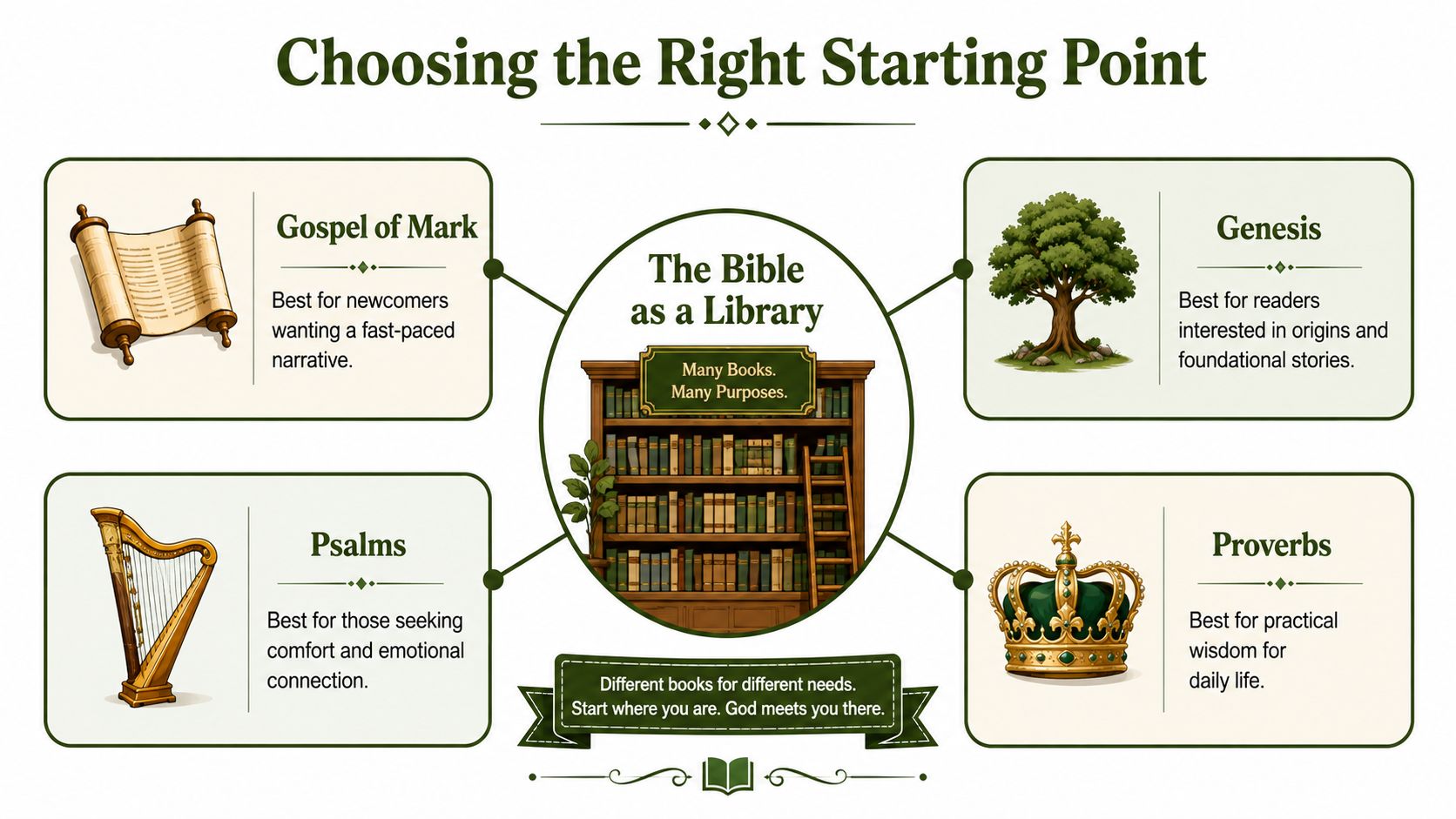
The Bible is a library, not a single modern-style book. In the Protestant canon, it contains 66 books, with 39 in the Old Testament and 27 in the New Testament, developed across roughly 1,500 years, as summarized in this history of the Bible's development and transmission. Its writings include narrative, poetry, wisdom, prophecy, letters, and apocalyptic writing.
That helps explain why opening at random can feel disorienting. Reading a poem as though it were an instruction manual won't help you understand either its language or its purpose.
Match your starting book to your purpose
For a first sustained reading, I recommend Mark or John. Read your chosen Gospel as a connected account of Jesus' life rather than a collection of inspirational sentences. Mark is a practical default if you'd rather stop comparing options and begin.
Your interests can also help you choose an entry point:
| If you're looking for… | Consider… | How to approach it |
|---|---|---|
| An introduction to Jesus | Mark or John | Follow the unfolding account and notice questions people ask |
| Language for prayer and emotion | Psalms | Read as poetry and prayer, attending to imagery |
| Practical reflection | Proverbs | Consider each saying carefully rather than treating it as a mechanical formula |
| Foundational stories and origins | Genesis | Follow the narrative without committing to an immediate cover-to-cover reading |
Use this map to identify an entry point that suits your present interests.
After a Gospel, try a short New Testament letter. Pay attention to the situation being addressed and how the writer develops an argument. A letter makes more sense when you follow its reasoning instead of collecting individual sentences.
You can also visit the Old Testament for background as questions arise. Beginning with a Gospel doesn't mean dismissing the rest of Scripture. It means choosing a manageable doorway into a much larger library.
Choose a starting place, not a permanent boundary. You're free to explore more once you've found your footing.
Building a Reading Habit That Sticks
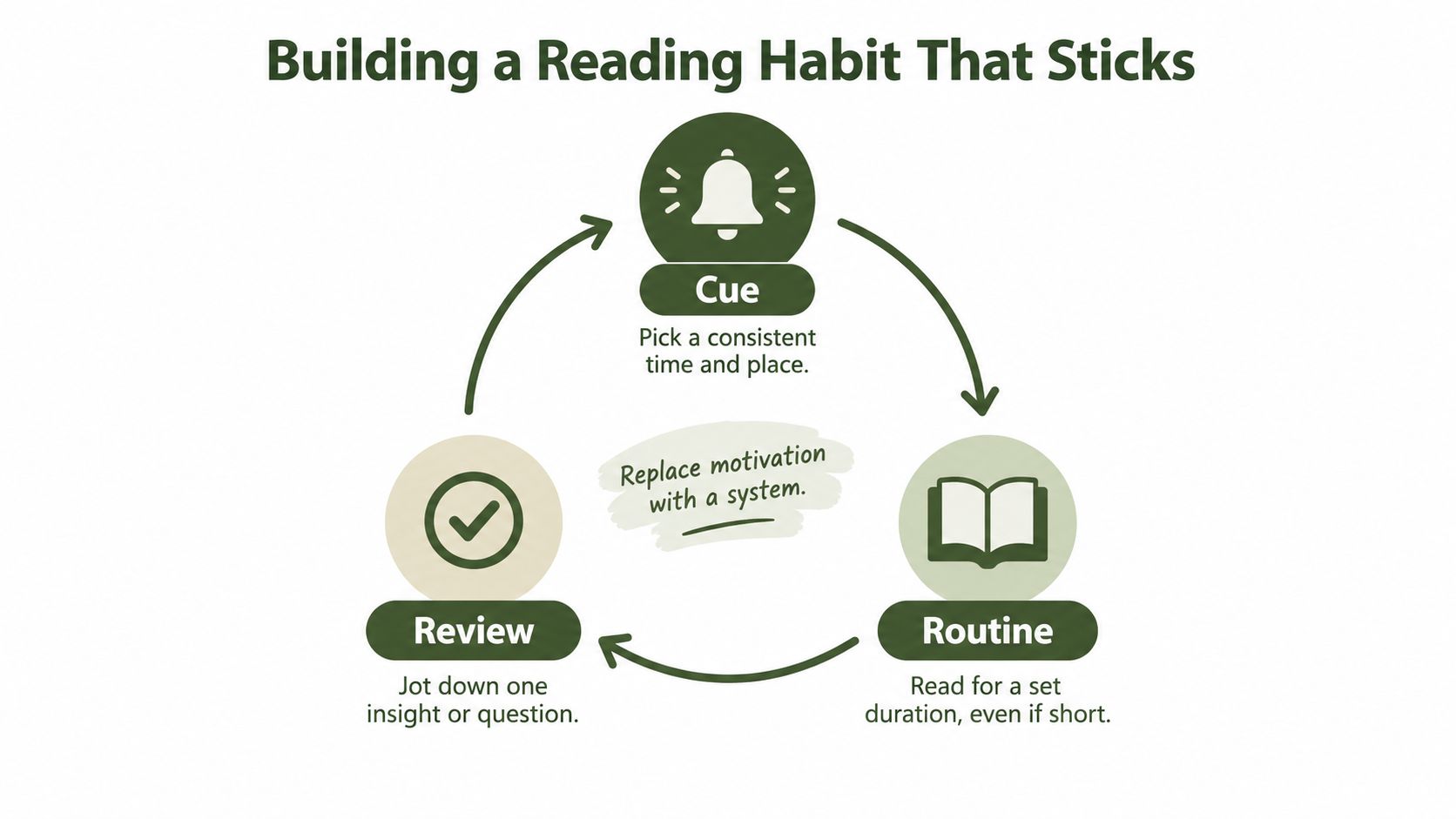
Instead of waiting until you feel motivated, attach reading to something you already do. You might sit with your Bible after making coffee or open a bookmarked passage when you settle into your evening chair.
The basic pattern is cue, routine, review. Use the diagram as a reminder of what your reading appointment includes.
Give each part a clear job
- Cue. Choose a recognizable event, such as putting your breakfast plate away. Keep your Bible or reading app ready in that location.
- Routine. Read without switching between messages, headlines, and the passage. If a sentence puzzles you, slow down rather than rushing to finish.
- Review. Close the session with a short written response. Record what you understood, what confused you, or a prayer connected to the reading.
As a starter schedule, try 10 minutes or a coherent passage, with three sessions weekly for the first two weeks. This is a suggested practice, not a proven adherence formula; research on religious-literacy practices supports comprehension activities such as previewing, questioning, summarizing, rereading, and repairing confusion.
Track whether you kept the appointment, not how many chapters you completed. A slow reading that changes your understanding is more useful than a hurried reading you can't explain.
Keep prayer connected to reading
You don't need polished language to respond. Write what you're grateful for, what you find difficult, or where you need help acting faithfully. If prayer feels like a separate habit you struggle to maintain, these ways to build a daily prayer habit can help you connect it to an existing routine.
For an additional resource alongside your practice, you can use this video.
Before increasing your reading time, ask whether you understand what you read. More time is an option, not an obligation.
Understanding Passages in Their Context
A message can sound very different when you read only its final sentence. The same caution applies to Scripture: surrounding material helps you recognize who's speaking, what question they're answering, and where their thought is going.
Read literary units rather than isolated verses. A literary unit is a meaningful section, such as a scene, paragraph, or portion of a psalm. Research on biblical literacy and interpretation recommends locating the unit, investigating historical context, considering its meaning for the original audience, and then applying it today.
Move from observation to application
Use this sequence when you sit down with a passage:
- Preview the setting. Check the genre and any available introduction to the book. Note the author or audience where known.
- Read the complete section. Notice repeated words, changes in speaker, and connections to the preceding material.
- Retell it plainly. Explain what happened or how the argument developed without copying the wording.
- Investigate your question. Consult a study Bible, compare another translation, or follow a relevant cross-reference.
- Consider a response. Ask what application follows from the passage's meaning, rather than from a sentence that caught your attention.
This visual shows why connecting the parts matters.
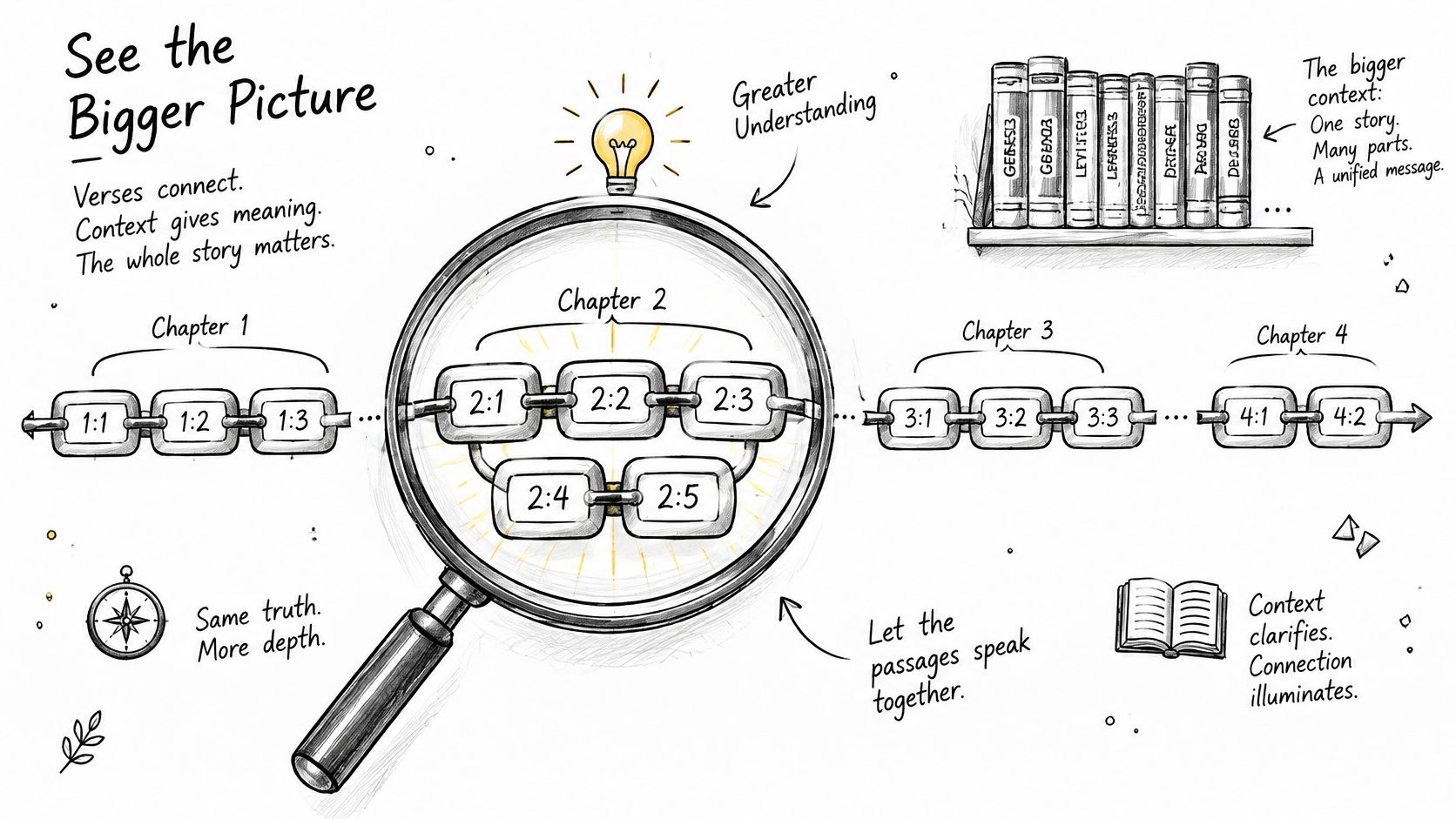
Practical rule: Establish what the passage communicates before deciding what you should do with it.
For example, in a letter, notice what a word like “therefore” points back to. In a story, distinguish the narrator's description from a character's opinion. These small checks help you avoid treating every statement as a direct instruction.
Once you've established the meaning, meditating on Scripture offers a way to linger over it thoughtfully. Reflection should deepen careful reading, not replace it.
What to Do When a Passage Confuses You
Some passages won't become clear because you read them slowly. A genealogy may leave you wondering why the names matter. A law may feel remote from your life, while a violent narrative may raise a serious moral objection.
Confusion isn't evidence that you've failed. Beginner guidance such as this introduction to reading the Bible provides a starting route, but you also need a way to examine difficult material without forcing a quick answer.
Name the kind of difficulty
Separate what you can observe from what you think it means. “The passage describes violence” is an observation; “the passage commands readers to imitate that violence” is an interpretation that needs examination.
| What feels difficult | A useful question |
|---|---|
| Poetry or prophecy | Could imagery or figurative language affect how I'm reading this? |
| A wisdom saying | Am I treating practical wisdom as an unconditional guarantee? |
| A law | Who received this instruction, and what setting does it address? |
| An apparent contradiction | What does each passage actually claim in its own context? |
| A troubling action | Is the writer describing conduct, approving it, or challenging it? |
Keep reference tools nearby when you need help investigating those questions.

Before claiming a promise directly for yourself, identify the speaker, recipient, circumstances, and any stated conditions. Then ask what you can responsibly learn from it. Personal relevance and direct address aren't necessarily the same thing.
Leave room for further study
Write down your objection accurately, including what you still don't know. Compare explanations, and ask a trusted pastor or study leader to explain their reasoning rather than provide a conclusion. These apps for Bible study and prayer can help you identify tools for further investigation.
You don't have to pretend a troubling passage feels comfortable. “I need to study this further” is a legitimate outcome.
Staying Consistent When Life Gets in the Way
A busy day requires a smaller reading session, not a verdict on your commitment. If you only have a few minutes, revisit a familiar paragraph, read it attentively, and name something you notice. If all you can manage is a verse, mark its location so you can return to the surrounding passage.
Devotional exposure and sustained understanding serve different purposes. A brief reading can prompt prayer or recollection, but it doesn't automatically give you the context you'd gain through extended study. Let the shorter session maintain contact without asking it to accomplish everything.
Restart without creating a backlog
After missed days, use a simple return protocol:
- Open your bookmark. Resume where you stopped rather than starting the entire book again.
- Recover the thread. Read your last note or skim the previous passage until you remember what was happening.
- Shrink the next appointment. Choose an amount you can realistically complete in your present circumstances.
- Remove the catch-up requirement. Don't turn missed readings into a debt you must repay before continuing.
Consistency means knowing how to return, not proving you'll never be interrupted.
If you've missed a week, your next task is still just the next reading. You don't need an explanation, an apology, or an unusually long session.
When interruptions keep happening, adjust the arrangement. Move your cue, put the book somewhere more accessible, or reduce the amount you expect to read. Treat the difficulty as information about your routine, not a judgment about your faith.
Your First Week of Bible Reading
For your first week, use Mark as your home base and the same chosen cue throughout. The following is a suggested schedule, not a requirement to complete a particular amount.
A gentle opening week
- Monday. Open Mark at the beginning. Preview the introduction if your Bible includes one, then read a complete opening scene.
- Tuesday. Revisit your note. If you have space, reread the scene and notice something you missed.
- Wednesday. Continue to the next scene. Summarize what happens and record a question.
- Thursday. Use a study note or another translation to investigate that question. You don't have to add new reading.
- Friday. Continue from your bookmark. Connect your response or prayer to something the passage communicates.
- Saturday. Leave room for rest, a missed appointment, or an optional rereading.
- Sunday. Review your notes. Decide whether your reading time and cue were realistic.
You're not trying to finish Mark this week. You're learning to begin, pay attention, and return.
Keep the same arrangement if it feels manageable. Expand later when you want more room for reading or investigation, rather than because a checklist makes you feel behind. For today, choose your cue, open your starting book, and read the next complete passage.
Scroll With God offers focused, single-verse reading with context and a prayer, plus access to the full chapter when you're ready to keep reading. Visit Scroll With God to choose a passage, explore its setting, and make your next phone break a manageable moment with Scripture.